Seyed Masoud Hosseini · Overview · Study log · Weekly summaries · Ideas · Search · Transcript · RSS feed
Design & Analysis of Algorithms · Lecture 6 of 34 · 1:20:14
4. Divide & Conquer: van Emde Boas Trees
Study guide
What this lecture covers
The lecture answers a specific question: can you beat the O(log n) bound of a balanced binary search tree for predecessor and successor queries when the stored elements are integers from a known universe of size U? Professor Demaine builds the van Emde Boas (vEB) data structure from scratch, motivating each design choice with a concrete failure of the previous version, until insert, delete and successor all run in O(log log U) time.
This is the fourth lecture in MIT's Design and Analysis of Algorithms course and the first to apply divide-and-conquer thinking to a data structure rather than an algorithm. After watching, you should be able to explain why clustering a universe into sqrt(U)-sized pieces yields a log log U recurrence, and describe the augmentation tricks (storing min and max, and not recursively storing the min) that remove the extra recursive calls that would otherwise make the structure too slow.
Key ideas
- Predecessor problem: given a set of integers from a universe
{0, ..., U-1}, support insert, delete and successor (or predecessor) faster than a comparison-based tree by exploiting that the elements are integers. - Bit vector: the starting structure, an array of size
Uwith a 1 for each present element; insert and delete are constant time, but successor takesO(U)time in the worst case. - Clustering: splitting the universe into
sqrt(U)clusters of sizesqrt(U)each, with a summary vector marking which clusters are non-empty, reduces successor toO(sqrt(U)). - Recursive vEB structure: each cluster and the summary are themselves recursively represented as smaller vEB structures, which is meant to give the recurrence
T(U) = T(sqrt(U)) + O(1). - High and low:
high(x)andlow(x)split an integer into its cluster number and its position within the cluster, corresponding to the top and bottom halves of the bits ofx. - Storing min and max: augmenting every structure with its minimum and maximum element lets successor decide with one comparison whether the answer is inside the current cluster or must come from the summary structure, cutting successor down to one recursive call.
- Not recursively storing the minimum: on insert, an empty structure just stores the new item in its min field without recursing, which makes the first insert into a cluster free and keeps insert to one effective recursive call.
- Space: a plain array-based vEB structure uses
O(U)space; replacing the cluster array with a hash table brings this down to aboutO(n log log U), and a further trick (not covered in detail) reachesO(n).
Walkthrough
The predecessor problem and the target bound (0:00)
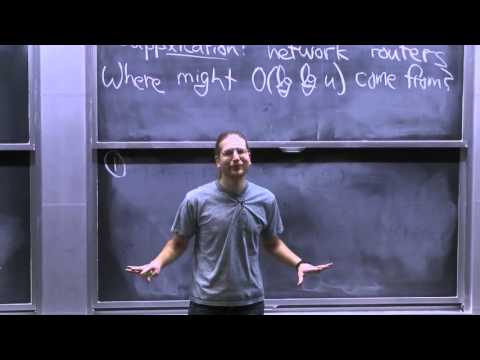
The lecture opens by defining the problem: store a set of n integers from a universe of size U and support insert, delete and successor. A balanced BST already gives O(log n); the goal is O(log log U), which is an exponential improvement when U is polynomial in n. The lecture motivates this with network routers, where routing tables are searched by IP address and U is small and fixed (2^32 for IPv4), so log log U is tiny in practice.
From a recurrence to a bit vector (5:01)
Working backward from the target running time, the class derives that a recurrence of the form T(U) = T(sqrt(U)) + O(1) solves to log log U, since repeatedly taking a square root of U reaches 1 after log log U steps. The simplest starting structure that could support this kind of division is a bit vector indexed by value, where insert and delete are constant time but successor requires scanning up to O(U) cells.
Clustering the universe (13:10)
The universe is split into sqrt(U) clusters of size sqrt(U), with a summary bit vector recording which clusters are non-empty. Successor now works in three steps: search inside the current cluster, then search the summary for the next non-empty cluster, then find the first set bit there, giving O(sqrt(U)) time. The lecture introduces high(x) and low(x) as the quotient and remainder of dividing x by sqrt(U), corresponding to the high and low halves of x's bits, and index(i, j) to recombine them.
Recursing, and why two recursive calls is not enough (25:42)
Each cluster and the summary become smaller recursive vEB structures of size sqrt(U). A naive recursive insert and successor both make two recursive calls, giving T(U) = 2T(sqrt(U)) + O(1), which only solves to O(log U) — no better than a balanced tree. The lecture works through the recursion tree to show why: the "mass" of log U is conserved rather than reduced when there are two branches.
Fixing successor with min and max (37:59)
Augmenting every structure with its minimum eliminates the recursive call used to find the smallest element of a cluster (replaced by a direct field lookup). Augmenting with the maximum lets successor test, in constant time, whether the answer lies inside the current cluster or must come from the summary — so only one of the two recursive branches is ever taken, giving O(log log U) successor.
Fixing insert by not storing the minimum recursively (50:07)
Insert into an empty structure just sets its min (and max) field and returns, without recursing. Because the minimum is never stored recursively, inserting a new smaller item swaps it into the min field and recursively inserts whatever was previously there. This makes the summary update free whenever a cluster was empty, so insert also collapses to one effective recursive call, reaching O(log log U). A small correction is needed in successor to check V.min directly, since it is no longer represented anywhere else.
Delete, the lower bound and space (1:01:28)
Delete mirrors insert, with special handling for deleting the minimum (which may require pulling up a new minimum from the first non-empty cluster) and the maximum (which may require searching the summary's last non-empty cluster). The lecture states, without proof, that O(log log U) is optimal for this kind of structure in most parameter ranges. It closes on space: the array-based version uses O(U) space, but replacing per-level arrays with hash tables reduces this to about O(n log log U), with a further refinement (stopping the recursion early and using linked lists) reaching O(n).
Before you watch
- Be comfortable with recurrences and the master method, since the lecture repeatedly analyzes recursive structures by their recurrence.
- Know how a balanced binary search tree (such as an AVL tree) supports insert, delete and successor in
O(log n), since vEB is presented as an improvement over it. - Basic bit manipulation (masking and shifting) helps with the high/low decomposition of integers.
Check your understanding
- Why does a recurrence with two recursive calls,
T(U) = 2T(sqrt(U)) + O(1), only solve toO(log U)instead ofO(log log U)? - How does storing the maximum of each cluster let successor avoid making two recursive calls?
- Why does not recursively storing the minimum element make the first insert into an empty cluster free?
- What is the space cost of the plain array-based van Emde Boas structure, and how does switching to hash tables for clusters change it?
Vocabulary
- predecessor problem (noun)
- The task of finding the largest stored value smaller than a given number.
The predecessor problem is closely related to finding the successor. - successor (noun)
- The smallest stored value that is larger than a given number.
The data structure must find the successor of any queried value quickly. - universe (noun)
- The full range of possible values a data structure can store.
The universe size U determines how the structure is divided. - bit vector (noun)
- An array of true/false flags used to mark which values are present.
A bit vector marks which numbers are currently stored. - clustering (noun)
- Grouping items into smaller sections to organize a larger structure.
Clustering splits the universe into smaller, manageable pieces. - summary (structure) (noun)
- A smaller structure that records which groups contain data, without storing the details.
The summary structure marks which clusters are non-empty. - augment (verb)
- To add extra information to a data structure to make certain operations faster.
The structure is augmented with its minimum and maximum values. - recursive structure (noun)
- A structure built from smaller copies of itself.
Each cluster is itself a recursive structure of the same type. - van Emde Boas tree (noun)
- A specialized data structure that supports very fast operations on integers from a known range.
The van Emde Boas tree achieves log log U time for its operations. - hash table (noun)
- A data structure that stores and retrieves values quickly using a computed index.
Replacing arrays with a hash table reduces the structure's memory use. - network router (noun)
- A device that directs data between computer networks.
A network router uses fast lookup structures to route by IP address. - from scratch (phrase)
- Starting with nothing and building up step by step.
The structure is built from scratch, fixing each flaw in turn. - quotient (noun)
- The whole-number result of dividing one number by another.
High(x) is the quotient of dividing x by the square root of U. - remainder (noun)
- What is left over after dividing one number by another.
Low(x) is the remainder after the division. - conserved (adjective)
- Staying the same amount even after a process is applied.
The total work is conserved rather than reduced across two branches. - collapse (to one call) (verb)
- To reduce down to a single, simpler step.
Insert collapses to one effective recursive call. - lower bound (noun)
- A proven minimum limit that a running time cannot go below.
Log log U is stated as a lower bound for this kind of structure. - refinement (noun)
- A small improvement that makes something more precise or efficient.
A further refinement brings the space cost down to O(n). - exponential improvement (phrase)
- A change making something dramatically faster, beyond just a small speedup.
Log log U is an exponential improvement over log n. - masking (bits) (noun)
- Using a fixed pattern to select or isolate specific bits of a number.
Masking and shifting help split the integer into high and low parts. - motivate (a choice) (verb)
- To give the reason behind a design decision.
Each design choice is motivated by a failure of the previous version. - field (data) (noun)
- A single stored piece of data inside a larger structure.
The min and max fields let successor skip a recursive call. - eliminate (verb)
- To remove something completely.
Storing the maximum eliminates one of the two recursive branches. - parameter range (phrase)
- The set of input sizes or values a result is expected to hold for.
The lower bound holds in most parameter ranges. - linked list (noun)
- A data structure where each item points to the next one in a chain.
A further refinement uses linked lists to reach O(n) space.
From the YouTube description
MIT 6.046J Design and Analysis of Algorithms, Spring 2015
View the complete course: http://ocw.mit.edu/6-046JS15
Instructor: Erik Demaine
In this lecture, Professor Demaine introduces the van Emde Boas Tree data structure and its uses.
License: Creative Commons BY-NC-SA
More information at http://ocw.mit.edu/terms
More courses at http://ocw.mit.edu
← Recitation 2: 2-3 Trees and B-Trees · 5. Amortization: Amortized Analysis →