Seyed Masoud Hosseini · Overview · Study log · Weekly summaries · Ideas · Search · Transcript · RSS feed
Probability · Lecture 34 of 76 · 13:09
Recitation: The Absent-Minded Professor
Study guide
What this lecture covers
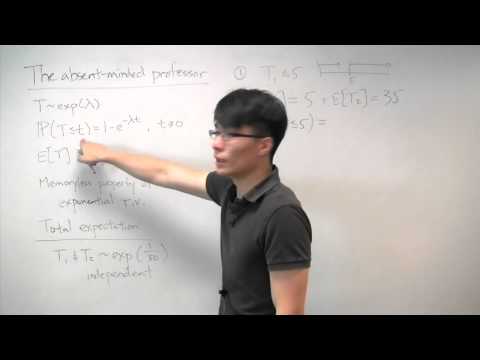
This recitation problem uses a professor who double-books two student appointments to practice exponential random variables. It asks for the expected total time from when the first student arrives until the second student leaves, given that appointment lengths are exponential and the second student arrives five minutes late.
It reinforces the memoryless property of the exponential distribution and the total expectation theorem, both introduced earlier in the course, by applying them to a scenario with two possible timelines depending on whether the first appointment finishes before or after the second student arrives.
Key ideas
- Exponential random variable: a continuous, non-negative random variable with rate
lambda, commonly used to model durations; its CDF is1 - e^(-lambda*t)and its mean is1/lambda. - Memoryless property: if you observe an exponential random variable partway through, the remaining time behaves exactly like a fresh exponential with the same rate, independent of time already elapsed.
- Splitting into scenarios: the total time depends on whether the first student finishes within five minutes (before the second arrives) or takes longer than five minutes (so the second student waits).
- Total expectation theorem: the overall expected time is found by weighting the expected time in each scenario by the probability of that scenario.
- Naive averaging can mislead: simply adding the two individual expected appointment lengths gives 60 minutes, but the actual answer is slightly higher because of the idle gap that can occur when the first student finishes early.
Walkthrough
Setting up the two appointments (0:00)
Two students, T1 and T2, each take an independent exponential amount of time with mean 30 minutes. The first arrives on time, and the second arrives exactly five minutes later. The goal is the expected time X from when the first student arrives until the second student leaves.
The two possible timelines (3:03)
If the first student's appointment lasts more than five minutes, the second student is already waiting when the first leaves, so the two appointments run back to back after the five-minute mark. If the first student finishes within five minutes, the professor sits idle until the second student arrives, adding a gap that a naive 60-minute estimate misses.
Applying the memoryless property (5:12)
In the case where the first appointment runs past five minutes, the memoryless property says the remaining time behaves like a brand-new exponential with mean 30, so the expected total time in that case is 5 (guaranteed) + 30 (remainder of the first appointment) + 30 (second appointment) = 65 minutes. In the case where the first appointment finishes within five minutes, the total time is simply 5 + 30 = 35 minutes, since the second student's appointment starts fresh once they arrive.
Combining with total expectation (10:18)
Weighting the 35-minute and 65-minute scenarios by their respective probabilities, 1 - e^(-5/30) and e^(-5/30), and summing gives an expected total time of approximately 60.4 minutes — a little more than the naive 60-minute guess, because of the wasted idle time when the first student leaves early.
Before you watch
- Know the exponential distribution's CDF and mean, and be comfortable with its memoryless property.
- Review the total expectation theorem for combining expectations across mutually exclusive scenarios.
- Being familiar with splitting a problem into cases based on a conditioning event will make the setup easier to follow.
Check your understanding
- Why does the naive calculation of adding the two mean appointment lengths underestimate the true expected time?
- How does the memoryless property justify treating the remainder of the first appointment as a fresh exponential random variable?
- What are the two scenarios the problem is split into, and what event defines the boundary between them?
- Why does an idle gap only occur in one of the two scenarios?
Vocabulary
- double-book (verb)
- To accidentally schedule two appointments at the same time.
The absent-minded professor double-books two student appointments. - memoryless property (phrase)
- A feature of some distributions where the remaining wait does not depend on how long you have already waited.
The memoryless property means the leftover time is a fresh exponential. - elapsed (adjective)
- Having already passed, referring to time.
The elapsed time does not affect the remaining wait, due to the memoryless property. - scenario (noun)
- One possible situation or sequence of events.
The problem splits into two different scenarios. - timeline (noun)
- The order and timing of events as they happen.
Each timeline shows a different way the appointments could unfold. - naive (adjective)
- Too simple, ignoring important details.
The naive guess ignores the idle gap between appointments. - idle (adjective)
- Not doing anything, waiting with nothing happening.
The professor sits idle until the second student arrives. - gap (noun)
- An empty space or period between two things.
An idle gap appears if the first student leaves early. - back to back (phrase)
- Happening one right after another with no break.
The two appointments run back to back after five minutes. - weight (verb)
- To give more or less importance to something based on its likelihood.
We weight each scenario by its probability. - boundary (noun)
- The line or point that separates two different situations.
Five minutes is the boundary between the two scenarios. - exponential random variable (phrase)
- A continuous random variable often used to model waiting or duration, with a constant rate.
Each appointment length is an exponential random variable. - rate (noun)
- A number controlling how quickly something happens on average.
The exponential distribution's rate lambda sets its mean duration. - mutually exclusive (phrase)
- Describing events that cannot both happen at the same time.
The two scenarios are mutually exclusive. - total expectation theorem (phrase)
- The rule that an overall average can be found by combining averages from separate scenarios, weighted by their probabilities.
The total expectation theorem combines the two timelines into one answer. - underestimate (verb)
- To guess a value that is lower than the true one.
The naive calculation underestimates the true expected time. - overlapping (adjective)
- Happening partly at the same time as something else.
The professor double-books two overlapping appointments. - remainder (noun)
- The part of something that is left after some has already happened.
The remainder of the first appointment behaves like a fresh exponential. - fresh (adjective)
- New and unaffected by anything that came before.
The memoryless property makes the leftover time act like a fresh exponential. - guaranteed (adjective)
- Certain to happen, with no possibility of failing.
The first five minutes are guaranteed to pass before the second student leaves. - estimate (noun)
- An approximate calculation or guess of a value.
The naive estimate of 60 minutes turns out to be slightly too low. - combine (verb)
- To join separate parts together into one result.
We combine the two scenario probabilities to get the final answer. - mislead (verb)
- To give a wrong impression or lead someone to a wrong conclusion.
Naive averaging can mislead you about the true expected time. - reinforce (verb)
- To strengthen understanding of something already learned.
This problem reinforces the memoryless property from earlier lectures. - duration (noun)
- The length of time something lasts.
The exponential distribution models the duration of each appointment. - wasted (adjective)
- Used badly or not used at all, with no benefit.
The extra 0.4 minutes comes from wasted idle time. - condition (on an event) (verb)
- To calculate something assuming a particular event has happened.
We condition on whether the first appointment lasts more than five minutes.
Chapters
- 0:00 <Untitled Chapter 1>
- 0:21 Exponential Random Variable
- 1:22 The Memory List Property of Exponential Random Variables
- 2:03 Total Expectation
From the YouTube description
MIT 6.041SC Probabilistic Systems Analysis and Applied Probability, Fall 2013
View the complete course: http://ocw.mit.edu/6-041SCF13
Instructor: Jimmy Li
License: Creative Commons BY-NC-SA
More information at http://ocw.mit.edu/terms
More courses at http://ocw.mit.edu
← Recitation: Probability that Three Pieces Form a Triangle · Lecture 10: Continuous Bayes' Rule; Derived Distributions →