Seyed Masoud Hosseini · Overview · Study log · Weekly summaries · Ideas · Search · Transcript · RSS feed
Probability · Lecture 33 of 76 · 12:30
Recitation: Probability that Three Pieces Form a Triangle
Study guide
What this lecture covers
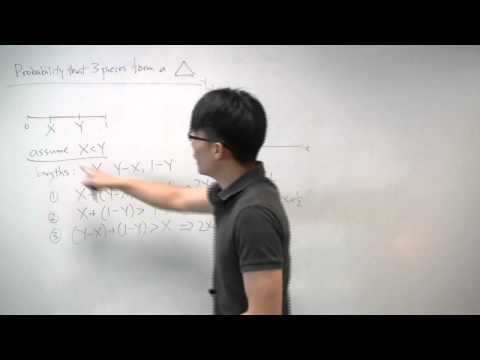
This recitation problem asks: if you break a unit-length stick at two independent, uniformly random points, what is the probability that the three resulting pieces can be assembled into a triangle? It is a classic application of setting up two random variables, translating a geometric condition into inequalities, and computing a probability as an area in the plane.
It builds on the joint density and independence ideas from the lecture on multiple continuous random variables, applying them to a self-contained geometric puzzle rather than introducing new theory.
Key ideas
- Triangle inequality as the governing condition: three lengths can form a triangle only if the sum of any two exceeds the third.
- Two break points as independent uniform variables:
XandY, the two break locations, are independent and uniform on[0,1], so their joint density is uniform (equal to 1) over the unit square. - Translating lengths into inequalities: assuming
X < Y, the three piece lengths areX,Y - X, and1 - Y; the triangle condition on these lengths simplifies toY > 1/2,X < 1/2, andY < X + 1/2. - Probability as area: because the joint density is uniform, the probability of forming a triangle equals the area of the region in the unit square satisfying all three inequalities.
- Case splitting by order: since either break point could come first, the problem is solved once for
X < Yand once forX > Y, and symmetry makes the second case identical to the first.
Walkthrough
Setting up the pieces and the triangle condition (0:01)
A stick of length 1 is broken at two independently and uniformly chosen points. The video first works out what condition the three resulting pieces must satisfy to form a triangle: any two pieces combined must be longer than the third, applied to all three pairs.
Reducing to inequalities in X and Y (3:05)
Assuming the first break point X lands to the left of the second, Y, the three lengths are X, Y - X, and 1 - Y. Substituting these into the three triangle-inequality conditions and simplifying algebraically reduces them to Y > 1/2, X < 1/2, and Y < X + 1/2.
Finding the region and its area (6:07)
Since X and Y are independent and uniform, their joint density is uniform over the unit square, so the probability of the event is just the area of the region satisfying the three inequalities. Plotting the three boundary lines shows this region is a small triangle with area 1/8.
Handling the other ordering (9:10)
The case where the second break point falls to the left of the first is handled by swapping the roles of X and Y in the same three conditions. By symmetry, this produces a region of the same shape and area, 1/8, in the other half of the square.
Combining both cases (11:13)
Adding the two symmetric contributions gives a total probability of 1/8 + 1/8 = 1/4 that the three pieces can form a triangle.
Before you watch
- Be comfortable modeling two independent random choices as a joint uniform density on a square.
- Know the triangle inequality (sum of any two sides must exceed the third).
- Reviewing how probabilities correspond to areas under a uniform joint density helps this problem go smoothly.
Check your understanding
- Why does independence of the two break points make their joint density uniform over the unit square?
- How do the three lengths of the pieces get expressed in terms of
XandYwhenX < Y? - Why is the probability of forming a triangle equal to the area of a region rather than requiring a full double integral?
- Why does the case
Y < Xgive the same probability as the caseX < Y?
Vocabulary
- triangle inequality (phrase)
- The rule that any two sides of a triangle added together must be longer than the third side.
The triangle inequality decides whether three pieces can form a triangle. - break point (noun)
- The exact location where something is cut or divided.
The stick has two random break points. - unit square (phrase)
- A square with sides of length 1.
The joint density is uniform over the unit square. - reduce to (phrasal verb)
- To simplify something down to a simpler form.
The three conditions reduce to three simple inequalities. - governing condition (phrase)
- The main rule that controls whether something is true.
The triangle inequality is the governing condition here. - region (noun)
- An area or section within a larger space.
The probability equals the area of a small region in the square. - boundary line (phrase)
- A line that marks the edge between two areas.
The three boundary lines mark off the triangular region. - ordering (noun)
- The arrangement of items in a particular sequence.
We consider both orderings of the two break points. - symmetry (noun)
- A property where two situations mirror each other exactly.
By symmetry, the second case gives the same area as the first. - contribution (noun)
- The part that something adds to a total result.
Both symmetric contributions add up to the final probability. - joint density (noun)
- A function that gives the probability weight for a pair of random variables at once.
Because X and Y are independent, their joint density is uniform over the square. - independent (adjective)
- Not affected by, or connected to, another random variable's outcome.
The two break points are chosen independently of each other. - uniform (adjective)
- Having the same value or chance everywhere in a range.
Each break point is uniform on the interval [0,1]. - geometric (adjective)
- Relating to shapes, areas, and positions in space.
The problem turns a probability question into a geometric one about areas. - assemble (verb)
- To put separate parts together to make a whole.
We ask whether the three pieces can be assembled into a triangle. - substitute (verb)
- To put one expression in place of another in an equation.
We substitute the piece lengths into the triangle-inequality conditions. - algebraically (adverb)
- By using algebra, that is, symbols and equations rather than pictures.
The three conditions simplify algebraically to three clean inequalities. - plot (verb)
- To draw points or lines on a graph.
Plotting the three boundary lines shows the shape of the region. - swap (verb)
- To exchange the positions or roles of two things.
We swap the roles of X and Y to handle the other ordering. - self-contained (adjective)
- Complete on its own, without needing extra outside material.
This is a self-contained geometric puzzle rather than new theory. - puzzle (noun)
- A problem that requires careful thought to solve.
The stick-breaking puzzle asks for the probability of forming a triangle. - recitation (noun)
- A class session where students review and practice problems from the main lecture.
This recitation applies ideas from the joint-density lecture to a new problem. - classic (adjective)
- Well known and often used as a standard example.
This is a classic application of geometric probability. - derive (verb)
- To work out a result step by step from known facts.
We derive the triangle condition from the three piece lengths. - double integral (noun)
- A calculation that adds up a quantity over a two-dimensional region.
A full double integral is not needed since the density is uniform. - proportion (noun)
- The size of one part compared with the whole.
The area of the region gives the proportion of outcomes that form a triangle. - span (verb)
- To stretch or extend across a certain range.
The break points span the full interval from 0 to 1. - interval (noun)
- A continuous range of numbers between two points.
Each break point is chosen uniformly on the interval [0,1]. - correspond to (phrasal verb)
- To match or relate directly to something else.
Probabilities correspond to areas under the uniform joint density. - yield (verb)
- To produce or give a result.
Adding the two symmetric contributions yields a total probability of 1/4.
Chapters
From the YouTube description
MIT 6.041SC Probabilistic Systems Analysis and Applied Probability, Fall 2013
View the complete course: http://ocw.mit.edu/6-041SCF13
Instructor: Jimmy Li
License: Creative Commons BY-NC-SA
More information at http://ocw.mit.edu/terms
More courses at http://ocw.mit.edu
← Recitation: Uniform Probabilities on a Triangle · Recitation: The Absent-Minded Professor →