Seyed Masoud Hosseini · Overview · Study log · Weekly summaries · Ideas · Search · Transcript · RSS feed
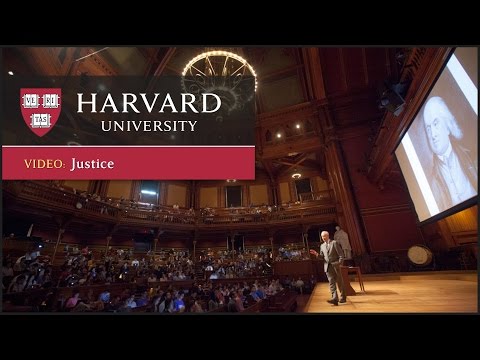
Justice · Lecture 1 of 19 · 54:56
Lecture 1: The Moral Side of Murder
Study guide
What this lecture covers
This opening lecture of Michael Sandel's Justice course asks what makes an act right or wrong, using a series of hypothetical and real-life dilemmas rather than abstract definitions. It sets up the two competing frameworks the whole course will return to: judging actions by their consequences, and judging them by duties or rights that hold regardless of outcome.
By the end, you can name and distinguish consequentialist and categorical moral reasoning, and you understand why the course treats classroom debate itself as a method of philosophy: testing your instinctive judgments about cases against the principles you claim to hold, and revising one or the other until they align.
Key ideas
- Consequentialist moral reasoning: locates the rightness of an act in the results it produces, such as the trolley driver choosing to kill one worker instead of five.
- Categorical moral reasoning: holds that some acts are wrong in themselves, regardless of the good consequences they might bring about.
- Utilitarianism: the leading consequentialist theory, associated with Jeremy Bentham, which the course will examine in depth.
- Kant's categorical ethics: the leading alternative to utilitarianism, which the course will also examine.
- The trolley problem: a thought experiment used to expose the tension between "better one dies than five" and the discomfort many feel about actively killing an innocent person.
- Consent as a moral variable: several discussions turn on whether a victim's agreement would change the moral status of an act.
- Philosophy as self-knowledge: Sandel frames the course as making the familiar strange, which he warns carries personal and political risks.
Walkthrough
The trolley problem (0:04)
Sandel opens with the classic dilemma: a runaway trolley will kill five workers unless the driver diverts it onto a side track, killing one. Most of the class would turn the trolley. He then varies the case: instead of driving, you are a bystander who could push a heavy man off a bridge to stop the trolley, sparing the five. Most students refuse to push, even though the arithmetic (one life for five) hasn't changed. Sandel uses this shift to surface the reasons behind people's intuitions, pressing volunteers to explain why turning feels different from pushing, and introducing a related case about a transplant surgeon who could kill one healthy patient to save five others needing organs.
Consequentialist and categorical reasoning (13:23)
Stepping back from the stories, Sandel names the two moral principles the discussion revealed. The first, consequentialist reasoning, judges an act by the state of the world it produces: better that one dies so five can live. The second, categorical reasoning, holds certain acts wrong in themselves no matter the consequences, which is why many students hesitated to push the bystander or harvest the healthy patient's organs. He previews that the course will study Bentham's utilitarianism as the leading consequentialist theory and Kant's ethics as the leading categorical theory.
The risks of studying political philosophy (16:24)
Sandel explains the course's method: reading philosophers such as Aristotle, Locke, Kant, and Mill alongside contemporary controversies like affirmative action and free speech. He then warns that this kind of self-examination carries personal and political risk, since philosophy works by making the familiar strange and, once unsettled, beliefs rarely return to their original comfortable state. He cites Socrates' dialogue with Callicles, who urges Socrates to abandon philosophy for practical life, as an early statement of this risk, and rejects skepticism as an evasion of the difficulty.
The case of Dudley and Stephens (29:38)
Sandel introduces a real nineteenth-century legal case: four shipwrecked sailors adrift without food, the captain kills and the crew eat the weakest member, the teenage cabin boy Richard Parker, to survive. He asks students to serve as jury and decide whether the killing was morally permissible. Most vote guilty, but a substantial minority defends the crew on grounds of necessity, arguing that extreme circumstances justify sacrificing one life to save others.
Does consent change the moral calculus? (39:47)
The discussion turns to whether a lottery to choose the victim, or Parker's own consent to being killed, would make the act morally permissible. Some students find that a fair procedure or genuine consent shifts their judgment toward permissibility; others insist the killing remains categorically wrong regardless of process or agreement, since murder is murder. Sandel closes by naming three unresolved questions the course will investigate: why murder might be categorically wrong, why a fair procedure could justify an outcome, and what moral work consent actually does.
Before you watch
- No prior lectures exist yet; this is the first session and assumes no background beyond willingness to argue about hypothetical cases.
- Be ready to take a side on each dilemma as it's posed, since the lecture is built around live polling and student responses.
Check your understanding
- Why did most people choose to turn the trolley but refuse to push the man off the bridge, even though both choices trade one life for five?
- What is the difference between consequentialist and categorical moral reasoning?
- What reasons did students give for and against convicting Dudley and Stephens?
- How did the possibility of consent or a lottery change some students' judgments about the cabin boy's killing?
Vocabulary
- dilemma (noun)
- A difficult situation where you must choose between two hard options.
The trolley problem is a classic moral dilemma. - hypothetical (adjective)
- Imagined for the sake of discussion, not necessarily real.
Sandel begins with a hypothetical trolley scenario. - consequentialist (adjective)
- Judging an action as right or wrong based on its results.
A consequentialist argument says one death is better than five. - categorical (adjective)
- Absolute and without exceptions, regardless of the outcome.
Categorical reasoning says killing is wrong no matter the result. - utilitarianism (noun)
- The theory that the right action produces the greatest overall happiness.
Utilitarianism is the leading consequentialist theory the course studies. - instinctive (adjective)
- Happening naturally and immediately, without conscious reasoning.
Students state their instinctive judgment before analyzing why. - bystander (noun)
- A person who is present at an event but not directly involved in causing it.
In the second version, you are a bystander who could push the man. - divert (verb)
- To change the direction or course of something.
The driver can divert the trolley onto a side track. - arithmetic (noun)
- Basic calculation with numbers, here meaning a simple counting of costs and benefits.
The arithmetic of one life versus five hasn't changed. - surface (verb)
- To bring something hidden into view or attention.
Sandel uses the cases to surface the reasoning behind intuitions. - transplant (noun)
- A surgical operation that moves an organ from one body to another.
The transplant surgeon case asks if killing one to save five is right. - harvest (organs) (verb)
- To remove organs from a body, often for use in another person.
Few students would harvest one patient's organs to save five others. - self-examination (noun)
- The careful, honest study of one's own beliefs or actions.
Sandel warns that philosophical self-examination carries personal risk. - skepticism (noun)
- The attitude of doubting whether firm knowledge or belief is possible.
He rejects skepticism as an easy way to avoid hard questions. - evasion (noun)
- An act of avoiding something difficult or unwanted.
Skepticism can be a form of evasion rather than an answer. - affirmative action (noun)
- Policies that give advantages to disadvantaged groups, often in jobs or education.
Contemporary controversies like affirmative action appear alongside the philosophers. - adrift (adjective)
- Floating without control or direction, especially on water.
The sailors were adrift at sea without food. - necessity (noun)
- A situation that forces an action because there is no other choice.
Some students defend the crew on grounds of necessity. - permissible (adjective)
- Allowed or acceptable according to rules or morals.
The class debates whether the killing was morally permissible. - lottery (noun)
- A random process used to choose an outcome fairly.
A lottery to pick the victim might make the act seem fairer. - consent (noun)
- Agreement or permission given for something to happen.
The discussion asks whether the boy's consent changes the moral calculus. - unresolved (adjective)
- Not yet settled or answered.
Sandel closes with three unresolved questions for the course. - moral calculus (noun)
- The reasoning process used to weigh right and wrong in a situation.
Consent might change the moral calculus of the killing.
Chapters
- 0:00 <Untitled Chapter 1>
- 15:40 Utilitarianism
- 19:36 The Political Risks
- 27:10 The Philosophy of Utilitarianism Jeremy Bentham
- 29:32 The Case of the Queen versus Dudley and Stephens
- 30:37 Richard Parker
- 40:06 Why Would Consent Make a Moral Difference
- 52:40 The Basic Idea of Consent
From the YouTube description
To register for the 2015 course, visit https://www.edx.org/course/justice-harvardx-er22-1x-0.
PART ONE: THE MORAL SIDE OF MURDER
If you had to choose between (1) killing one person to save the lives of five others and (2) doing nothing even though you knew that five people would die right before your eyes if you did nothing—what would you do? What would be the right thing to do? Thats the hypothetical scenario Professor Michael Sandel uses to launch his course on moral reasoning. After the majority of students votes for killing the one person in order to save the lives of five others, Sandel presents three similar moral conundrums—each one artfully designed to make the decision more difficult. As students stand up to defend their conflicting choices, it becomes clear that the assumptions behind our moral reasoning are often contradictory, and the question of what is right and what is wrong is not always black and white.
PART TWO: THE CASE FOR CANNIBALISM
Sandel introduces the principles of utilitarian philosopher, Jeremy Bentham, with a famous nineteenth century legal case involving a shipwrecked crew of four. After nineteen days lost at sea, the captain decides to kill the weakest amongst them, the young cabin boy, so that the rest can feed on his blood and body to survive. The case sets up a classroom debate about the moral validity of utilitarianism—and its doctrine that the right thing to do is whatever produces "the greatest good for the greatest number."