Four treasuries walk into a bar: OlympusDAO, NetNet, Standard Reserve and Brim
By Seyed Masoud Hosseini · · Crypto
One 2021 idea, one spectacular crash, and three new projects on Robinhood Chain that each say they fixed it. A plain-English tour of treasury-backed tokens, with pictures, a comparison table and the one question that matters: where does the yield really come from?
In 2021 a token called OHM went from nothing to a market value of more than three billion dollars in about six months, then lost about 91% of its price. Five years later, three new projects on Robinhood Chain are trying the same idea again. Each one says it knows what went wrong.
I spent a day reading their docs, whitepapers and the few independent articles that exist. This post is what I wish I had read first. No maths degree needed. There are pictures.
Not financial advice. This is me trying to understand how these systems work. Two of them are days or weeks old, one isn't live yet, and the numbers below were true on 17 September 2026 and may be wrong tomorrow.
The one idea behind all four
All four projects share one trick: a token with a treasury behind it.
Think of a company. It has cash and assets in the bank. Divide that by the number of shares and you get its book value per share. The share price on the market is usually higher, because people believe the company will grow. The gap between the two is the premium.
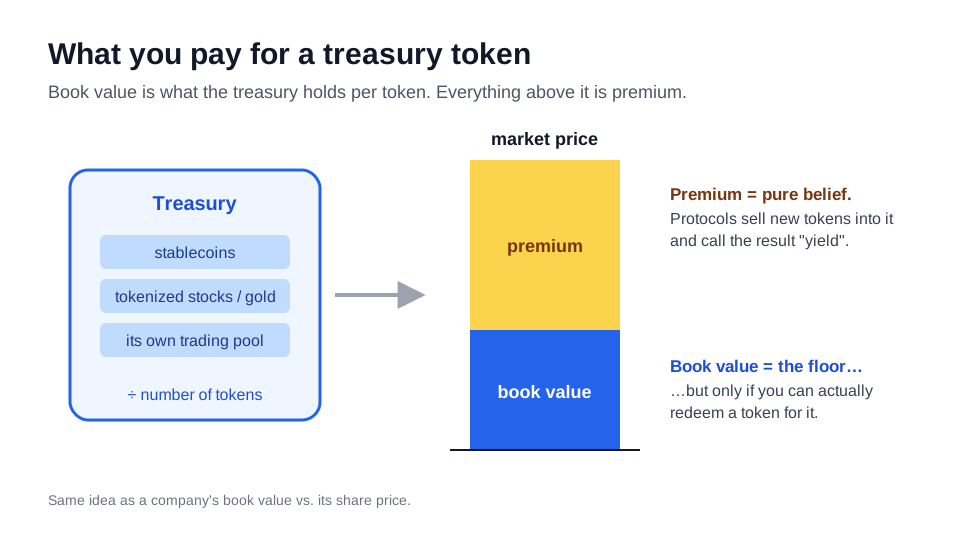
Treasury tokens work the same way:
- Book value is what the treasury holds per token: stablecoins, tokenized stocks, gold, and sometimes the protocol's own trading pool.
- The premium is whatever people pay above that. It's pure belief.
Now the key move. If the market pays a premium, the protocol can create new tokens and sell them (or hand them out) above book value. Every such sale actually raises the book value for everyone else, and the protocol calls what it hands out "yield".
That's it. Every design in this post is a different answer to two questions:
- Where does the yield come from? In other words, when are you allowed to print new tokens, and who pays for them?
- Whose reserve is it? Can I actually get the book value back if I want to leave, or does it belong to the protocol?
Keep those two in your head and everything else is detail.
The original: OlympusDAO (2021)
Olympus launched in March 2021 on Ethereum with a meme: (3,3). It comes from game theory. If everyone stakes and nobody sells, everyone wins. Staking paid rewards in new OHM, on a schedule, and the advertised yields ran into four digits a year.
It worked beautifully on the way up. It also worked on the way down.
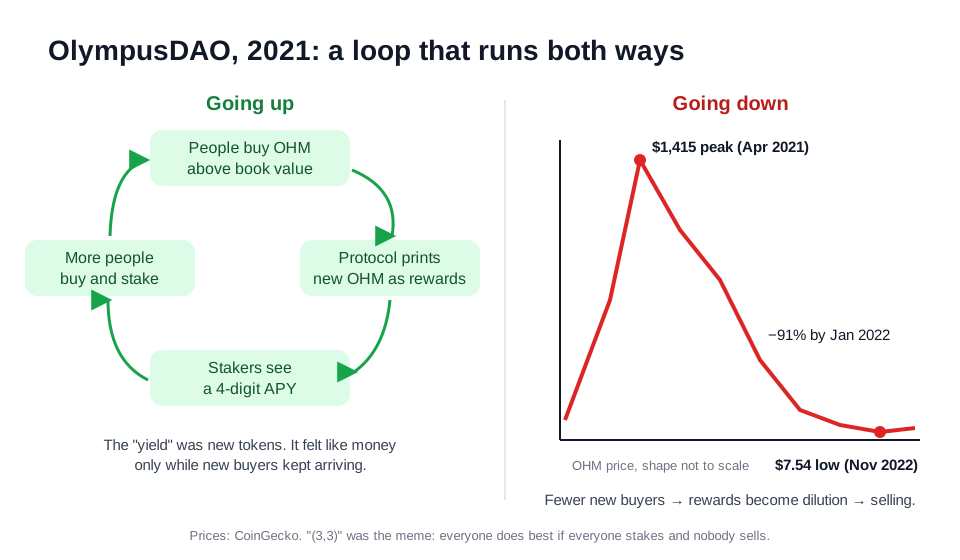
The problem is simple once you see it. The "yield" was new tokens. It felt like income only while new buyers kept paying a premium. When they stopped, the rewards became plain dilution, people sold, and the loop spun backwards. OHM hit about $1,415 in April 2021, was down 91% by January 2022, and bottomed at $7.54 in November 2022 (CoinGecko).
There was a second, quieter problem. The treasury "backing" was a number on a dashboard, not something a holder could claim. Mick Hagen, who says he was one of the biggest Olympus holders (and now works on Brim, one of the projects below), remembers OHM trading below its own backing for months while the treasury held hundreds of millions. His line for it is the best one I read all day: "A floor you can't call is a screenshot."
Dozens of copies ("forks") appeared on other chains. Some ended badly, like Wonderland, whose treasury manager turned out to be a co-founder of a collapsed exchange with a fraud conviction.
What Olympus did next is the interesting part. It stopped selling yield and started defending its backing:
- Automatic buybacks near backing (Range Bound Stability, since November 2022): the protocol sells OHM when the price is high in its band and buys it back when it's low.
- Cooler Loans: borrow stablecoins against your OHM, up to roughly 95% of its backing, at 0.5% a year, with no liquidation if the price drops.
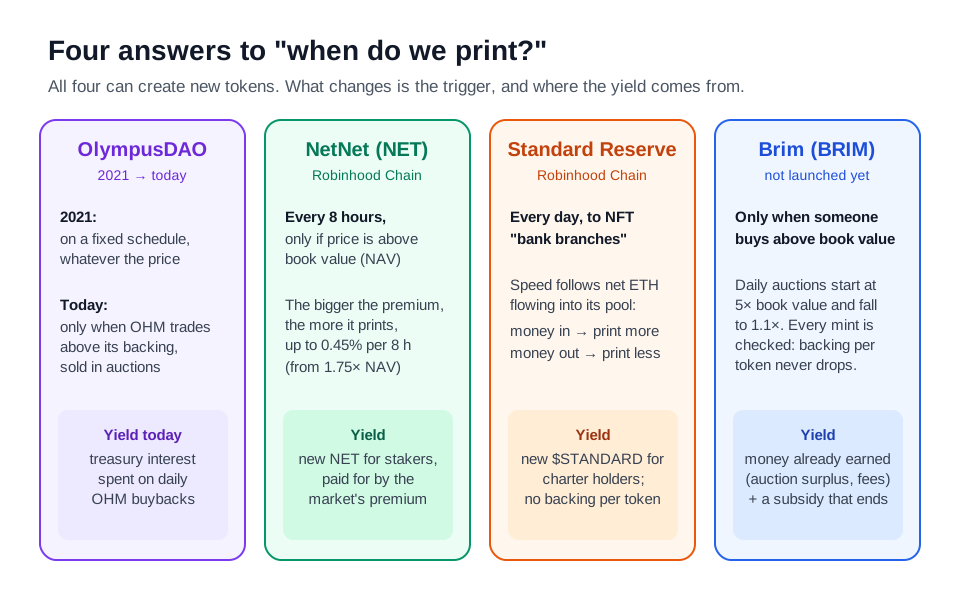
- Printing only at a premium: new OHM is created only when it trades above backing, and it's sold through auctions.
- Yield from real income: treasury interest is spent on daily buybacks.
Today OHM trades around $20 with about $11.20 of liquid backing per token (olympusdao.finance and CoinGecko, 17 Sep 2026). It's a calmer animal. And its 2021 design is exactly what the next three projects are reacting to.
The three new ones: four answers to "when do we print?"
NetNet (NET): the faithful remix
NetNet is the closest to Olympus v1. It's described as a reserve-backed token in that lineage, rebuilt with fixed formulas and no admin. It even keeps the rebasing staked token (sNET), whose balance grows every 8 hours.
The big change is what controls the printer. NetNet mints new NET only when the market price is above book value (it calls book value NAV), and the bigger the premium, the faster it prints:
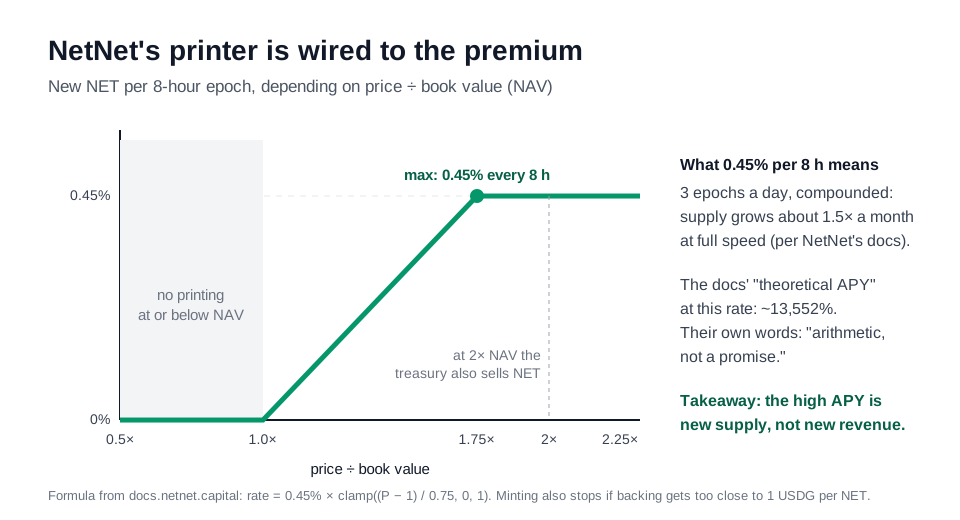
- At or below NAV, nothing is printed.
- At 1.75× NAV or more, it prints the maximum: 0.45% every 8 hours. The docs are honest about what that means. They show a "theoretical APY" of about 13,552% and call it "arithmetic, not a promise". At full speed, supply grows about 1.5× a month.
- Backing: the docs promise at least 1 USDG (a dollar stablecoin) of backing per NET. The treasury bids to buy NET back at book value minus 1.5%, but only with 1% of its reserves per 8 hours.
- Extras: tokenized stocks held on the side (not counted in NAV), a lending facility, and a list of casino-style games.
The numbers are wild. NET went from $15.83 in late July to $1,887 in late August, and sat around $973 on 17 September (CoinGecko). Only about 4,800 of 91,000 NET count as circulating, because over 90% is staked.
My honest reading: the formula is clever, because it stops printing exactly when printing would hurt. But at today's price the "at least 1 USDG" floor is very far away, so it protects someone who buys today very little. The team is anonymous, I found no audit, and one exchange blog claims the deployer can still change fees and mint. That contradicts the docs, and I couldn't verify either side on-chain.
The sharpest critique comes from Hagen, a competitor, so read it with that in mind:
- Two exceptions. NetNet's docs say no operation may lower backing per token, with two named exceptions: the dividend mint and the team's option. "Nothing can lower your backing, except the yield."
- A mirror, not an engine. The dividend grows with the premium, and every printed token can be sold into that premium. So the printing creates the selling that closes the gap that pays for the printing.
- Where it ends. When the premium is gone, printing stops by formula and the exit is a bid capped at 1% of reserves per 8 hours. His words: "NET's endgame isn't a crash. It's boredom."
- In fairness, per token, NetNet's 1.5% exit haircut is cheaper than Brim's 2% fee, and he admits it.
Standard Reserve ($STANDARD): the central banker
Standard Reserve went live on 14 September 2026, three days before I wrote this. It openly pitches itself as a fix for Olympus, but it does something surprising: it drops backing per token completely.
Instead, it runs like a tiny central bank in about 4,000 lines of code that can't be changed.
- Bank branches: you don't just hold the token. New $STANDARD is issued every day to "branches", NFT licences grouped under 1,000 founding "charters". You can buy more branches in daily auctions.
- A thermostat: how much is printed depends on one signal, the net ETH flowing into or out of its trading pool.
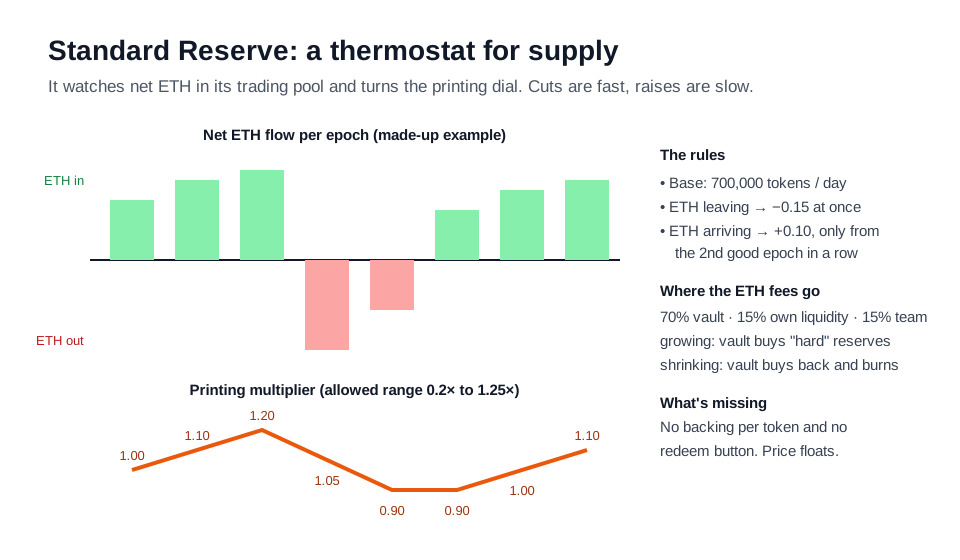
- The rules: the base rate is 700,000 tokens a day, times a multiplier between 0.2× and 1.25×. When ETH leaves, the dial drops by 0.15 immediately. When ETH arrives, it rises by 0.10, but only from the second good period in a row. The whitepaper calls this "defense faster than generosity".
- Fees: trading fees are paid in ETH and split three ways. 70% goes to a vault that buys "hard" reserves (like tokenized gold) in good times and buys back and burns $STANDARD in bad times. 15% goes to liquidity the protocol owns, and 15% to the team.
- Leaving: there's no redeem button. You retire a branch and pay a "resolution fee" of 2% to 60%. The fee grows with the square of how many other people are leaving that week.
That last rule is the most honest description of a bank run I've seen in code: the more people rush for the door, the more expensive the door gets.
My honest reading: as an engineer I like the controller idea. It's a feedback loop, and "cut fast, raise slowly" is sensible. But it's three days old, the signal hasn't been tested in a real downturn, and one critic points out that rewards earned but not yet claimed are hidden selling pressure waiting to happen. The code can't be patched, and the deployer still holds an owner role.
Hagen's critique here is about the second question, whose reserve is it?
- The gold stays with the bank. In growth mode the vault buys gold, and the whitepaper gives token holders no path to it. The whitepaper says every path through the economy either burns $STANDARD or brings the central bank hard assets. None of them bring you any. He compares the bank to a dragon sitting on its gold.
- The buyback is small. In decline mode it buys back at most about 5% of the pool's depth a day, which he calls "not a floor, a countdown".
- Rewards arrive at the wrong time. Issuance peaks after the longest run of inflows, so bankers get the most tokens exactly when the mood is about to turn.
- Holding the token isn't holding a charter. If you own a charter, you may do fine. If you only hold $STANDARD, you're "the customer, not the shareholder".
(His post was written before Standard Reserve launched on 14 September, so he treats it as a design, not a live system.)
Brim (BRIM): the one with a redeem button
Brim isn't live yet; its launch sale ("First Fill") has no date. Its slogan is "(3,3) with a redeem button", and its whitepaper names Olympus, Terra and NetNet as designs it's learning from.
Three rules make it different:
- Every mint is checked. New BRIM can only be created if the buyer pays at least book value. Daily auctions start at 5× book value and fall to 1.1×. So minting can never lower the backing per token.
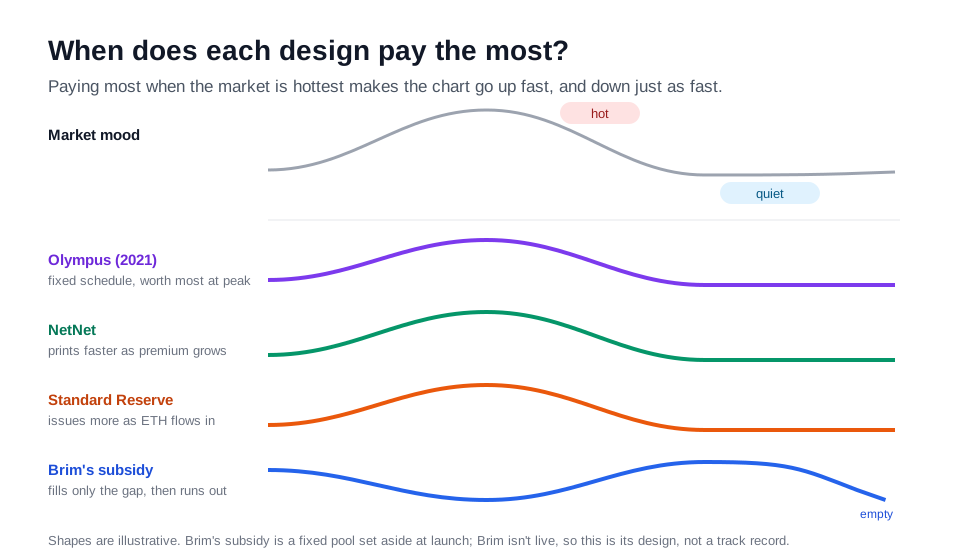
- Yield comes only from money already earned. Surplus from auctions, trading fees (3% on buys, 5% on sells), profits from a trading desk, and exit fees. There's also a fixed pool of pre-minted tokens (the "Well") that tops rewards up toward a 200% yearly target while it lasts. Brim itself says the target is not a promise. The subsidy pays only the gap that real revenue leaves, and its payouts taper as the pool drains. A hot week draws nothing, and a quiet week draws the most. Those tokens were paid for at launch, so paying them out doesn't create new supply.
- You can always leave at book value. Burn BRIM and you receive your share of every asset in the reserve, minus a 2% fee. The fee stays in the reserve, so each exit slightly raises backing for everyone who stays.
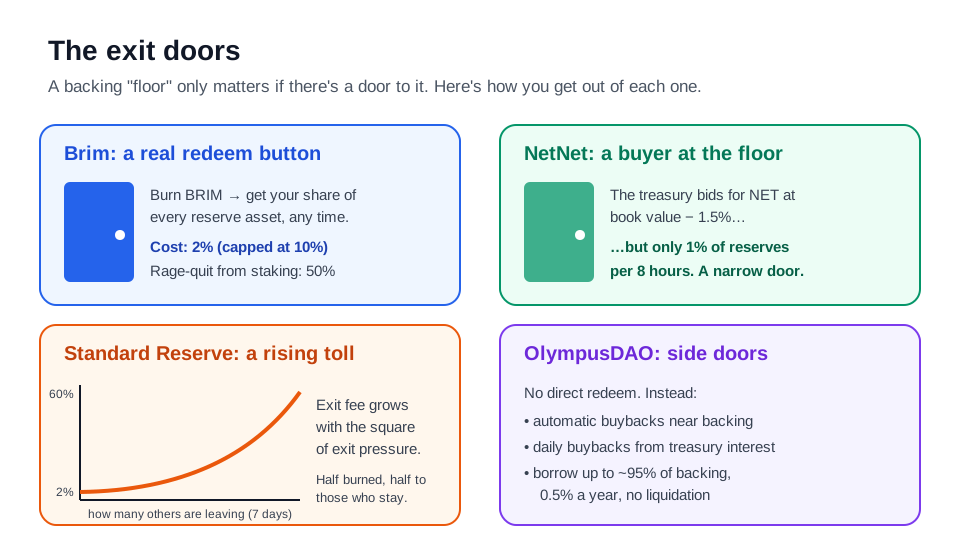
One honest detail from Brim's side: the promise is that the protocol's own actions never lower book value. It is not a promise that book value never falls. Once the reserve holds stocks, the floor moves with the stock market. "Anyone promising you the second thing is selling something," Hagen writes.
My honest reading: this is the design whose floor is closest to a real floor, because you can actually walk through the door. But the fees are high (50% if you "rage quit" from staking), the reserve is meant to move into tokenized stocks that can drop and can be frozen by their issuers, governance can pause things, the team is anonymous, and none of it has been tested with real money. And most of the best arguments for Brim come from the people building it.
The analogy that made it click for me
Hagen compares these tokens to things that already exist in traditional finance, and it's the clearest way I've found to think about them:
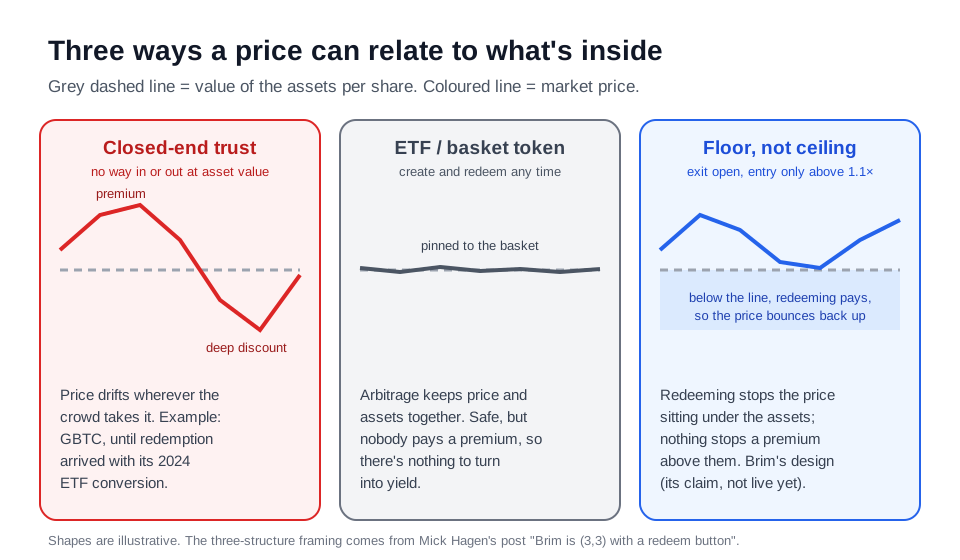
- A closed-end trust has no redemption. The price goes wherever the crowd takes it. Bitcoin's GBTC traded at a premium for years, then at a deep discount (close to 50% at its worst), and the gap only closed when its January 2024 ETF conversion brought redemption into view. That's the Olympus problem with a stock ticker.
- An ETF lets people create and redeem shares against the basket, so the price stays pinned to the assets. It's safe, but nobody pays a premium for it, so there's nothing to turn into yield.
- "Floor, not ceiling" is the third shape Brim is aiming for. The exit is open, so a price below the assets is an arbitrage that corrects itself. The entry is closed below 1.1× book value, so nothing pins the price down to the basket. The premium above the floor is what pays the yield.
He makes a second point that's easy to miss: timing. Olympus's schedule, NetNet's printer and Standard Reserve's issuance all pay the most when the market is hottest, which is exactly when nobody needs help. Brim's subsidy is designed to do the opposite.
Side by side
| OlympusDAO | NetNet | Standard Reserve | Brim | |
|---|---|---|---|---|
| Chain | Ethereum | Robinhood Chain | Robinhood Chain | Robinhood Chain |
| Live since | Mar 2021 | ~Jul 2026 | 14 Sep 2026 | not yet |
| Backing per token | yes (~$11.20) | "at least 1 USDG" | none | yes |
| Redeem at backing? | indirectly | small buyback bid | no (2–60% exit fee) | yes, 2% fee |
| Prints new tokens when… | trading above backing | price above NAV | net ETH flows in | someone pays above book value |
| Yield comes from | treasury interest → buybacks | new tokens from the premium | new tokens to charter NFTs | earned revenue + a limited subsidy |
| Who can change the rules | DAO vote | nobody (formulas), in theory | nobody (immutable), in theory | boards with timelocks |
| Price vs. backing today | ~1.8× | up to ~970× | n/a | n/a |
"In theory" because both still have a deployer or owner role of some kind. See the notes above.
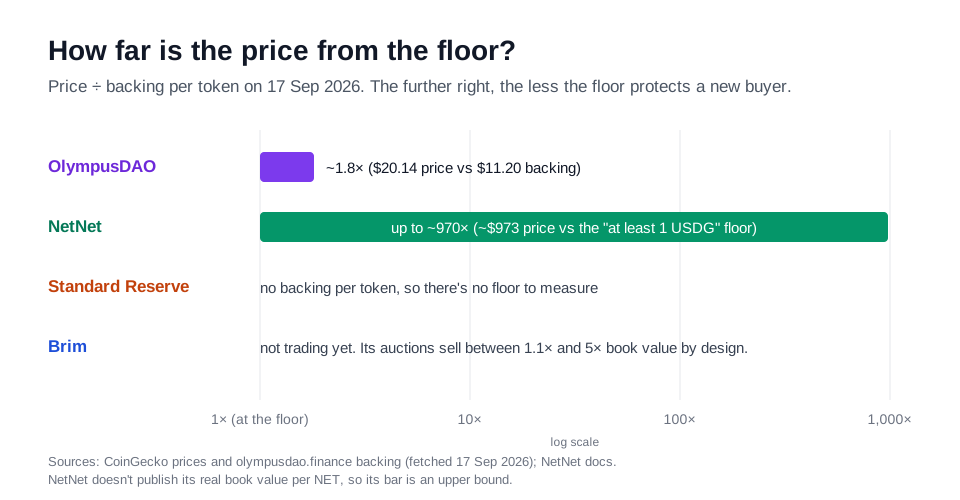
How to read a four-digit APY
After all this reading, I use one question to judge any of these tokens:
"If I earn 1,000% this year, who is paying me?"
- If the answer is "new tokens", your share of the pie isn't growing much. The pie is being cut into more slices. You win only if the price holds while supply grows, and that depends on new buyers.
- If the answer is "fees and interest the treasury actually collected", that's real income. It's usually a much smaller number.
- If the answer is "a subsidy", find out how long it lasts.
And a second question about the floor:
"Whose reserve is it, and is there a door?" Check how far the price is from the backing, and whether you can actually reach it. A floor you can't reach, or can only reach through a narrow buyback or a 60% toll, is not much of a floor. Or, as Hagen puts it, a floor you can't call is a screenshot.
What I'll watch next
- NetNet: whether an audit appears, and what happens to NET's price when the premium shrinks and printing stops.
- Standard Reserve: the first week with more ETH leaving than arriving. That's the real test of the thermostat and the exit toll.
- Brim: whether it launches, and whether redemptions keep working when a reserve asset has a bad day.
- Olympus: whether its boring, backing-first version keeps OHM's price and backing close together.
Five years after the (3,3) summer, everyone seems to agree that printing tokens isn't income. They just disagree about how to stop pretending it is.
Sources
- OlympusDAO: olympusdao.finance, docs, CoinGecko, the forks story (Yahoo Finance)
- NetNet: netnet.capital, docs: mechanism, CoinGecko, Bitrue explainer
- Standard Reserve: standardreserve.xyz, whitepaper, TechFlow analysis, Gate launch news
- Brim: brim.finance, whitepaper, yellow paper, and Mick Hagen's post "Brim is (3,3) with a redeem button" (@mickhagen on X). He writes as part of the Brim team, so it's a view from one side.
- Context: 0xSammy on reserve banks on Robinhood Chain
Prices and figures are as of 17 September 2026.