Seyed Masoud Hosseini · Overview · Study log · Weekly summaries · Ideas · Search · Transcript · RSS feed
Financial Markets · Lecture 8 of 23 · 1:15:16
Lecture 8: Theory of Debt, Its Proper Role, Leverage Cycles
Study guide
What this lecture covers
Shiller asks a basic question: why is the interest rate a few percent a year, rather than zero, negative, or something wildly different? He builds up an answer through the history of interest rate theory, from Eugen von Boehm-Bawerk's 19th-century causes of interest to Irving Fisher's two-period model of saving and borrowing, then moves into the practical mathematics of bond pricing, compounding, present value and forward rates. He closes by stepping back from the models to ask whether lending, especially consumer lending, can become exploitative, using the concept of usury and Elizabeth Warren's advocacy work as a case study.
This lecture follows the course's earlier sessions on market efficiency and continues the pattern of pairing a formal model with a behavioral or historical counterpoint. After watching, you should be able to explain Fisher's model of the interest rate as a tangency between a production possibility frontier and indifference curves, price a discount bond, consol, annuity and conventional bond, compute a simple forward rate, and describe the historical and ethical debate around usury.
Key ideas
- Von Boehm-Bawerk's three causes of interest: technical progress, the "roundaboutness" advantage of indirect production methods, and time preference (impatience), first laid out in his 1884 book on the theory of interest.
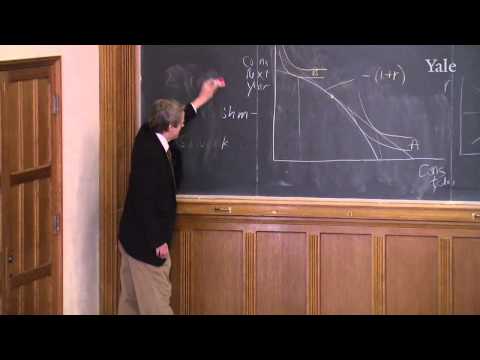
- Fisher's two-period model: interest rates emerge from the tangency between a production possibility frontier (representing technology) and an individual's indifference curves (representing time preference); with only one person and a straight-line frontier, only roundaboutness and technology matter, but a concave frontier brings impatience into play too.
- Gains from trade in lending: when two people with different patience levels can trade through a loan, both can reach a higher utility than they could in isolation, which is Fisher's basic justification for why lending markets are valuable.
- Discount bond: a bond with no periodic interest that is priced today by discounting a fixed future payment;
price = 100 / (1 + r)^T. - Present discounted value (PDV): the core finance concept that a future payment is worth less than the same amount today, computed using the relevant compounding convention (annual, semiannual, or continuous).
- Consol, annuity and conventional bond formulas: a consol (perpetuity) is priced as
coupon / r; an annuity pays a fixed amount for a set number of periods; a conventional bond combines an annuity of coupon payments with a discount bond for the principal. - Forward rate: the interest rate for a future period implied by today's term structure, a concept Shiller traces to Sir John Hicks's 1939 book "Value and Capital" (a claim Hicks himself, in a letter to Shiller, wasn't fully certain of).
- Expectations theory of the term structure: the idea that forward rates equal the market's expected future spot rates, adjusted in practice by a risk premium that tends to push forward rates above expected future spot rates.
- Usury: the ancient and still-debated question of when charging interest becomes exploitative, discussed through biblical and Quranic references and Elizabeth Warren's advocacy that led to the Consumer Financial Protection Bureau.
Walkthrough
Why is the interest rate a few percent? (1:01)
Shiller frames the lecture's technical core around a basic question: why does the interest rate typically sit in the low single digits, and why is it usually positive at all? He introduces Eugen von Boehm-Bawerk's 1884 answer of three causes - technical progress, roundaboutness, and time preference - as a literary, pre-mathematical account that sets up the more formal treatment to follow.
Fisher's Robinson Crusoe model of interest (9:13)
Using Irving Fisher's 1930 book "The Theory of Interest," Shiller builds a graphical model with consumption today on one axis and consumption next year on the other. A single Robinson Crusoe choosing along a straight-line production possibility frontier reveals interest determined purely by technology. Making the frontier concave (diminishing returns to saving) brings in the shape of Crusoe's indifference curves, so the interest rate becomes the slope at the tangency between technology and preferences, incorporating both roundaboutness and impatience.
Two Crusoes and the gains from lending (21:38)
Shiller extends the model to two Crusoes with identical technology but different patience: one wants to consume a lot now, the other wants to save for later. Before they discover each other, each maximizes utility independently at a different point on the same production frontier. Once they find each other, they can trade through a loan, letting the impatient Crusoe consume more now in exchange for repayment later, and both end up at a higher utility than they achieved alone. This is Fisher's basic case for why a lending market is a mutually beneficial arrangement, not a zero-sum transfer.
Bond pricing, compounding and present value (28:50)
Shiller works through the mechanics of pricing debt instruments. A discount bond paying a fixed amount at maturity is priced as that amount divided by (1 + r)^T; he explains the difference between annual and semiannual compounding (the convention used in the Fabozzi textbook, denoted with z = r/2) and continuous compounding, using e^(rT). He defines present discounted value generally as a sum (or integral, for continuous payment streams) of future payments each divided by the appropriate discount factor, then applies this to a consol or perpetuity (price = coupon / r), an annuity that pays a fixed amount for a set number of periods (the formula behind mortgages), and a conventional bond, which combines an annuity of coupons with a discount bond for the final principal repayment.
Forward rates and the term structure (47:28)
Shiller introduces the forward rate, the interest rate for a future period that is implied by bonds of different maturities quoted today, a concept he traces to Sir John Hicks's 1939 book, recounting how he once wrote to Hicks directly to ask about its origin. He derives a simple one-year-ahead forward rate by showing how buying a two-year bond and shorting a one-year bond locks in a rate for the second year, then introduces the expectations theory of the term structure, which holds that forward rates equal expected future spot rates, modified in practice by a risk premium that tends to push forward rates somewhat higher than the market's true expectation.
Usury, honeymoon loans, and consumer protection (1:03:08)
Shiller shifts from formal theory to the ethics of lending, noting that biblical and Quranic passages on "usury" are ambiguous between condemning interest outright and condemning only excessive interest, and that many religious traditions historically treated charging interest as immoral. He questions whether modern products like vacation and honeymoon loans are exploitative or legitimate investments in life experience, citing economist Franco Modigliani's view of a honeymoon as an investment. He closes with Elizabeth Warren's writing on the harms of aggressive consumer lending and her role in creating the Consumer Financial Protection Bureau under the Dodd-Frank Act, concluding that lending is fundamentally valuable, as Fisher's model shows, but still requires regulation to prevent real abuses.
Before you watch
- Basic comfort with supply-and-demand graphs and indifference curves from introductory microeconomics will make the Fisher model easier to follow.
- It helps to have seen the course's earlier lectures for context on how Shiller pairs formal financial theory with behavioral and historical commentary.
Check your understanding
- In Fisher's model, why does a concave production possibility frontier allow both technology and impatience to influence the interest rate, while a straight-line frontier reflects only technology?
- How do two Robinson Crusoes with different time preferences both end up better off once they can trade through a loan?
- What is the difference between a discount bond, a consol, an annuity, and a conventional bond, and how are their present values calculated?
- What is a forward rate, and how can it be derived from the prices of bonds with two different maturities?
- Why does Shiller present the ethics of lending, including usury and consumer loans, as an unresolved tension even though Fisher's model shows lending as mutually beneficial?
Vocabulary
- interest rate (noun)
- The percentage cost of borrowing money, or the return earned on lending it.
The lecture asks why the interest rate is usually a few percent, not zero. - time preference (phrase)
- A person's tendency to prefer consuming now rather than waiting for later.
Time preference, or impatience, is one cause of interest. - roundaboutness (noun)
- The idea that indirect, longer production methods can be more productive than direct ones.
Roundaboutness explains why investing in tools now pays off later. - production possibility frontier (phrase)
- A graph showing the maximum combinations of two things an economy can produce.
Fisher's model uses a production possibility frontier for consumption over time. - indifference curve (noun)
- A graph line showing combinations that give a person equal satisfaction.
Indifference curves show how much someone values consuming now versus later. - tangency (noun)
- The point where two curves just touch without crossing.
The interest rate is set at the tangency of the frontier and indifference curve. - gains from trade (phrase)
- The extra benefit two parties get by exchanging with each other rather than acting alone.
Lending creates gains from trade between patient and impatient people. - discount bond (phrase)
- A bond that pays no periodic interest but is sold below its face value.
A discount bond's price today reflects the future payment discounted by the interest rate. - present discounted value (phrase)
- The current worth of a future payment, once interest is accounted for.
Present discounted value shows a future dollar is worth less than one today. - compounding (noun)
- Earning interest on both the original amount and previously earned interest.
Compounding can be calculated annually, semiannually, or continuously. - consol (noun)
- A bond that pays interest forever but never repays the principal.
A consol's price simply equals the coupon divided by the interest rate. - annuity (noun)
- A financial product or formula paying a fixed amount for a set number of periods.
The mortgage payment formula is based on the annuity formula. - term structure (phrase)
- The relationship between interest rates and how long until a bond matures.
The term structure shows how rates differ for short and long bonds. - forward rate (phrase)
- An interest rate for a future period implied by current bond prices.
The forward rate can be derived by comparing one-year and two-year bonds. - risk premium (phrase)
- The extra return demanded for holding a riskier investment.
A risk premium can push forward rates above expected future rates. - usury (noun)
- The practice of charging excessive or unfair interest on a loan.
Ancient religious texts debate whether usury is always wrong. - exploitative (adjective)
- Taking unfair advantage of someone for personal benefit.
Aggressive consumer lending can become exploitative. - principal (loan) (noun)
- The original amount of money borrowed, not including interest.
A conventional bond repays the principal at maturity. - ambiguous (adjective)
- Open to more than one interpretation.
Religious texts on usury are ambiguous about excessive interest. - advocacy (noun)
- Public support for or promotion of a particular cause.
Elizabeth Warren's advocacy led to new consumer lending protections.
Chapters
- 0:00 Chapter 1. Introduction
- 1:24 Chapter 2. Theories for the Determinants of Interest Rates
- 28:11 Chapter 3. Present Discounted Values, Compounding, and Pricing Bond Contracts
- 47:50 Chapter 4. Forward Rates and the Term Structure of Interest Rates
- 1:03:29 Chapter 5. The Ancient History of Interest Rates and Usurious Loans
- 1:11:08 Chapter 6. Elizabeth Warren and the Consumer Financial Protection Bureau
From the YouTube description
Financial Markets (2011) (ECON 252)
Professor Shiller devotes the beginning of the lecture to exploring the theoretical determinants of the level of interest rates. Eugen von Boehm-Bawerk names technical progress, roundaboutness, and time preference as the crucial factors. Professor Shiller complements von Boehm-Bawerk's analysis with two of Irving Fisher's modeling approaches, the view of the interest rate as the equilibrium variable in the savings market and the perspective of simple Robinson Crusoe economies on the determination of interest rates. Subsequently, Professor Shiller focuses his attention on present discounted values and derives the price for discount bonds, consols, annuities, as well as corporate bonds. His treatment of the term structure of interest rates leads him to forward rates and the expectations theory of the term structure of interest rates. At the end of the lecture, he offers insights on usurious loan practices, from ancient times until today, and describes the improvements in consumer financial protection that have been made after the financial crisis of the 2000s.
00:00 - Chapter 1. Introduction
01:24 - Chapter 2. Theories for the Determinants of Interest Rates
28:11 - Chapter 3. Present Discounted Values, Compounding, and Pricing Bond Contracts
47:50 - Chapter 4. Forward Rates and the Term Structure of Interest Rates
01:03:29 - Chapter 5. The Ancient History of Interest Rates and Usurious Loans
01:11:08 - Chapter 6. Elizabeth Warren and the Consumer Financial Protection Bureau
This course was recorded in Spring 2011.
← Lecture 7: Efficient Markets · Lecture 9: Corporate Stocks →