Seyed Masoud Hosseini · Overview · Study log · Weekly summaries · Ideas · Search · Transcript · RSS feed
Financial Markets · Lecture 17 of 23 · 1:11:56
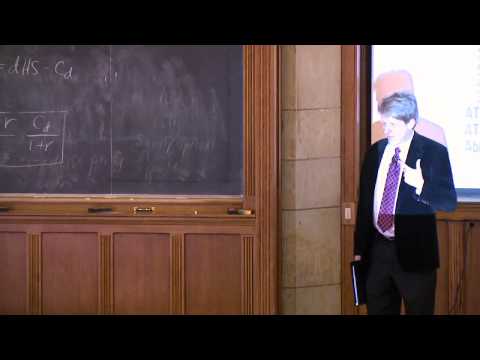
Lecture 17: Options Markets
Study guide
What this lecture covers
This lecture introduces options: contracts that give the right, but not the obligation, to buy (a call) or sell (a put) an asset at a fixed strike price. Professor Shiller builds up from everyday analogies, such as an option to buy land, to the formal machinery used to price stock options, ending with a look at implied volatility and the VIX index. It sits within the course's broader treatment of derivatives markets, following earlier lectures on stocks, bonds and futures.
By the end you should be able to explain what makes an option valuable, read an options price table, use put-call parity to check consistency between call and put prices, and follow the logic behind the binomial pricing model and the Black-Scholes formula, without needing to derive Black-Scholes yourself.
Key ideas
- Call and put options: a call gives the right to buy at the strike (exercise) price; a put gives the right to sell at it, both by a set exercise date.
- American vs. European options: American options can be exercised any time up to expiration; European options only on the expiration date itself.
- Theoretical purpose of options: economist Kenneth Arrow argued markets need prices for all possible future states; options, as shown by Stephen Ross, help complete that set of prices.
- Behavioral purpose of options: incentive stock options work partly because they make a company's share price salient to employees, and options resemble insurance, which offers peace of mind.
- Out of the money vs. in the money: a call is out of the money when the stock price is below the strike, and in the money when it is above; the reverse holds for puts.
- Put-call parity: on any date, the stock price equals the call price minus the put price plus the present value of the exercise price (adjusted for expected dividends).
- No-arbitrage pricing: option prices can be derived without knowing the probability of a price move, using a riskless hedged portfolio of the stock and the option.
- Implied volatility and the VIX: inverting the Black-Scholes formula from an observed option price yields the market's implied estimate of future volatility, tracked by the CBOE's VIX index.
Walkthrough
Defining options and everyday examples (0:00)
The lecture opens with the definitions of calls, puts, strike price and exercise date, then the American versus European distinction. Shiller gives non-financial illustrations, such as buying an option on a farmer's land before building a supermarket, and notes that mortgages and dating both have option-like features.
Why options exist (7:11)
Two justifications are offered. The theoretical case, drawing on Kenneth Arrow and Stephen Ross, is that options help complete the set of market prices needed for an efficient economy. The behavioral case ties options to attention and salience: incentive stock options change how employees think about company value, and options resemble insurance in providing peace of mind.
Reading an options price table and the derivatives market (17:11)
Using a Wall Street Journal clipping for America Online (later AOL Time Warner), Shiller shows how strike prices, expiration dates, and call and put prices are quoted. He explains the roles of the option buyer and the "writer" (seller), and how options trading became a large, independent derivatives market after the Chicago Board Options Exchange opened in 1973.
Payoff diagrams and put-call parity (24:54)
On the exercise date, a call's value is max(stock price - strike, 0), a broken straight-line relationship rather than a smooth linear one. Combining a long call and a short put reproduces the stock's own linear payoff, which leads to the put-call parity equation linking the stock price, call price, put price and the present value of the strike price (plus dividends).
Price bounds and the binomial model (39:07)
Before expiration, a call's price sits above the payoff line but below the stock price itself, and gets closer to the payoff line as expiration nears, which is why American call options are rarely exercised early. Shiller then derives a two-state (binomial) pricing formula by constructing a hedge ratio H of shares per option that makes a stock-plus-option portfolio riskless, then setting its return equal to the riskless rate. This no-arbitrage argument prices the option without using the probability of an up or down move.
The Black-Scholes formula (51:02)
The Black-Scholes Option Pricing Formula, developed by Fisher Black and Myron Scholes, extends the same no-arbitrage logic to continuous time. It prices a call using the stock price, strike price, time to maturity, interest rate and sigma, the standard deviation of the stock's price changes, without needing a probability estimate.
Implied volatility and the VIX (55:49)
Inverting Black-Scholes from an observed market price for an option yields the implied volatility, the market's expectation of future price variability; the CBOE publishes this as the VIX. Shiller compares the VIX since 1986 with actual historical volatility, pointing to spikes around the 1987 crash, the Asian financial crisis and the 2008 crisis, and contrasts these calm-punctuated-by-shocks patterns with the unusually volatile Great Depression era.
Options on housing (1:09:33)
The lecture closes with Shiller's own effort to launch options on single-family home prices at the Chicago Mercantile Exchange in 2006, and his continuing view that put options attached to mortgages could help homeowners manage price-decline risk.
Before you watch
- Review the course's earlier lectures on stocks and futures, since options are introduced as a derivative built on those underlying assets.
- Basic familiarity with present value discounting is assumed when the lecture adjusts put-call parity for time and dividends.
Check your understanding
- What distinguishes an American option from a European option, and why is the American option never worth less than the European one?
- State the put-call parity relationship and explain why arbitrage should force it to hold.
- Why does the no-arbitrage pricing of a call option not require knowing the probability of the stock going up or down?
- What does a high VIX reading tell you about market expectations, and how does implied volatility differ from historical volatility?
- Why does the lecture argue that exercising an American call option early is usually a mistake?
Vocabulary
- option (financial) (noun)
- A contract giving the right, but not the obligation, to buy or sell an asset at a set price.
An option lets you buy a stock later at today's agreed price. - call option (phrase)
- An option giving the right to buy an asset at a fixed price.
A call option pays off if the stock price rises above the strike. - put option (phrase)
- An option giving the right to sell an asset at a fixed price.
A put option pays off if the stock price falls below the strike. - strike price (phrase)
- The fixed price at which an option lets its holder buy or sell.
The strike price is set when the option contract is created. - exercise (an option) (verb)
- To use the right given by an option to buy or sell the asset.
You would only exercise a call option if the stock price is higher than the strike. - in the money (phrase)
- Describing an option that would currently be profitable to exercise.
A call option is in the money when the stock price is above the strike. - out of the money (phrase)
- Describing an option that would currently be unprofitable to exercise.
A call option is out of the money when the stock trades below the strike. - put-call parity (phrase)
- A pricing rule linking the stock price, call price, and put price so they stay consistent.
Put-call parity prevents risk-free arbitrage between calls and puts. - no-arbitrage (phrase)
- A pricing principle assuming no risk-free profit opportunity exists in the market.
Option prices are derived using no-arbitrage logic. - hedge ratio (phrase)
- The number of shares needed to offset the risk of one option, making a combined position riskless.
The hedge ratio balances the stock and option positions. - riskless portfolio (phrase)
- A combination of assets with no uncertainty about its future value.
Combining a stock and an option can create a riskless portfolio. - Black-Scholes formula (phrase)
- A famous equation used to calculate the fair price of an option.
The Black-Scholes formula prices options without needing to know future probabilities. - volatility (noun)
- How much and how quickly a price moves up and down.
Higher volatility increases the value of an option. - implied volatility (phrase)
- The market's expected future volatility, calculated backward from an option's price.
Implied volatility rises sharply during a market crisis. - VIX (noun)
- A widely watched index measuring the market's expected volatility.
The VIX spiked during the 2008 financial crisis. - salience (noun)
- The quality of standing out and grabbing attention.
Stock options increase the salience of share price to employees. - writer (of an option) (noun)
- The person who sells, or issues, an option contract.
The option writer takes on the obligation if the buyer exercises. - payoff diagram (phrase)
- A graph showing how much a financial position gains or loses at different prices.
A payoff diagram shows a call option's value at expiration. - complete (markets) (verb)
- To fill in missing prices so all possible future outcomes can be traded.
Options help complete the set of prices in the market. - peace of mind (phrase)
- A feeling of calm and reassurance about the future.
Options can offer peace of mind, similar to insurance.
Chapters
- 0:00 Chapter 1. Examples of Options Markets and Core Terms
- 7:11 Chapter 2. Purposes of Option Contracts
- 17:11 Chapter 3. Quoted Prices of Options and the Role of Derivatives Markets
- 24:54 Chapter 4. Call and Put Options and the Put-Call Parity
- 34:56 Chapter 5. Boundaries on the Price of a Call Option
- 39:07 Chapter 6. Pricing Options with the Binomial Asset Pricing Model
- 51:02 Chapter 7. The Black-Scholes Option Pricing Formula
- 55:49 Chapter 8. Implied Volatility - The VIX Index in Comparison to Actual Market Volatility
- 1:09:33 Chapter 9. The Potential for Options in the Housing Market
From the YouTube description
Financial Markets (2011) (ECON 252)
After introducing the core terms and main ideas of options in the beginning of the lecture, Professor Shiller emphasizes two purposes of options, a theoretical and a behavioral purpose. Subsequently, he provides a graphical representation for the value of a call and a put option, and, in this context, addresses the put-call parity for European options. Within the framework of the Binomial Asset Pricing model, he derives the value of a call-option from the no-arbitrage-principle, and, as a continuous-time analogue to this formula, he presents the Black-Scholes Option Pricing formula. He contrasts implied volatility, as represented by the VIX index of the Chicago Board Options Exchange, which uses a different formula in the spirit of Black-Scholes, with the actual S&P Composite volatility from 1986 until 2010. Professor Shiller concludes the lecture with some thoughts about options on single-family homes that he launched with his colleagues of the Chicago Mercantile Exchange in 2006.
00:00 - Chapter 1. Examples of Options Markets and Core Terms
07:11 - Chapter 2. Purposes of Option Contracts
17:11 - Chapter 3. Quoted Prices of Options and the Role of Derivatives Markets
24:54 - Chapter 4. Call and Put Options and the Put-Call Parity
34:56 - Chapter 5. Boundaries on the Price of a Call Option
39:07 - Chapter 6. Pricing Options with the Binomial Asset Pricing Model
51:02 - Chapter 7. The Black-Scholes Option Pricing Formula
55:49 - Chapter 8. Implied Volatility - The VIX Index in Comparison to Actual Market Volatility
01:09:33 - Chapter 9. The Potential for Options in the Housing Market
This course was recorded in Spring 2011.
← Lecture 16: Guest Speaker Laura Cha · Lecture 18: Monetary Policy →