Seyed Masoud Hosseini · Overview · Study log · Weekly summaries · Ideas · Search · Transcript · RSS feed
Financial Markets · Lecture 15 of 23 · 1:12:36
Lecture 15: Forward and Futures Markets
Study guide
What this lecture covers
This lecture asks what futures markets actually do and why they matter beyond finance itself. Shiller argues that futures markets are, in effect, markets that price the future, and that this is socially valuable even though speculation carries a poor public reputation. He builds the explanation historically, starting from the world's first true futures market in 17th-century Japan, then moves through modern agricultural, oil, and financial futures.
The lecture also develops the mechanics that separate futures from forward contracts: standardization, daily settlement through margin accounts, and the elimination of counterparty risk. After watching, you should be able to explain why futures markets reduce counterparty risk compared to forward contracts, read a futures curve, and use the fair-value formula to explain when a market is in contango or backwardation.
Key ideas
- Forwards vs. futures: forward contracts are private, non-standardized agreements between two counterparties and carry counterparty risk; futures are standardized, exchange-traded contracts that virtually eliminate that risk.
- Speculation as a social function: Shiller argues, citing Adam Smith and a comparative survey he ran in Moscow and New York, that people widely misunderstand speculative storage of commodities as harmful, when it actually smooths prices and helps prevent shortages.
- Standardization and centralization: the world's first true futures market, in Dojima, Japan (1600s), solved forward contracts' inconsistency and counterparty risk by standardizing contract terms and enforcing common trading hours, which is why futures prices, not messy spot prices, become the reference price for a commodity.
- Margin accounts and daily settlement: a trader posts a fraction of a futures contract's value as margin, and gains or losses are settled daily against that account; if the margin runs out, the broker simply closes the position, which is what removes counterparty risk from futures trading.
- Fair value formula: the futures price approximately equals
(1 + r + s) x spot price, whereris the interest cost andsis the storage cost to the contract's maturity, explaining why futures prices are normally above spot prices (contango). - Contango vs. backwardation: contango is a rising futures curve (the normal case, reflecting storage and interest costs); backwardation is a falling futures curve, which can occur when convenience yield (the benefit of having physical inventory on hand) makes storage effectively cheap or even valuable.
- Financial futures use a different formula: for stock index futures, the fair-value equation becomes
(1 + r - y) x spot price, whereyis the dividend yield, because stocks have no physical storage cost and are never depleted, so the futures curve mostly reflects interest and dividend rates, not new information about the future.
Walkthrough
Forwards vs. futures contracts and speculation in derivative markets (0:00)
Shiller distinguishes forwards from futures and defines both as derivatives, priced off an underlying market. He addresses the negative public perception of derivatives and speculation, citing a 1991 survey he ran comparing attitudes in Moscow and New York toward grain speculation, in which Americans were, on average, more likely than Russians to believe (incorrectly) that speculative storage worsens shortages.
The first futures market and the role of standardization (12:46)
The lecture traces the origin of futures trading to the Dojima rice market in Osaka, Japan, active from 1673, describing its 91 warehouses, standardized contracts, enforced trading hours (marked by a burning fuse and enforced with buckets of water), and a system of hand signals. Shiller explains that standardization is what let the futures price become the effective reference price for rice, since spot prices for a specific, variable batch of rice are much harder to interpret.
Rice futures and contango vs. backwardation (23:03)
Using a real rice futures curve from March 2011, Shiller shows an upward-sloping (contango) curve and explains why it does not represent an obvious arbitrage profit: storage costs prevent riskless gains from buying spot rice and selling futures. He connects the pattern to real-world food price pressures linked to unrest in the Middle East at the time, and to Adam Smith's argument that self-interested storage, not charity, is what prevents famine.
Counterparty risk and margin accounts (31:47)
Shiller explains how forward contracts expose both parties to counterparty risk, and how futures markets eliminate it through standardized exchange-traded contracts, margin accounts, and daily settlement, where gains and losses are credited or debited each day and a broker simply closes out a position if margin runs low.
Wheat futures and the fair value formula for futures pricing (37:50)
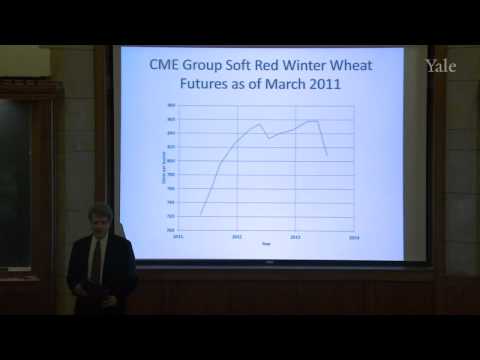
Using a soft red winter wheat futures curve, Shiller derives the fair-value formula futures price = (1 + r + s) x spot price, where r is the interest cost and s is storage cost over the contract horizon, and explains why the curve trends toward the spot price as maturity approaches, and why it typically drops around harvest time when storage is least needed.
Oil futures (47:00)
Shiller examines an oil futures curve from March 2011, showing initial contango followed by backwardation further out, and connects this to real-world supply uncertainty from the Middle East. He introduces the concept of convenience yield: businesses that depend on physical oil (like factories or refineries) may keep storing it even when futures prices are falling, because having oil on hand has its own value.
The history of the oil market (55:04)
The lecture reviews long-run inflation-adjusted oil prices back to 1871, covering early price swings from US discoveries, the Standard Oil monopoly and its breakup, decades of price stability under the Texas Railroad Commission, and then the two major oil crises: 1973-74, tied to OPEC's embargo during the Yom Kippur War, and 1979-80, tied to the Iranian Revolution and Iran-Iraq War. Shiller connects each crisis to a subsequent worldwide recession and notes the 2008 spike above $140 a barrel as a more puzzling episode linked to the broader financial crisis.
Financial futures and the difficulty of forecasting (1:08:16)
Shiller closes with S&P 500 index futures, explained through cash settlement (since delivering 500 stocks physically is impractical) and a modified fair-value formula (1 + r - y) x spot price using the dividend yield instead of storage cost. He emphasizes that because stocks are never "depleted" the way physical commodities are, the S&P 500 futures curve mostly reflects fair value rather than genuine information about future prices, so it should not be read as a market forecast.
Before you watch
- The earlier lecture on forward markets and forward interest rates provides useful groundwork, since this lecture builds directly on the forward-versus-futures distinction.
- Basic familiarity with what a spot price and an interest rate are will help with the fair-value formula.
Check your understanding
- Why do futures markets eliminate counterparty risk in a way that forward contracts do not?
- How does the fair-value formula explain why futures curves for storable commodities are usually upward sloping?
- What is convenience yield, and how does it explain backwardation in a market like oil?
- Why does Shiller argue that the S&P 500 futures curve is not useful for forecasting the future direction of the stock market, unlike an oil futures curve?
- Using the historical oil price chart, how does Shiller connect the 1973-74 and 1979-80 oil crises to broader economic events?
Vocabulary
- futures market (phrase)
- A marketplace for standardized contracts to buy or sell an asset at a future date.
Futures markets help set today's price for a good delivered later. - forward contract (phrase)
- A private agreement between two parties to trade an asset at a set future price.
A forward contract carries more counterparty risk than a futures contract. - counterparty risk (phrase)
- The danger that the other party in a contract will fail to fulfill their side.
Futures exchanges are designed to reduce counterparty risk. - speculation (noun)
- Buying or selling assets hoping to profit from future price changes.
Speculation has a poor public reputation but can smooth prices. - standardization (noun)
- Making contracts follow the same fixed terms so they can be easily traded.
Standardization let futures prices become a reliable price reference. - margin account (phrase)
- A deposit held to cover potential losses on a futures position.
Traders must maintain enough money in their margin account. - settlement (daily) (phrase)
- The process of crediting or debiting gains and losses at the end of each trading day.
Daily settlement keeps futures losses from building up unnoticed. - spot price (phrase)
- The current market price for immediate delivery of an asset.
The futures price is compared to the spot price using the fair-value formula. - contango (noun)
- A market condition where futures prices are higher than the current spot price.
Contango is the normal pattern for storable goods. - backwardation (noun)
- A market condition where futures prices are lower than the current spot price.
Backwardation can occur when holding physical inventory is valuable. - convenience yield (phrase)
- The extra benefit of physically holding a commodity rather than a futures contract for it.
Convenience yield explains why refiners keep storing oil despite falling futures prices. - storage cost (phrase)
- The expense of physically holding a commodity until it is used or sold.
Storage cost pushes futures prices above spot prices. - arbitrage (noun)
- Profiting from price differences of the same asset in different markets, with no real risk.
Storage costs prevent simple arbitrage between spot and futures rice prices. - embargo (noun)
- An official ban on trade with a country or in a particular good.
The 1973 oil embargo caused a major price spike. - dividend yield (phrase)
- The annual dividend payment expressed as a percentage of a stock's price.
Stock index futures use the dividend yield in their pricing formula. - cash settlement (phrase)
- Paying the value difference in cash instead of delivering the actual asset.
S&P 500 futures use cash settlement instead of delivering 500 stocks. - reference price (phrase)
- A widely accepted price used as the standard for a commodity.
Standardized futures prices become the reference price for rice. - unrest (noun)
- A state of instability or public disturbance in a region.
Middle East unrest pushed up oil futures prices. - depleted (adjective)
- Used up or reduced in supply.
Stocks are never depleted the way physical commodities are. - puzzling (adjective)
- Difficult to understand or explain clearly.
The 2008 oil price spike is a puzzling episode.
Chapters
- 0:00 Chapter 1. Forwards vs. Futures Contracts; Speculation in Derivative Markets
- 12:46 Chapter 2. The First Futures Market and the Role of Standardization
- 23:03 Chapter 3. Rice Futures and Contango vs. Backwardation
- 31:47 Chapter 4. Counterparty Risk and Margin Accounts
- 37:50 Chapter 5. Wheat Futures and the Fair Value Formula for Futures Pricing
- 47:00 Chapter 6. Oil Futures
- 55:04 Chapter 7. The History of the Oil Market
- 1:08:16 Chapter 8. Financial Futures and the Difficulty of Forecasting
From the YouTube description
Financial Markets (2011) (ECON 252)
To begin the lecture, Professor Shiller elaborates on the difference between forwards and futures and on the role of futures markets to infer future prices for the underlying commodity or financial asset. Generalizing the discussion beyond futures markets to derivatives markets, he assesses the issue of speculation in those markets and its impact on capitalist activity. Subsequently, he introduces the notions of counterparty risk, standardization of contracts, and clearinghouses within the framework of the first futures market, the market for rice futures in Dojima, Japan. While describing wheat futures, he addresses the price patterns of contango and backwardation, margin accounts that help alleviating counterparty risk, as well as the fair value formula for futures prices. The third commodity futures market is the oil futures market, which leads to description of the history of the oil market in general from the 1870s, to the first and second oil crisis, until the oil price spike in 2008. Professor Shiller concludes this lecture with financial futures, specifically S&P 500 index futures, touching upon the difference between physical delivery and cash settlement.
00:00 - Chapter 1. Forwards vs. Futures Contracts; Speculation in Derivative Markets
12:46 - Chapter 2. The First Futures Market and the Role of Standardization
23:03 - Chapter 3. Rice Futures and Contango vs. Backwardation
31:47 - Chapter 4. Counterparty Risk and Margin Accounts
37:50 - Chapter 5. Wheat Futures and the Fair Value Formula for Futures Pricing
47:00 - Chapter 6. Oil Futures
55:04 - Chapter 7. The History of the Oil Market
01:08:16 - Chapter 8. Financial Futures and the Difficulty of Forecasting
This course was recorded in Spring 2011.
← Lecture 14: Guest Speaker Maurice 'Hank' Greenberg · Lecture 16: Guest Speaker Laura Cha →