Seyed Masoud Hosseini · Overview · Study log · Weekly summaries · Ideas · Search · Transcript · RSS feed
Moral Foundations of Politics · Lecture 23 of 25 · 52:14
23. Democracy and Majority Rule (II)
Study guide
What this lecture covers
Building on the previous lecture's introduction to Madison and majority tyranny, this lecture asks what, if anything, justifies treating majority rule as legitimate. It works through Rousseau's general will, Condorcet's paradox and Arrow's theorem, Locke's power-based defense of majority rule, the Buchanan-Tullock calculus of decision rules and its Rae-Barry correction, and finally Joseph Schumpeter's influential model of democracy as market competition among parties.
After watching, you should be able to explain why majority rule does not reliably track a coherent "general will," state Locke's alternative justification for majority rule as a check on domination, and describe Schumpeter's analogy between democratic and economic competition, including its main objections.
Key ideas
- General will problem: Rousseau's idea of a general will that remains after individual "pluses and minuses cancel out" is appealing but has never been given a coherent operational meaning.
- Condorcet's paradox and Arrow's theorem: majority voting over three or more options can produce cyclical, intransitive collective preferences even when individual preferences are rational, and Kenneth Arrow showed this is a general problem, not a special case.
- Agenda manipulation: because voting order affects outcomes, whoever controls the sequence of votes, such as amendments before a final motion, can often engineer a preferred result.
- Locke's power-based defense: Locke justifies majority rule not as expressing a true collective will but as a realistic claim that a community, once formed, must move as the greater force directs, since no other outcome lets it act as one body.
- Non-domination: Shapiro reads Locke's argument as a cousin of negative utilitarianism, where majority rule and the crosscutting cleavages that go with it limit the possibility that any single group can dominate the rest.
- Buchanan and Tullock's calculus: choosing a decision rule (unanimity, supermajority, simple majority) means minimizing the sum of external costs (bad decisions imposed on you) and decision-making costs (time and effort to reach agreement).
- Rae and Barry's correction: Buchanan and Tullock wrongly privilege the status quo; behind a veil of ignorance about whether you favor the status quo, majority rule (or close to it) is the rule that minimizes the chance of an unwanted outcome being imposed.
- Schumpeter's market model of democracy: politics resembles a marketplace where parties (firms) compete for votes (profits) from voters (consumers), and what disciplines political elites is the voters' ability to remove them from office.
Walkthrough
Introduction: Majority Rule and Democratic Competition (0:00)
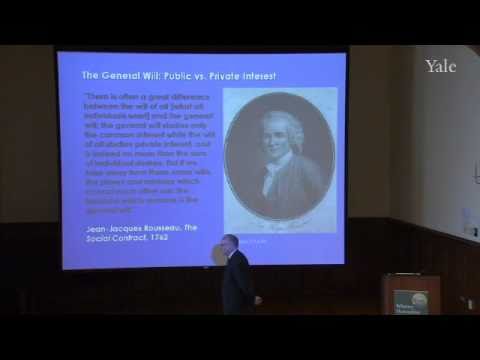
Shapiro asks why majority rule is widely treated as conferring legitimacy, prompting a student suggestion of a utilitarian justification. He then introduces Rousseau's distinction between the "will of all" (the mere sum of private preferences) and the "general will" (the common interest that remains once individual pluses and minuses cancel out), and notes how difficult it has been to give this idea any workable operational content.
Locke on Majority Rule (11:38)
The lecture presents Condorcet's paradox: with three voters and three options, pairwise majority votes can produce a cycle (A beats B, B beats C, C beats A), violating the transitivity we expect of rational preferences. Kenneth Arrow's 1951 theorem generalizes this result, and Gerald Kramer later showed that controlling the order of votes can produce almost any desired outcome, undermining the idea that majority rule reveals any coherent general will. Turning to Locke, Shapiro shows that, despite his reputation as a defender of individual rights, Locke justifies majority rule on realist grounds: once a community is formed, it must move as "the greater force carries it" or cease to act as one body. Shapiro reframes this as a form of negative utilitarianism aimed at limiting domination rather than identifying a true collective will.
Why does Majority Rule Limit the Possibility of Domination? (17:24)
A student connects Locke's argument to the earlier discussion of crosscutting cleavages: uncertainty about whether you will be in the majority or minority next time discourages domination now. Shapiro develops this with James Buchanan and Gordon Tullock's 1962 calculus for choosing decision rules: societies should weigh external costs (the risk of an unwanted decision being imposed) against decision-making costs (the time and effort of reaching agreement), favoring unanimity or supermajorities for very important questions and simple majority or delegation for less important ones. He then presents Brian Barry and Douglas Rae's critique: Buchanan and Tullock's model implicitly assumes agreement with the status quo as a starting point, which biases the whole calculus toward preserving it. Behind a genuine veil of ignorance about whether you favor the status quo, majority rule, not unanimity, minimizes the chance of an unwanted outcome being imposed on you.
Majority versus Unanimity Rule (25:55)
Shapiro consolidates the Rae-Barry argument as showing that majority rule, or something close to it, is the rule a self-interested person would choose behind a veil of ignorance, once the status quo is not given special privilege, since it best minimizes the chance of an unfavorable outcome being imposed.
Schumpeter: Non-dominant and Pluralist Competition (30:32)
The lecture turns to Joseph Schumpeter's Capitalism, Socialism and Democracy, which rejects the classical idea of a general will and instead defines democracy as "that institutional arrangement for arriving at political decisions in which individuals acquire the power to decide by means of a competitive struggle for the people's vote." Schumpeter's analogy maps voters onto consumers, parties onto firms, votes onto profits, and platforms and legislation onto products, with democratic legitimacy standing in for consumer sovereignty. What restrains political elites is the voters' ability to remove them. Shapiro extends this with the Hotelling-Downs median voter model, illustrating with the 1964 Goldwater and 1980 Reagan elections how parties converge toward where they believe the median voter sits, which can push competition toward personality rather than policy unless other forces, such as primaries, pull parties apart. He closes with several objections to the Schumpeterian model, including its oligopolistic character, its neglect of money in politics, its treatment of participation as pure cost, and its minimalism, illustrated by Samuel Huntington's "two turnover test" for calling a system a genuine democracy. Shapiro credits Locke with anticipating the model's most durable insight: linking majority rule to resisting domination.
Before you watch
- Review the previous lecture's discussion of Madison, factions, and crosscutting cleavages, since this lecture builds directly on those ideas.
- Recall the course's earlier discussion of transitivity and rational preference orderings, referenced in explaining Condorcet's paradox.
- Familiarity with basic supply-and-demand or market competition ideas will help with the Schumpeter analogy.
Check your understanding
- What does Condorcet's paradox show about the relationship between individually rational preferences and majority-rule outcomes?
- How does Locke's defense of majority rule differ from an argument that majority rule identifies the "general will"?
- What mistake do Rae and Barry identify in Buchanan and Tullock's argument for preferring unanimity on important questions?
- In Schumpeter's model, what plays the role of "consumer sovereignty" in democratic politics, and what disciplines political elites?
- Why does the median voter model predict that competing parties will converge on similar policies, and what can pull them apart?
Vocabulary
- general will (phrase)
- Rousseau's idea of a society's true common interest, distinct from the sum of individual wants.
The general will is supposed to remain after private interests cancel out. - paradox (noun)
- A situation that seems contradictory or logically impossible, yet occurs.
Condorcet's paradox shows majority voting can produce inconsistent results. - cyclical (adjective)
- Repeating in a loop, with no clear final winner.
Voting can produce cyclical preferences: A beats B, B beats C, C beats A. - transitivity (noun)
- The logical property that if A beats B and B beats C, then A must beat C.
Majority voting can violate transitivity. - theorem (noun)
- A statement proven to be true using logic or mathematics.
Arrow's theorem generalizes Condorcet's paradox. - agenda manipulation (phrase)
- Controlling the order in which options are voted on to influence the outcome.
Agenda manipulation can produce almost any result a controller wants. - realist (argument) (adjective)
- Based on practical necessity rather than an ideal or moral claim.
Locke's defense of majority rule is realist, not idealistic. - negative utilitarianism (phrase)
- A view focused on minimizing harm or domination, rather than maximizing overall happiness.
Shapiro reads Locke's argument as a form of negative utilitarianism. - domination (noun)
- The condition of being controlled or ruled over by another's arbitrary power.
Majority rule can help limit domination by any single group. - external cost (phrase)
- The cost imposed on you by a decision you didn't want.
Unanimity minimizes external costs but raises decision-making costs. - decision-making cost (phrase)
- The time and effort needed to reach agreement on a decision.
Requiring unanimity increases decision-making costs. - status quo (phrase)
- The way things currently are, before any change.
Buchanan and Tullock's model was biased toward the status quo. - median voter (phrase)
- The voter positioned exactly in the middle of the political spectrum.
Parties tend to converge on the position of the median voter. - converge (verb)
- To move toward the same point or position over time.
Competing parties tend to converge on similar platforms. - oligopolistic (adjective)
- Dominated by a small number of large competitors.
Critics call the two-party system oligopolistic, like a market with few firms. - consumer sovereignty (phrase)
- The idea that consumers, through their choices, ultimately control what is produced.
Democratic legitimacy is compared to consumer sovereignty in Schumpeter's model. - operational (adjective)
- Able to actually work or function in practice.
The general will has never been given operational meaning. - engineer (an outcome) (verb)
- To carefully plan and produce a specific result.
Controlling the vote order can engineer almost any outcome. - discipline (control) (verb)
- To control or restrain someone's behavior through rules or consequences.
Voters' ability to remove leaders disciplines political elites. - durable (insight) (adjective)
- Lasting a long time without losing value or relevance.
Locke's insight about resisting domination proved durable.
Chapters
- 0:00 Chapter 1. Introduction: Majority Rule and Democratic Competition
- 11:38 Chapter 2. Locke on Majority Rule
- 17:24 Chapter 3. Why does Majority Rule Limit the Possibility of Domination?
- 25:55 Chapter 4. Majority versus Unanimity Rule
- 30:32 Chapter 5. Schumpeter: Non-dominant and Pluralist Competition
From the YouTube description
Moral Foundations of Politics (PLSC 118)
Majority rule and democratic competition serve as the focus of this, second lecture on the democratic tradition. What it is about majority rule that confers legitimacy on collective decisions. Is there validity to a utilitarian justification, that catering to the wishes of the majority maximizes the happiness of the greatest number? Does majority rule reflect what Rousseau called the general will? What, even, is the general will? Does Arrow's paradox indicate that the results of voting are arbitrary? Is majority rule just an exercise in realpolitik? Professor Shapiro makes the point that crosscutting cleavages discussed on Monday are the key to unlocking majority rule and limiting the possibility of domination; although one may be in the majority today, the possibility of being in the minority tomorrow prevents tyranny. Several models of democracy are discussed: the public choice model of Buchanan and Tullock, Rae and Barry's critique of Buchanan and Tullock, Schumpeter's marketplace model, the Hotelling-Downs median voter theorem, and Huntington's two turnover test.
00:00 - Chapter 1. Introduction: Majority Rule and Democratic Competition
11:38 - Chapter 2. Locke on Majority Rule
17:24 - Chapter 3. Why does Majority Rule Limit the Possibility of Domination?
25:55 - Chapter 4. Majority versus Unanimity Rule
30:32 - Chapter 5. Schumpeter: Non-dominant and Pluralist Competition
This course was recorded in Spring 2010.
← 22. Democracy and Majority Rule (I) · 24. Democratic Justice: Theory →