Seyed Masoud Hosseini · Overview · Study log · Weekly summaries · Ideas · Search · Transcript · RSS feed
Moral Foundations of Politics · Lecture 17 of 25 · 51:47
17. Distributive Justice and the Welfare State
Study guide
What this lecture covers
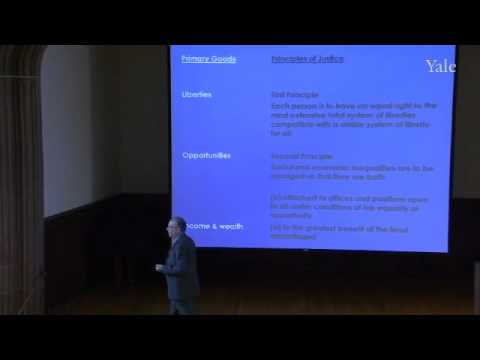
This lecture works through the second half of Rawls's theory of justice: how liberties, opportunities, and income and wealth are ranked and distributed. It picks up from an earlier class on the first principle (liberty) and moves into the two parts of the second principle, ending on the difference principle, Rawls's most debated idea.
By the end you should be able to state Rawls's lexical ranking of liberties, opportunities, and income and wealth, explain the difference principle in your own words, and describe both Shapiro's defense of it and the objections it runs into, including the problem of effort and desert.
Key ideas
- Lexical ranking: Rawls orders his values so that a higher-ranked value (liberty, then fair equality of opportunity, then income and wealth) can never be sacrificed to gain more of a lower-ranked one.
- Fair equality of opportunity: positions must be open to all, which rules out systems like apartheid or systematic pay discrimination by gender.
- Difference principle (maximin): income and wealth should be distributed to the greatest benefit of the least advantaged person, an idea borrowed from welfare economics' "maximin" rule.
- Grave risks argument: even in a generally prosperous society some people face severe deprivation, so you should plan as if you might be that person, even if the odds are low.
- Chain connection: Rawls's claim that helping the worst-off has knock-on benefits for everyone else; Shapiro treats this as an unconvincing add-on.
- Basic structure, not policy: Rawls's principles are meant to guide the design of institutions, not to settle specific policy trade-offs like a particular tax cut.
- Moral arbitrariness: differences between people, whether from nature or nurture, are matters of luck, so justice should not reward or punish people for them.
- The effort problem: if capacities are morally arbitrary, so is the capacity or will to work hard, which undercuts any attempt to say effort alone deserves reward.
Walkthrough
Principle of Justice I: Distribution of Liberties (0:00)
Shapiro recaps Rawls's shift away from measuring justice by utility toward a resourcist approach based on basic goods: liberties, opportunities, and income and wealth. He explains the lexical ranking that governs conflicts among these values and reviews the first principle, illustrated by the example of religious freedom: you compare the position of the worst-off person under different arrangements, such as a fundamentalist regime versus one with a disestablished church, and prefer whichever leaves the least advantaged person better off.
Fair Equality of Opportunity (4:46)
The lecture turns to the second principle's opportunity component, which Rawls numbers 2b despite it being logically prior to 2a. Fair equality of opportunity rules out systems that systematically disadvantage a group, such as apartheid-style job reservation or gender-based pay gaps. Shapiro connects this to the lexical ranking by discussing how a proposed affirmative-action remedy could conflict with liberties protected by the first principle, using the New Haven firefighters case as an example of that kind of dispute.
Incomes and Wealth (9:16)
Shapiro introduces the difference principle: income and wealth should go to the greatest benefit of the least advantaged. He traces it to the older welfare-economics idea of maximin, and explains why focusing on the worst-off person follows from the veil of ignorance. He then raises the hard case Rawls has to answer: what if a tiny gain for the poorest comes at a large cost to the middle class? Rawls's two responses are the grave-risks argument, that even low-probability severe deprivation matters enormously, and chain connection, the claim that helping the bottom eventually helps everyone. Shapiro finds grave risks only partly satisfying and treats chain connection skeptically, since it would collapse the difference between Rawls and utilitarianism. He also defends Rawls against the charge that the theory endorses any specific bad policy, arguing that Rawls is describing the basic structure of society, not giving marginal policy advice, and famously declines to choose between capitalism and socialism.
Incomes and Wealth: The Difference Principle (23:21)
Using a Pareto-style diagram with two people, A and B, Shapiro shows why the difference principle produces L-shaped indifference curves: you move toward equality and then only accept further changes that raise the position of whoever is worst off, since you don't know behind the veil of ignorance whether you'll be A or B. A student exchange clarifies that moving past equality in the wrong direction would just swap who counts as least advantaged, which the principle is designed to avoid.
Rawls, Bentham and Pareto Compared (33:59)
Shapiro compares the difference principle with Pareto improvements and Bentham's utilitarianism, showing that Rawls's principle contains the Pareto principle and overlaps with Bentham where a change benefits the least advantaged. He then presents what he sees as the theory's genuinely radical move: since differences between people, whether from genetics or upbringing, are morally arbitrary, justice should be indifferent to who ends up worst off. A classroom discussion pushes on this by raising effort: if two equally capable people choose differently, hard work versus leisure, shouldn't the hard worker deserve more? Shapiro shows that Rawls's own attempt to protect desert for effort fails, because the capacity or disposition to work hard is itself a matter of moral luck. He also distinguishes this argument from determinism and closes by noting the irony that Rawls's reasoning, if followed through, places him to the left of Marx, since Marx still cared about who produced what, while Rawls denies that production gives anyone a moral claim.
Before you watch
- Have Rawls's veil of ignorance and his first principle of equal basic liberties fresh, since this lecture builds directly on them.
- Recall the general conception of distributive justice from the previous class: distribute goods equally unless inequality benefits everyone.
- Be ready to think about Pareto improvements, since the lecture uses Pareto-style diagrams to explain the difference principle.
Check your understanding
- What does Rawls's lexical ranking require when two of his principles come into conflict?
- Why does the difference principle focus on the position of the least advantaged person rather than an average?
- What is the grave risks argument, and why does Shapiro call it only partly satisfying?
- Why does Rawls's attempt to preserve desert for effort fail, according to the classroom discussion?
- In what sense does Shapiro argue the difference principle is philosophically radical but not necessarily radical in its distributive consequences?
Vocabulary
- lexical ranking (phrase)
- An ordering where a higher-priority value can never be traded away for more of a lower one.
Rawls's lexical ranking puts liberty before income and wealth. - fair equality of opportunity (phrase)
- The principle that positions and jobs should be genuinely open to everyone, not blocked by discrimination.
Fair equality of opportunity rules out systems like apartheid. - difference principle (phrase)
- Rawls's rule that inequalities in income and wealth are just only if they benefit the least advantaged.
The difference principle allows inequality only if it helps the worst-off. - maximin (noun)
- A decision rule that chooses the option with the best worst-case outcome.
The difference principle is based on the maximin rule from welfare economics. - grave risk (phrase)
- A serious danger, even if the chance of it happening is small.
The grave-risks argument says you should plan for even unlikely severe deprivation. - chain connection (phrase)
- Rawls's claim that benefits to the worst-off also tend to benefit everyone else.
Chain connection suggests helping the poorest helps the whole society. - basic structure (phrase)
- The main institutions of a society, like its legal and economic system, rather than individual policies.
Rawls's principles guide the basic structure, not specific tax policy. - moral arbitrariness (phrase)
- The idea that differences between people from luck, nature, or upbringing have no moral significance.
Moral arbitrariness means talent shouldn't automatically earn extra reward. - desert (noun)
- What a person deserves as a result of their effort or actions.
The effort problem questions whether hard work really grounds desert. - affirmative action (phrase)
- Policies designed to increase opportunities for historically disadvantaged groups.
An affirmative-action remedy might conflict with basic liberties. - job reservation (phrase)
- A system that sets aside certain jobs exclusively for one group, often used to discriminate.
Apartheid used job reservation to exclude Black workers. - indifference curve (noun)
- A graph line showing combinations that give equal benefit, used here for two people's outcomes.
The difference principle produces L-shaped indifference curves. - L-shaped (adjective)
- Shaped like the letter L, with one flat and one vertical segment.
Rawls's difference principle creates L-shaped preference curves. - genetics (noun)
- The biological traits a person inherits from their parents.
Genetics is one source of the moral arbitrariness Rawls discusses. - upbringing (noun)
- The way a person is raised and cared for as a child.
Upbringing shapes talents just as much as genetics does. - determinism (noun)
- The view that all events, including choices, are fully caused by prior conditions.
Shapiro distinguishes moral arbitrariness from full determinism. - consolidate (verb)
- To combine several things into a single, more coherent whole.
Rawls consolidates liberty, opportunity and wealth into one theory. - trade-off (noun)
- A balance between competing goals where gaining one thing means giving up another.
The difference principle raises a hard trade-off case. - irony (noun)
- A situation with a surprising or contradictory twist to what's expected.
Shapiro notes the irony that Rawls ends up left of Marx. - endorse (verb)
- To publicly support or approve of an idea or plan.
Shapiro doesn't fully endorse the chain connection argument.
Chapters
- 0:00 Chapter 1. Principle of Justice I: Distribution of Liberties
- 4:46 Chapter 2. Principle of Justice IIb: Fair Equality of Opportunity
- 9:16 Chapter 3. Principle of Justice IIa: Incomes and Wealth
- 23:21 Chapter 4. Incomes and Wealth: The Difference Principle
- 33:59 Chapter 5. Incomes and Wealth: Rawls, Bentham and Pareto Compared
From the YouTube description
Moral Foundations of Politics (PLSC 118)
The main focus of today's discussion is Rawls's third, and most problematic, principle is the difference principle, which states that income and wealth is to be distributed "to the greatest benefit of the least advantaged individual." This stems from the logic that what is good for the least advantaged individual will be good for the second-least advantaged, and the third, and so on. But what if slightly benefiting the least advantaged person comes at a huge cost to others? Professor Shapiro explores Rawls's defense. It is important to note that Rawls is not trying to give marginal policy advice, or even determine whether socialism or capitalism benefits the least advantaged (which he leaves to empirics), but trying to determine the basic structure of society. However, Professor Shapiro shows that the difference principle is not necessarily radical in the redistributive sense when compared with Pareto or Bentham, but it is radical in a philosophical sense. Rawls argues that the differences between individuals are morally arbitrary--it's moral luck that determines the family one is born into, what country one is born in, or one's capacities. However, some of the consequences are unsavory. Although Rawls tries in vain to exclude what one chooses to make of one's capacities, could not effort, or capacity to work, fall into this sphere as well? What is to be said of two equally intelligent people, one of who works hard and gets A's while the other lies on the couch and watches ESPN all day?
00:00 - Chapter 1. Principle of Justice I: Distribution of Liberties
04:46 - Chapter 2. Principle of Justice IIb: Fair Equality of Opportunity
09:16 - Chapter 3. Principle of Justice IIa: Incomes and Wealth
23:21 - Chapter 4. Incomes and Wealth: The Difference Principle
33:59 - Chapter 5. Incomes and Wealth: Rawls, Bentham and Pareto Compared
This course was recorded in Spring 2010.
← Lecture 16: The Rawlsian Social Contract · 18. The 'Political-not-Metaphysical' Legacy →