Seyed Masoud Hosseini · Overview · Study log · Weekly summaries · Ideas · Search · Transcript · RSS feed
Moral Foundations of Politics · Lecture 14 of 25 · 47:19
Lecture 14: Rights as Side Constraints and the Minimal State
Study guide
What this lecture covers
This lecture continues Nozick's hypothetical social contract story from the previous lecture, tracing the path from the "ultra-minimal state" (a single dominant protective association) to the "minimal state" (the classical night-watchman state that does nothing but protect rights). It explains the deontological character of Nozick's argument, contrasting it with teleological theories like utilitarianism, and works through his most difficult chapter: how forcibly incorporating "independents" who refuse to join can be made legitimate through a hypothetical compensation test.
By the end, you should understand why Nozick's minimal state rejects redistribution, how his compensation argument tries to reconcile forced incorporation with a consent-based theory of legitimacy, why that compensation test runs into the same problem that decades of welfare economics could not solve, and why a student's objection in the discussion suggests the same reasoning that justifies the minimal state could also justify a much larger welfare state.
Key ideas
- Ultra-minimal to minimal state: once one protective association marginalizes its rivals, Nozick calls it the ultra-minimal state; forcing remaining independents to join produces the minimal, or night-watchman, state.
- Deontological vs. teleological: Nozick's rights-based theory (deontological, from Kant) treats rights as side-constraints on action, not as goals to be maximized, unlike utilitarianism (teleological).
- Deep pluralism of values: because people disagree fundamentally about redistribution, healthcare and similar policies, Nozick argues there is no basis for a state that goes beyond protecting rights.
- The compensation argument: Nozick claims that forcing independents to join is legitimate if, in principle, members could compensate independents for the rights violation and still be better off than living in fear, even though no actual payment occurs.
- Hypothetical compensation tests fail: decades of welfare economics (Kaldor, Hicks, Scitovsky, Samuelson) tried to devise a compensation test that avoided interpersonal comparisons of utility, and none succeeded, undermining Nozick's argument.
- "Ought entails can": Nozick's fallback argument is that since a state without any incorporation of independents is unavoidable given the natural monopoly of force, incorporating them is not illegitimate, only inevitable.
- Proving too much: a classroom objection suggests the same "compensation for fear" logic used to justify the minimal state could equally justify mandatory unemployment insurance or other welfare-state policies, undercutting Nozick's minimal conclusion.
Walkthrough
From ultra-minimal to minimal state (0:03)
The lecture recaps how competing protective associations converge into a single dominant one, the ultra-minimal state, and addresses a natural objection: if coercive force is a natural monopoly, why isn't there a single world government? The answer offered is that what counts as a viable "territory" for a monopoly of force depends on available military technology, illustrated with Bertrand Russell's post-Hiroshima call for world government and the practical limits later seen in Iraq.
Rights as side-constraints and deontological theory (9:15)
The lecture explains why the minimal state does not redistribute wealth: Nozick treats rights as side-constraints on action, not goals to be pursued, and grounds this in Kant's deontological ethics rather than in the consequences an action produces. Given genuine disagreement over values like whether to have a welfare state, Nozick argues there is no shared basis for going beyond protecting people from force and fraud.
The compensation argument for incorporating independents (16:23)
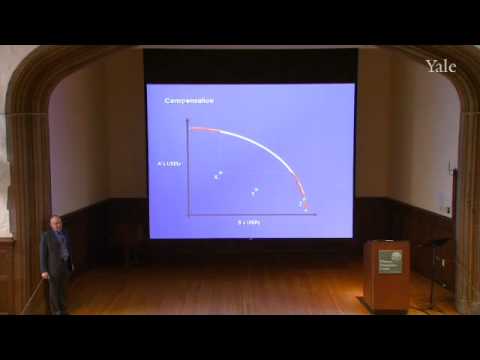
The lecture unpacks Nozick's central and most difficult move: since coercive force is a natural monopoly, the dominant protective association cannot tolerate independents like Timothy McVeigh or Osama bin Laden and will force them to join. To reconcile this with a consent-based theory of legitimacy, Nozick argues that if members could, in principle, compensate independents enough to offset the rights violation while remaining better off than living in fear, the forced incorporation is legitimate, even without actual payment.
Why the compensation test fails (22:31)
The lecture connects Nozick's compensation idea to a broader tradition in welfare economics that tried to find a way to call one social state better than another without making interpersonal comparisons of utility. It explains that every such compensation test ultimately relies on a common monetary metric, which itself involves interpersonal comparisons, so the project failed, and with it Nozick's attempt to justify incorporation without violating his own consent-based premises.
"Ought entails can" and its limits (28:50)
Facing this failure, the lecture presents Nozick's fallback: the Kantian principle that you cannot have a moral obligation to do the impossible. Since the natural monopoly of force makes tolerating independents impractical, their forced incorporation is treated as unavoidable rather than illegitimate. A student's objection in the discussion raises the deeper problem: the same reasoning, applied to fears like unemployment, could justify compulsory unemployment insurance or other welfare-state policies, suggesting Nozick's argument either fails to establish the minimal state or justifies far more than it intends.
Before you watch
- Watch the previous lecture, "Appropriating Locke Today," which introduces Nozick's hypothetical state of nature, protective associations, and the claim that coercive force is a natural monopoly.
- Recall the course's earlier discussion of the Pareto diagram and Pareto-undecidable outcomes, since the compensation argument is explained in those terms.
Check your understanding
- What is the difference between Nozick's ultra-minimal state and his minimal state, and what step moves you from one to the other?
- Why does Nozick call rights "side-constraints" rather than goals, and how does this distinguish his theory from utilitarianism?
- How does Nozick's compensation argument try to justify forcing independents to join the dominant protective association without abandoning consent as the basis of legitimacy?
- Why did decades of welfare economics fail to produce a compensation test that avoids interpersonal comparisons of utility, and what does that failure mean for Nozick's argument?
- How does the classroom objection about unemployment insurance suggest that Nozick's reasoning might justify more than just a minimal state?
Vocabulary
- ultra-minimal state (phrase)
- Nozick's term for a single dominant protective association that has pushed out its rivals.
The ultra-minimal state is one step before Nozick's full minimal state. - minimal state (phrase)
- A government limited to protecting people's rights, doing nothing more, such as redistribution.
Nozick argues only the minimal state can be justified. - night-watchman state (phrase)
- A government whose only job is protecting citizens from force, theft and fraud.
The night-watchman state does not provide welfare or public services. - side-constraint (phrase)
- A rule that limits what actions are allowed, rather than a goal to be maximized.
Nozick treats rights as side-constraints, not goals to pursue. - pluralism (noun)
- The existence of many different and sometimes conflicting values or viewpoints in society.
Deep pluralism of values means people disagree fundamentally about policy. - compensation (noun)
- Payment or benefit given to make up for harm or loss.
Nozick's compensation argument justifies incorporating independents. - compensate (verb)
- To pay or provide something to make up for a loss or harm.
Members could, in principle, compensate independents for their loss of freedom. - welfare economics (phrase)
- The branch of economics studying how to judge whether social outcomes are good or bad.
Decades of welfare economics tried to build a fair compensation test. - in principle (phrase)
- In theory, even if not actually done in practice.
Compensation only has to be possible in principle, not actually paid. - ought entails can (phrase)
- The principle that you can only be morally required to do something that is actually possible.
Nozick falls back on the idea that ought entails can. - fallback (argument) (noun)
- A backup argument used when the main one runs into trouble.
Nozick's fallback is that incorporation is simply unavoidable. - prove too much (idiom)
- When an argument's logic would also justify conclusions the arguer didn't intend.
A student argues Nozick's reasoning proves too much and justifies welfare policy. - unemployment insurance (phrase)
- A government program paying benefits to people who lose their jobs.
The same logic used for the minimal state might justify unemployment insurance. - metric (noun)
- A standard of measurement used to compare things.
Compensation tests need a common monetary metric. - sidestep (verb)
- To avoid dealing with a problem directly.
Nozick tries to sidestep the interpersonal comparison problem. - marginalize (verb)
- To push something to the edge, reducing its power or importance.
The dominant protective association marginalizes its competitors. - reconcile (verb)
- To make two conflicting ideas or facts fit together.
Nozick tries to reconcile force with consent-based legitimacy. - practical (limits) (adjective)
- Related to what is actually workable, given real-world conditions.
Available technology sets the practical limits on a territory of force. - tolerate (verb)
- To accept or allow something without opposing it.
A dominant association cannot tolerate armed independents. - residual (problem) (adjective)
- Remaining after most of something has been dealt with.
A residual problem of legitimacy remains even after incorporation.
Chapters
- 0:00 Chapter 1. Evolution of the State without Rights Violations
- 15:50 Chapter 2. Nozick's Theory of the Only Legitimate State
- 20:57 Chapter 3. A Compensation Test That Is Compatible with the Pareto System
- 23:17 Chapter 4. Neoclassical Utilitarianism: The Pareto Diagram
From the YouTube description
Moral Foundations of Politics (PLSC 118)
Today, Professor Shapiro dives more deeply into Robert Nozick's theory of the minimal, or night watchman, state. This formulation is not redistributive, nor does it consider rights as goals, but rather as side-constraints on what we can do. In other words, Nozick's is a deontological, not teleological, approach. However, the Achilles' heel of this formulation is the incorporation of independents, based on a system of compensation. Some people will opt not to enter into our hypothetical social contract, but for the dominant protective association to protect its members from the fear of these independents, they must be forced to incorporate. Nozick thinks that if members could compensate the independents for this rights violation, it would legitimize the state. Unfortunately, no one has ever solved the puzzle of compensation without some interpersonal comparison of utility. But another way to salvage Nozick's account is with the Kantian dictum "ought entails can," meaning that since independents cannot be tolerated, it cannot be an obligation not to violate their rights. But what if the independents could compensate the members for their fear? And couldn't this compensation model be used to justify the welfare state as well? Isn't the value of consent, in which Nozick's account is rooted, completely violated here?
00:00 - Chapter 1. Evolution of the State without Rights Violations
15:50 - Chapter 2. Nozick's Theory of the Only Legitimate State
20:57 - Chapter 3. A Compensation Test That Is Compatible with the Pareto System
23:17 - Chapter 4. Neoclassical Utilitarianism: The Pareto Diagram
This course was recorded in Spring 2010.
← Lecture 13: Appropriating Locke Today · Lecture 15: Compensation versus Redistribution →