Seyed Masoud Hosseini · Overview · Study log · Weekly summaries · Ideas · Search · Transcript · RSS feed
Death · Lecture 10 of 26 · 49:50
Lecture 10: Personal identity and the soul theory
Study guide
What this lecture covers
Having concluded that Plato's arguments for the soul fail, Kagan now turns to the course's second big question: not what a person is made of, but what it takes for a person to survive over time, including possibly past death. He builds up the needed concepts gently, starting with everyday examples like a train and a car, before applying them to personal identity and to the "soul view," according to which having the same soul is what makes you the same person over time.
After watching, you should be able to explain the difference between an object-stage and an extended-through-time object, state what the soul theory says the "glue" of personal identity is, and explain why John Locke thought that view had an implausible consequence.
Key ideas
- Two questions about death: first, what am I made of (addressed in prior lectures on dualism and physicalism); second, what does it take for me to survive, including possibly the death of my body.
- Survival as sameness over time: to survive until Tuesday is for there to be a person on Tuesday who is the very same person as the one here today, not merely a person who resembles them.
- Stages vs. the whole object: the train example (caboose vs. locomotive) shows that pointing to different parts or moments of a thing does not mean you're talking about different things; a 'stage' or 'slice' is not the same as the entire object extended through space or time.
- Space-time worms: philosophers describe an object extended through both space and time as a 'space-time worm'; car stages or person stages are slices of that worm.
- Metaphysical glue: the key question for identity over time is what connects different stages into one and the same space-time worm; for cars, it is roughly being the same continuous hunk of matter, even as individual atoms or parts are replaced.
- The soul theory of personal identity: on this view, the key to being the same person over time is having the same soul; if the soul persists after bodily death, the person survives death.
- Locke's objection: if personal identity depends entirely on having the same soul, and souls are undetectable, there would be no way to ever know whether you are the same person as yesterday, since a soul-swap with identical memories would be undetectable, which Locke found an implausible consequence.
- The objection targets the soul theory, not the soul's existence: even if souls exist, this argument suggests sameness of soul might not be what actually matters for personal identity.
Walkthrough
Introduction and the two basic questions (0:00)
Kagan recaps his decision to proceed on physicalist assumptions and reframes the course's second major question: given what a person is made of, what does it take for that thing to survive over time? He illustrates with the simple case of surviving the weekend, and stresses that the question is not about superficial changes, like hair or wrinkles, but about whether the future person really is the very same extended-through-time individual as the present one.
The train metaphor for identity across space (1:39)
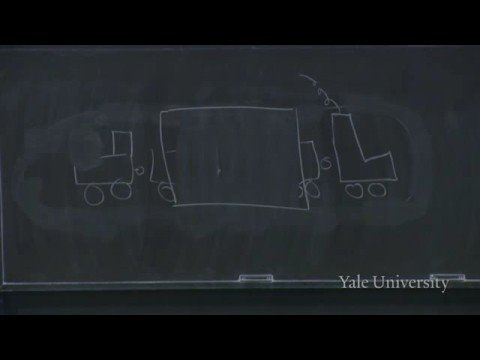
Kagan uses a train, seen first at the caboose and later at the locomotive, to show that pointing to different parts does not mean picking out different things: both times you are picking out the same extended object, the whole train. He extends the example with a train partly hidden behind a warehouse, showing that whether it's one train or two depends on facts that may not be visible, introducing the idea that identity claims can be uncertain even when meaningful.
The aging car and space-time worms (14:04)
Kagan shifts from spatial extension to temporal extension using his own car, tracked from 1990 through 2006. He introduces the term 'space-time worm' for an object extended through both space and time, and 'stages' or 'slices' for its momentary parts. He proposes that for cars, the relevant 'metaphysical glue' connecting stages into one worm is being the same continuous hunk of matter, even though individual parts like tires or a steering wheel can be replaced along the way.
Applying the framework to personal identity (30:36)
Kagan applies the stage/worm distinction to people: asking whether a person in 2050 is 'Shelly Kagan' is not asking whether that stage resembles his current stage, but whether it belongs to the same extended-through-time person. He reframes the question of surviving death as asking whether some future person-stage could belong to the same space-time worm as the present stage, which depends on identifying the correct metaphysical glue for personal identity.
The soul theory and Locke's objection (46:28)
Kagan presents the natural dualist proposal: the key to personal identity is having the same soul, which is what makes surviving bodily death conceivable at all. He then presents a thought experiment: if God secretly swapped your soul overnight while preserving all your memories and beliefs, the soul theory implies you would no longer be the same person, yet there would be no possible way to detect this. He attributes to John Locke the worry that this consequence is too implausible to accept, which raises doubts about whether sameness of soul is really what personal identity consists in, even if souls exist.
Before you watch
- Review the previous two lectures, where Kagan concludes that Plato's arguments for the soul fail and adopts physicalism as a working assumption for the rest of the course.
- Recall the basic distinction between dualism and physicalism about what a person is made of, since this lecture builds on it to ask what personal survival requires.
Check your understanding
- Explain, using the train example, why pointing to different parts of an object at different times does not automatically mean you're pointing to different objects.
- What does it mean to call an object a 'space-time worm,' and how does this differ from talking about its 'stages'?
- What, according to Kagan, is the 'metaphysical glue' that makes different car stages part of the same car?
- State the soul theory of personal identity in your own words.
- Explain Locke's thought experiment about a nightly soul-swap and why he thought it was too implausible to accept.
Vocabulary
- personal identity (noun)
- The question of what makes someone the same person over time.
Personal identity is the course's second major question. - survive (verb)
- To continue existing as the same thing over time.
The question is whether a person can survive their own death. - resemble (verb)
- To look or be similar to something else.
Surviving means being the same person, not just one who resembles you. - extended (through time) (adjective)
- Stretching out continuously across a period of time.
A person is an object extended through time. - stage (noun)
- A single moment or slice of an object's existence.
The caboose and locomotive are stages of the same train. - space-time worm (noun)
- A philosophical term for an object considered as extended through both space and time.
A person is a kind of space-time worm. - metaphysical glue (noun)
- Whatever connects different stages into one continuous object.
The metaphysical glue for a car is being the same continuous matter. - continuous (adjective)
- Unbroken, without gaps, over time or space.
The car remains the same continuous hunk of matter. - soul theory (noun)
- The view that having the same soul is what makes you the same person over time.
The soul theory says personal identity depends on the soul. - implausible (adjective)
- Hard to believe or unlikely to be true.
Locke found the soul-swap consequence implausible. - undetectable (adjective)
- Impossible to notice or measure.
A soul-swap would be completely undetectable. - thought experiment (noun)
- An imagined scenario used to test an idea through reasoning.
Locke uses a thought experiment about a nightly soul-swap. - caboose (noun)
- The last car of a train.
Kagan uses the caboose and locomotive as an example. - locomotive (noun)
- The front engine car of a train that pulls the rest.
The locomotive pulls the whole train. - slice (noun)
- A single moment or thin section of something extended over time.
A stage is a slice of a space-time worm. - superficial (adjective)
- Relating only to surface appearance, not deep or essential features.
Superficial changes like hair color do not affect identity. - framework (noun)
- A basic structure used to organize ideas or analysis.
Kagan applies the stage and worm framework to people. - consequence (noun)
- A result or effect that follows from something.
Locke found the consequence too implausible. - hidden (behind an object) (adjective)
- Blocked from view by something in front of it.
The train partly hidden behind a warehouse raises a puzzle. - identify (recognize) (verb)
- To recognize something as being a specific, particular thing.
We must identify the correct metaphysical glue for people.
Chapters
- 0:00 Chapter 1. Introduction
- 1:39 Chapter 2. What Does It Mean to Survive? The Train Metaphor
- 14:04 Chapter 3. The Aging of a Car and Space-Time Worms
- 30:30 Chapter 4. Will I Survive My Death? The Dualist's Soul as the Metaphysical Glue
- 46:28 Chapter 5. Is the Soul Truly the Key to Personal Identity?
From the YouTube description
Death (PHIL 176)
The lecture focuses on the question of the metaphysical key to personal identity. What does it mean for a person that presently exists to be the very same person in the future? The first approach to answering this question is the "soul theory," that is, the key to being the same person is having the same soul. Difficulties with that approach are then discussed, independent of the question whether souls exist or not.
00:00 - Chapter 1. Introduction
01:39 - Chapter 2. What Does It Mean to Survive? The Train Metaphor
14:04 - Chapter 3. The Aging of a Car and Space-Time Worms
30:30 - Chapter 4. Will I Survive My Death? The Dualist's Soul as the Metaphysical Glue
46:28 - Chapter 5. Is the Soul Truly the Key to Personal Identity?
This course was recorded in Spring 2007.
← Lecture 9: Why Plato's soul arguments fail, and the turn to physicalism · Lecture 11: The body theory and the personality theory of identity →