Seyed Masoud Hosseini · Overview · Study log · Weekly summaries · Ideas · Search · Transcript · RSS feed
Matrix Methods for Data Analysis & ML · Lecture 10 of 36 · 49:21
Lecture 8: Norms of Vectors and Matrices
Study guide
What this lecture covers
This lecture is a systematic tour of norms, ways to measure the size of a vector, matrix, or function. Strang reviews the Lp family of vector norms (L1, L2, L-infinity, and the problematic L0), then builds geometric intuition by drawing the unit ball of each: a diamond, a circle, and a square in two dimensions. He uses this picture to explain why minimizing in the L1 norm tends to produce sparse solutions, a fact central to compressed sensing.
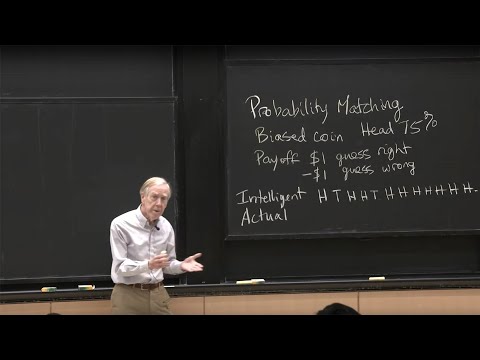
The lecture then extends these ideas to matrices, revisiting the spectral (L2), Frobenius, and nuclear norms from the previous lecture and showing how each connects to a vector norm of the singular values. It opens with an aside about a probability puzzle from a colleague's talk and closes with a research conjecture linking neural network training to the nuclear norm. After watching you should be able to sketch the unit ball for the L1, L2, and L-infinity norms, explain why L1 minimization favors sparse solutions, and state how each matrix norm relates to the singular values.
Key ideas
- The Lp family of vector norms:
||v||_p = (sum of |v_i|^p)^(1/p); L2 is ordinary length, L1 is the sum of absolute values, and L-infinity is the largest entry, with L0 (the count of nonzero entries) not being a true norm since it fails to scale with the vector. - Unit ball shapes: the set of vectors with norm 1 is a diamond for L1, a circle for L2, and a square for L-infinity; these shapes are convex, while the L0 "unit ball" and any
p < 1case are not. - L1 favors sparsity: minimizing the L1 norm subject to a linear constraint tends to land on a solution with more zero components than minimizing L2, because the diamond's corners touch the axes first as the norm grows from the origin.
- Weighted (S) norm: for a positive definite symmetric matrix
S,sqrt(v^T S v)defines a valid norm whose unit ball is an ellipse; using the identity matrix forSrecovers the ordinary L2 norm. - Matrix 2-norm from vector norms: the matrix 2-norm is defined as the maximum ratio
||Ax|| / ||x||over all vectorsx, and this maximum equals the largest singular valueσ1, achieved atx = v1, the first right singular vector. - Frobenius and nuclear norms revisited: the Frobenius norm equals the square root of the sum of the squares of all singular values, and the nuclear norm equals the sum of the singular values; both are unchanged by multiplying by an orthogonal matrix, since orthogonal matrices preserve norms.
- Nuclear norm and deep learning: a research conjecture mentioned in the lecture proposes that gradient descent training of certain neural networks, which have far more weights than data samples, tends to select the solution that minimizes the nuclear norm among all solutions achieving the same loss.
Walkthrough
The Lp family and unit-ball geometry (4:06)
Strang reviews the L2, L1, and L-infinity vector norms, then explains why the L0 norm (counting nonzero entries) fails to be a true norm since doubling a vector doesn't double this count. Plotting the set of unit-norm vectors in 2D for each case produces a circle (L2), a diamond (L1), and a square (L-infinity), and Strang notes that as p decreases toward 1 these shapes remain convex, while going below p = 1 produces a non-convex shape that violates the triangle inequality.
Why L1 minimization gives sparse solutions (22:33)
Using a simple constrained minimization problem, find the point on a given line closest to the origin, Strang compares the L2 winner (the ordinary nearest point) to the L1 winner (found by growing the diamond from the origin until it first touches the line). The L1 solution lands exactly on an axis, meaning one of its components is zero, illustrating in two dimensions why L1 minimization favors sparse vectors more generally.
Weighted norms and the S norm (17:30)
Strang defines a norm built from a positive definite symmetric matrix S, sqrt(v^T S v), the same energy expression from earlier lectures, now used as a norm. Its unit ball is an ellipse whose axis lengths depend on the entries of S, and choosing S as the identity matrix recovers the ordinary L2 norm as a special case.
Matrix norms and the singular values (31:55)
Strang defines the matrix 2-norm as the maximum blow-up factor ||Ax|| / ||x|| over all vectors x, and shows this maximum is achieved at x = v1, the first right singular vector, giving ||Av1|| / ||v1|| = σ1. He then revisits the Frobenius norm, showing it equals the square root of the sum of the squares of the singular values (using that orthogonal matrices don't change the norm to simplify A = UΣV^T down to Σ alone), and the nuclear norm as the sum of the singular values, an L1-type norm applied to the vector of singular values.
Before you watch
- Watch Lecture 6 on the singular value decomposition and Lecture 7 on matrix norms and the Eckart-Young theorem first, since this lecture builds directly on the spectral, Frobenius, and nuclear norms introduced there.
- Familiarity with positive definite matrices and the energy function
v^T S vfrom Lecture 5 is assumed for the weighted norm section.
Check your understanding
- Why does the L0 "norm" fail to satisfy the scaling property required of a true norm?
- What shape is the unit ball for the L1 norm in two dimensions, and why does that shape lead to sparse minimizers?
- How is the matrix 2-norm defined in terms of vector norms, and why does it equal the largest singular value?
- How does the Frobenius norm of a matrix relate to its singular values?
- What does the S-norm
sqrt(v^T S v)reduce to whenSis the identity matrix, and what shape does its unit ball take for a general positive definiteS?
Vocabulary
- systematic (adjective)
- Organized and done according to a clear plan or method.
This lecture is a systematic tour of norms. - norm (noun)
- A way to measure the size of a vector, matrix, or function using a single positive number.
The L2 norm is the most common way to measure length. - Lp norm (noun)
- A family of norms defined by raising entries to the power p, summing, then taking the p-th root.
L1, L2, and L-infinity are all members of the Lp family. - absolute value (noun)
- The distance of a number from zero, ignoring its sign.
The L1 norm sums the absolute values of the entries. - unit ball (noun)
- The set of all points with norm exactly equal to 1.
The unit ball for the L1 norm is shaped like a diamond. - convex (adjective)
- Curved so a straight line between any two points inside the shape stays inside it.
Every Lp unit ball with p at least 1 is convex. - triangle inequality (noun)
- The rule that the length of one side of a triangle is never more than the sum of the other two.
A true norm must satisfy the triangle inequality. - sparsity (noun)
- The property of having mostly zero values.
L1 minimization is known for producing sparsity. - compressed sensing (noun)
- A technique that reconstructs a signal from very few measurements by assuming it is sparse.
Sparsity is central to compressed sensing. - constrained minimization (noun)
- The task of finding the smallest value of something while requiring another condition to hold.
Finding the closest point on a line to the origin is a constrained minimization problem. - weighted norm (noun)
- A norm that treats some directions as more important than others, using a matrix.
The S-norm is a weighted norm built from a positive definite matrix. - ellipse (noun)
- An oval shape, like a stretched circle.
The unit ball of a weighted norm is an ellipse. - blow-up factor (noun)
- How much bigger the output of a matrix multiplication is compared to the input.
The matrix 2-norm is the largest possible blow-up factor. - spectral norm (noun)
- A matrix norm equal to its largest singular value.
The spectral norm equals sigma1. - gradient descent (noun)
- A training method that repeatedly moves parameters in the direction that reduces error the fastest.
Gradient descent trains many modern neural networks. - neural network (noun)
- A computer model made of connected layers that learns patterns from data.
A research conjecture links neural network training to the nuclear norm. - conjecture (noun)
- An idea believed to be true but not yet fully proven.
The link between deep learning and the nuclear norm is still a conjecture. - scale (a vector) (verb)
- To multiply a vector by a number, making it bigger or smaller.
Doubling a vector should double its norm. - axis (noun)
- A reference line used to measure or plot values.
The ellipse has axes of different lengths. - blow-up (noun)
- An increase in size caused by an operation.
The matrix norm measures the maximum blow-up factor.
Chapters
- 0:00 <Untitled Chapter 1>
- 6:31 Lp Norm
- 7:31 Zero Norm
- 9:18 Geometry of a Norm
- 21:09 Weighted Norm
- 32:09 Matrix Norms
- 33:05 Two Norm of a Matrix
- 34:27 Matrix Norm
- 35:15 Norms of Matrices
- 43:34 Nuclear Norm
- 46:27 The Nuclear Norm
- 46:48 Nuclear Norm
From the YouTube description
MIT 18.065 Matrix Methods in Data Analysis, Signal Processing, and Machine Learning, Spring 2018
Instructor: Gilbert Strang
View the complete course: https://ocw.mit.edu/18-065S18
YouTube Playlist: https://www.youtube.com/playlist?list=PLUl4u3cNGP63oMNUHXqIUcrkS2PivhN3k
A norm is a way to measure the size of a vector, a matrix, a tensor, or a function. Professor Strang reviews a variety of norms that are important to understand including S-norms, the nuclear norm, and the Frobenius norm.
License: Creative Commons BY-NC-SA
More information at https://ocw.mit.edu/terms
More courses at https://ocw.mit.edu
← Lecture 7: Eckart-Young, the Closest Rank k Matrix to A · Lecture 9: Four Ways to Solve Least Squares Problems →