Seyed Masoud Hosseini · Overview · Study log · Weekly summaries · Ideas · Search · Transcript · RSS feed
Machine Learning Compilation · Lecture 3 of 8 · 1:06:57
Episode 3: TensorIR Case Study
Study guide
What this lecture covers
This lecture is a deep, hands-on dive into TensorIR, TVM's tensor program abstraction, using a matrix-multiplication-plus-ReLU example throughout. It answers a practical question left open in Episode 2: what does a real tensor program abstraction look like in detail, and how does its extra structure (the "block" concept) let a compiler safely and automatically transform loop code into faster variants?
The lecture builds a low-level NumPy reference implementation first, then shows the equivalent TVMScript/TensorIR code side by side, explaining blocks and block axis properties. It then performs live schedule transformations, split, reorder, compute_at, and decompose_reduction, building toward a version that runs more than five times faster, and explains why through CPU cache behavior. After watching, you should be able to read TensorIR code, understand what block axes declare, and explain why loop order affects performance.
Key ideas
- Low-level NumPy: a restricted style of NumPy using explicit loops and pre-allocated arrays instead of vectorized calls, used here as a bridge to understanding low-level tensor program code.
- TensorIR / TVMScript: TVM's tensor program abstraction, written in a Python-embedded syntax, that represents the same computation as low-level NumPy but with explicit buffers, loops and blocks.
- Block: a TensorIR construct (
T.block) that encapsulates a self-contained unit of computation, declaring which regions of memory it reads and writes. - Block axis (
vi,vj,vk): declarations binding loop iterators to a block's computation, each marked as either spatial (independent across iterations, like output row/column indices) or reduction (accumulated across iterations, like the summed dimension in a matmul). T.axis.remap: shorthand (vi, vj, vk = T.axis.remap("SSR", [i, j, k])) for declaring multiple block axes and their spatial/reduction properties at once.- Schedule: a TVM object (
tvm.tir.Schedule) used to apply transformations such assplit,reorder,compute_atanddecompose_reductionto a block's loops without rewriting the program by hand. - IRModule: a container holding a collection of tensor primitive functions (
PrimFuncs), inspected and transformed as a unit. - Cache locality: reordering loops changes memory access strides; accessing nearby elements in sequence keeps data in the CPU's L1/L2 cache, which the lecture shows can produce a measured 5x-plus speedup.
Walkthrough
Recap and the running example (1:03)
The lecture recaps the MLC process as transforming tensor functions across abstractions, then introduces the example used throughout: matrix multiply Y = A @ B followed by C = relu(Y), chosen because it resembles a linear-plus-ReLU layer in a neural network.
Building a low-level NumPy reference (5:44)
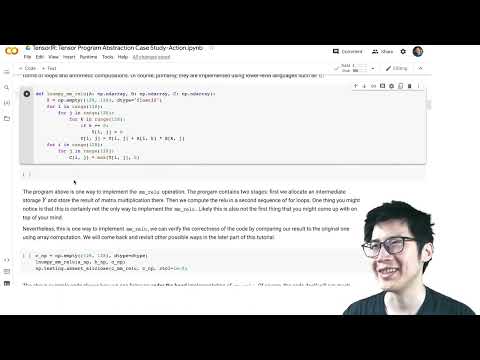
Starting from plain NumPy (A @ B, then np.maximum), the lecture asks what happens "under the hood" and writes an explicit low-level NumPy version: pre-allocated buffers, explicit triple-nested loops for the matmul reduction, and a separate loop for the ReLU, validated against the NumPy result with np.testing.assert_allclose.
TensorIR and the block concept (13:17)
Placing the TVMScript implementation next to the low-level NumPy code, the lecture maps each element: T.Buffer arguments correspond to the NumPy function arguments, T.alloc_buffer to the intermediate array, and T.grid loops to the explicit for-loops. It then focuses on the new construct with no NumPy equivalent: the block, which declares its axes (vi, vj, vk) as spatial or reduction, encoding which iterations are independent (safe to reorder or parallelize) and which must be accumulated in a fixed order.
Inspecting IRModules and PrimFunc (31:28)
The lecture shows that a TensorIR module is typed as IRModule, a container that can hold multiple PrimFuncs (for example, separate matmul and ReLU functions), and demonstrates retrieving individual functions by name.
Transforming the schedule step by step (39:33)
Using tvm.tir.Schedule, the lecture retrieves the compute block and its loops, applies split to divide the j loop into j0/j1, applies reorder to move j0 between the outer loops and k, then applies compute_at to move the ReLU computation inside the j0 loop, and finally decompose_reduction to separate the matmul's zero-initialization from its accumulation update. Each step is compared against a matching low-level NumPy variant.
Building, running and measuring performance (53:50)
The transformed IRModule is compiled with tvm.build(mod, target="llvm"), run on tvm.nd.array inputs, and validated for correctness. Timing both the original and transformed schedules shows the transformed version runs more than five times faster despite only reordering loops, which the lecture attributes to memory access patterns.
Why loop order matters: cache locality (56:06)
The lecture explains CPU cache hierarchy (L1, L2, main memory) and their large latency differences, then shows that the transformed loop order accesses Y and B in contiguous four-element stripes, keeping recently used data in cache, while the original order jumps across memory with a stride of 128 elements, causing frequent cache misses.
Constructing TensorIR from tensor expressions (1:01:08)
As an alternative to hand-writing TVMScript, the lecture shows the tensor expression (TE) domain-specific language, using te.placeholder and te.compute with a lambda describing each output element, then te.create_prim_func to generate the same TensorIR function automatically.
Before you watch
- Watch Episodes 1 and 2 first; this lecture assumes familiarity with tensors, tensor functions and the general tensor program abstraction.
- Comfort reading NumPy array code and nested loops is necessary to follow the low-level NumPy comparisons.
- A basic idea of CPU cache hierarchy is helpful but not required, since the lecture explains it directly.
Check your understanding
- What does it mean for a block axis to be marked "spatial" versus "reduction," and why does that distinction matter for parallelization?
- In the TVMScript code, what information does a block declare that a plain low-level NumPy loop does not?
- What sequence of schedule operations transformed the original matmul-plus-ReLU program into the faster version, and what did each step change?
- Why did reordering the loops produce a measured performance improvement, according to the cache locality explanation?
- What is
te.computeused for, and how does it relate to writing TensorIR by hand in TVMScript?
Vocabulary
- hands-on (adjective)
- Involving direct practice, not just theory.
This is a hands-on walkthrough of writing tensor programs. - case study (noun)
- A detailed example used to explain a general idea in practice.
The matmul-plus-ReLU example is a case study of TensorIR. - block (noun)
- A self-contained unit of computation that declares what memory it reads and writes.
Each block in TensorIR clearly states its inputs and outputs. - block axis (noun)
- A label that binds a loop variable to a block and marks it as independent or accumulated.
The block axis vi marks the output row as independent across iterations. - reduction (noun)
- Combining many values into one, usually by adding them together.
Summing over k in a matmul is a reduction. - pre-allocate (verb)
- To reserve memory space before starting a computation, instead of creating it as you go.
The low-level version pre-allocates the output array first. - validate (verb)
- To check that a result is correct.
The result was validated against the plain NumPy version. - encapsulate (verb)
- To wrap something so its inner details are hidden and self-contained.
A block encapsulates one unit of computation. - iterator (noun)
- A variable that changes value to step through a loop.
The iterators i, j and k step through the rows, columns and sum. - compute_at (noun)
- A scheduling command that moves one computation to run inside another loop.
compute_at moves the ReLU step inside the matmul's loop. - decompose (verb)
- To break a step into smaller separate parts.
The reduction is decomposed into an initialization step and an update step. - cache locality (noun)
- How close together in memory the data a program accesses tends to be, which affects speed.
Good cache locality made the transformed program much faster. - contiguous (adjective)
- Placed next to each other in memory without gaps.
Accessing contiguous memory is much faster than jumping around. - stride (noun)
- The distance in memory between one accessed element and the next.
A large stride causes the program to jump across memory and slow down. - cache miss (noun)
- When the CPU needs data that isn't in its fast cache memory and must fetch it more slowly.
Jumping around memory caused many cache misses. - container (noun)
- An object that holds a group of other items together.
An IRModule is a container that holds several tensor functions. - domain-specific language (noun)
- A small programming language designed for one particular kind of task.
Tensor expression is a domain-specific language for describing computations. - placeholder (noun)
- A stand-in value that marks where real data will go later.
te.placeholder creates a stand-in for the input tensor. - generate (verb)
- To automatically produce something, like code, rather than writing it by hand.
te.create_prim_func can generate a TensorIR function automatically. - matrix multiply (noun)
- An operation that combines two matrices to produce a new matrix.
The running example throughout is matrix multiply plus ReLU.
Chapters
- 0:00 <Untitled Chapter 1>
- 5:42 Matrix Multiplication
- 17:15 Loops
- 22:43 Axis Properties
- 30:52 Functional Attributes
- 50:33 Decomposed Reduction
- 57:33 Key Takeaways
- 58:15 Loop Patterns
- 1:06:34 Summary
From the YouTube description
In the third lecture for Machine Learning Compilation, CMU professor Tianqi Chen covers a case study in tensor program abstraction with TensorIR. The primary purpose of tensor program abstraction is to represent loops and corresponding hardware acceleration choices such as threading, use of specialized hardware instructions, and memory access. TensorIR is a brand new low-level intermediate representation with full scheduling support for Apache TVM. You will learn how blocks, the basic unit of computation in TensorIR, generalize the high-dimension tensor expressions. Tianqi will cover several code examples to give you insights into how TensorIR works internally and how it performs transformations of primitive tensor functions.
Episode 3 Notes: https://mlc.ai/chapter_tensor_program/case_study.html
Episode 3 Notebook, Tensor Program Abstraction Case Study: TensorIR: https://github.com/mlc-ai/notebooks/blob/main/3_TensorIR_Tensor_Program_Abstraction_Case_Study_Action.ipynb
Episode 3 Exercises for TensorIR: https://mlc.ai/chapter_tensor_program/tensorir_exercises.html
What is ML Compilation?
As the first course of its kind in the world for ML compilation, in this series CMU professor Tianqi Chen introduces why AI training and inference workloads need ML compilation to transform and optimize ML models from their development state in frameworks like PyTorch and TensorFlow to their deployment form on CPUs and GPUs. MLC helps solve the problem of combinatorial explosion of ML models and deployment hardware platforms.
This course is targeted not just for for undergraduate and graduate students but also people putting ML to use - data scientists, ML engineers and hardware providers. It covers ML programming abstractions, learning-driven search, compilation, and optimized library runtimes. These themes form a new field of ML systems – machine learning compilation.
In this course, we offer the first comprehensive treatment of its kind to study key elements of this emerging field systematically. We will learn the key abstractions to represent machine learning programs, automatic optimization techniques, and approaches to optimize dependency, memory, and performance in end-to-end machine learning deployment. By completing this course, you will learn how to apply the latest developments in ML compilation to build models that can be optimized for emerging hardware stacks. This let you deploy your models efficiently - minimizing memory usage, reducing inference latency and scaling to multiple heterogeneous hardware nodes.
Full course schedule: https://mlc.ai/summer22/schedule
Instructors:
- Tianqi Chen with Hongyi Jin (TA), Siyuan Feng (TA) and Ruihang Lai (TA)
← Episode 2: Tensor Program Abstraction · Episode 4: Build End to End Models →