Seyed Masoud Hosseini · Overview · Study log · Weekly summaries · Ideas · Search · Transcript · RSS feed
Blockchain & Money · Lecture 9 of 23 · 1:21:22
9. Permissioned Systems
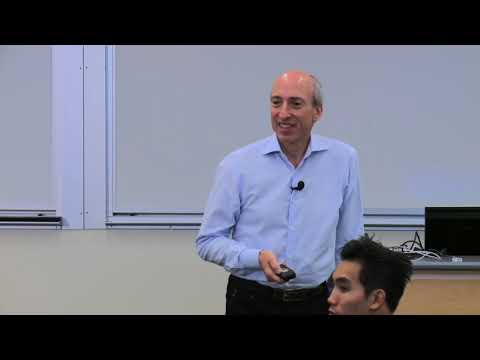
Study guide
What this lecture covers
This lecture, taught as a discussion, asks what separates permissioned (private) blockchains such as Hyperledger and Corda from permissionless chains like Bitcoin and Ethereum, and from ordinary traditional databases. It follows earlier lectures on blockchain fundamentals and the Buterin trilemma of decentralization, scalability, and security, extending that framework to a business setting.
After watching, you should be able to list the technical features that permissioned and permissionless systems share (append-only logs, cryptographic hashing, distributed ledgers), name what separates them (the consensus mechanism and whether writing is open or restricted), and reason about when a business problem calls for a blockchain solution at all versus a conventional client-server database.
Key ideas
- Permissioned blockchain: a distributed ledger where only an authorized, limited set of nodes can validate and write transactions, trading openness for scalability and privacy.
- Consensus mechanism as the key difference: both blockchain types use append-only logs and cryptographic hashing, but permissionless chains rely on proof-of-work with open participation, while permissioned chains use closed mechanisms like notary nodes or PBFT (practical Byzantine fault tolerance).
- No native currency: permissioned systems generally lack a built-in token, which matters if a project needs token economics to incentivize participants.
- Registration authority: some permissioned systems mask transaction details from other members of the network and rely on an authority that can unmask the data when needed, adding a second layer of privacy beyond restricted membership.
- Partitioning: private blockchains can segregate data and transactions among subsets of participants, reducing the need for a separate layer-two scaling solution.
- Traditional databases (CRUD): unlike append-only ledgers, conventional databases allow create, read, update, and delete operations, and rely on a single trusted party rather than distributed validation.
- Finality of settlement: recording that a transfer of value is complete and immutable; the lecture argues this is where blockchain-style ledgers add the most value over ordinary databases.
- Reconciliation cost: blockchains can reduce the cost of keeping multiple parties' separate ledgers in sync when they all track the same underlying assets.
Walkthrough
Readings and what defines a permissioned ledger (3:02)
The class reviews the assigned readings on permissioned or private distributed ledgers. Students note that permissioned systems restrict who can write to the ledger, trading decentralization for solutions to scalability problems raised by the Buterin trilemma. The discussion also covers Digital Asset Holdings, a company led by Blythe Masters, as an example of a business building on permissioned ledger technology.
Business trade-offs and shared technical features (7:30)
Students identify trade-offs between permissioned and permissionless chains: permissioned systems offer more governance flexibility (a small group can agree to changes) and more privacy, while giving up broad decentralization. Gensler confirms that append-only logs, cryptographic hash functions, and network consensus mechanisms appear in both types of blockchain, and in traditional databases the difference lies in the consensus layer.
Challenges, public policy, and financial stability (13:43)
The lecture returns to the recurring challenge list: scalability, privacy, and interoperability. Gensler discusses how policy tends to lag new technology by years, citing the SEC's three-year process to rule on electronic bulletin boards in the 1990s as a parallel. A long discussion with students covers whether crypto assets, currently a small fraction of global financial markets, pose systemic risk, drawing on historical examples of derivatives opacity in the 1990s and 2008 financial crisis.
Front-running, investor protection, and market structure (27:30)
A student question about data sold to high-frequency traders leads into a discussion of front-running across both traditional and crypto markets. Gensler explains that many crypto exchanges act as both market makers and order-book operators, which he argues creates conditions for front-running that regulated exchanges police more closely. He notes that today's stock exchanges rely on very precise time-stamping for price-time priority, something current blockchain latency cannot yet match.
Centralization trade-offs and technical features of permissioned chains (41:58)
Referencing Coase's 1930s theory of the firm, Gensler frames centralization versus decentralization as a cost trade-off, noting the financial sector currently favors permissioned systems. He then works through the technical checklist: permissioned chains use cryptography similarly to permissionless ones, lack native currency, use closed consensus mechanisms instead of proof-of-work, and can partition data among authorized subgroups. Examples discussed include real estate title records and Walmart's supply-chain tracking of agricultural products.
Blockchains versus traditional databases (1:03:30)
Gensler contrasts append-only, cryptographically committed ledgers with traditional CRUD databases. He argues that when a business needs final, immutable settlement of who owns something of value, and when multiple parties would otherwise keep separate ledgers requiring reconciliation, a blockchain-style structure adds real value; otherwise a traditional database may be sufficient.
Decision framework: access control and use-case fit (1:12:42)
The lecture closes with a framework for deciding among public permissionless, private permissioned, and client-server (traditional database) architectures, based on whether a project needs public write access, peer-to-peer transactions without a central intermediary, token economics, or verifiability among a limited set of trusted parties. Gensler urges students to ground their final projects in a genuine pain point rather than forcing a traditional database problem onto blockchain technology.
Before you watch
- Review the earlier lectures on blockchain fundamentals, the Buterin trilemma, and proof-of-work consensus, since this lecture builds directly on those concepts.
- Be familiar with basic derivatives and financial-crisis history, as the lecture uses 1990s and 2008 examples to discuss systemic risk and transparency.
Check your understanding
- What technical features do permissioned and permissionless blockchains share, and what is the main thing that separates them?
- Why does the lecture argue that permissioned systems are less likely to need a separate layer-two scaling solution?
- What conditions does Gensler suggest make a business problem a good fit for a blockchain-based ledger rather than a traditional database?
- How does a registration authority address privacy differently from simply limiting network membership?
- What historical parallel does the lecture use to argue that public policy typically lags behind new technology?
Vocabulary
- permissioned system (noun)
- A network where only approved participants can validate and write data.
Corda is a permissioned system built for financial institutions. - notary node (noun)
- A trusted server that confirms transactions are valid in a permissioned network.
A notary node helps prevent double-spending without mining. - PBFT (noun)
- A consensus method letting a known group agree despite some dishonest members.
Some permissioned chains use PBFT instead of proof-of-work. - native currency (noun)
- A blockchain's own built-in digital token.
Most permissioned systems have no native currency. - reconciliation (noun)
- The process of matching separate records to make sure they agree.
Blockchains can lower the cost of reconciliation between parties. - finality (noun)
- The point at which a transaction is fully and permanently settled.
Finality of settlement is where a ledger adds the most value. - CRUD (noun)
- The basic operations of create, read, update, and delete used in databases.
A traditional database supports CRUD, unlike an append-only ledger. - front-running (noun)
- Using early access to information to trade ahead of others unfairly.
Front-running is a concern on exchanges that also make markets. - market maker (noun)
- A firm that buys and sells to keep a market liquid.
Some crypto exchanges act as both market maker and order book. - systemic risk (noun)
- A risk that could damage the entire financial system, not just one firm.
Regulators debate whether crypto poses systemic risk. - governance flexibility (noun)
- The ease of changing a system's rules through a small group's agreement.
Permissioned chains offer more governance flexibility. - opacity (noun)
- A lack of clarity or visibility into how something works.
Derivatives opacity contributed to past financial crises. - price-time priority (noun)
- A trading rule that ranks orders by price, then by arrival time.
Stock exchanges rely on price-time priority for fairness. - pain point (noun)
- A specific, real problem people experience and want solved.
Founders should ground their project in a genuine pain point. - notary (noun)
- A trusted party who confirms that a document or transaction is valid.
A notary node validates transactions in some permissioned chains. - supply chain (noun)
- The full chain of steps that move a product from source to buyer.
Walmart tracks agricultural products through its supply chain. - lag (verb)
- To fall behind in progress or timing.
Public policy tends to lag new technology by years. - ground (verb)
- To base something firmly on real facts or a real problem.
Ground your project in a genuine business pain point. - checklist (noun)
- A list used to check that all needed items are covered.
The lecture works through a technical checklist of features. - precise (adjective)
- Exact and accurate in detail.
Stock exchanges rely on precise time-stamping for fairness.
Chapters
- 0:00 MIT OpenCourseWare
- 0:15 Introduction
- 1:49 Readings
- 9:55 What is a blockchain
- 14:00 Challenges in blockchain
- 19:00 Public policy framework
- 35:40 How does it affect policymakers
- 39:15 Tradeoffs
- 41:35 Cost
- 42:35 Financial Sector
- 43:10 Permissioned vs Permissionless
- 46:20 Key Design Features
- 57:46 Technical Features
From the YouTube description
MIT 15.S12 Blockchain and Money, Fall 2018
Instructor: Prof. Gary Gensler
View the complete course: https://ocw.mit.edu/15-S12F18
YouTube Playlist: https://www.youtube.com/playlist?list=PLUl4u3cNGP63UUkfL0onkxF6MYgVa04Fn
In this lecture, Prof. Gensler discusses permissioned or private distributed ledger technology.
License: Creative Commons BY-NC-SA
More information at https://ocw.mit.edu/terms
More courses at https://ocw.mit.edu
← Lecture 8: Public Policy · 10. Financial System Challenges & Opportunities →