Seyed Masoud Hosseini · Overview · Study log · Weekly summaries · Ideas · Search · Transcript · RSS feed
Blockchain & Money · Lecture 21 of 23 · 1:10:09
22. Trade Finance & Supply Chain
Study guide
What this lecture covers
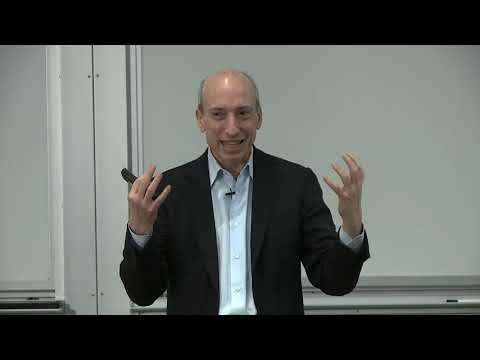
This class, taught by Gary Gensler at MIT, walks through trade finance: the banking system that funds and de-risks the movement of goods across borders. The lecture answers a practical question: why is this specific corner of finance, worth around $17 trillion a year, considered one of the best-fitting use cases for blockchain technology? It sits roughly two-thirds through the course, after the group has covered Bitcoin's mechanics and before it moves on to digital identity.
By the end you should be able to describe how a letter of credit and documentary collection work, name the pain points (paperwork, fraud, information asymmetry across jurisdictions) that make trade finance attractive to blockchain projects, and weigh the arguments for and against using blockchain instead of a traditional shared database, using the class discussion of supply-chain tracking (coffee, diamonds, Walmart) as a concrete test case.
Key ideas
- Trade finance: banking services that guarantee payment or move paperwork for cross-border trade, roughly $5-6 trillion of the $17 trillion in annual goods exports.
- Letter of credit: a bank-issued guarantee that removes counterparty risk by promising the exporter payment once specified documents are presented.
- Documentary collection: banks move the paperwork between exporter and importer without taking on the credit risk themselves.
- Bill of lading: a centuries-old, warehouse-receipt-like document proving goods were loaded onto a ship; historically easy to forge, which is why trade finance built up so many verification steps.
- Open account: the informal, invoice-based way most domestic and much large-company international trade is actually settled, without letters of credit.
- Permissioned blockchain: the technology nearly every trade-finance consortium (Corda, Hyperledger-based IBM projects) is actually using, rather than public networks with native tokens.
- Verification and networking cost: the lecture's recurring lens for deciding whether blockchain adds value anywhere, including in supply-chain tracking debates.
Walkthrough
What trade finance is and why it's hard (1:29)
The class opens by naming trade finance's core attributes: many stakeholders, heavy paperwork (still moved physically by document couriers in some cases), cross-border trust gaps, and a fraud risk called double financing, where the same shipment is used to secure funding twice. Small and medium-sized exporters suffer most, since banks reject roughly half of their financing requests versus far fewer for large multinationals, partly because banks in one country have no easy way to vet an unfamiliar business in another.
The economics and mechanics of financing trade (6:33)
Gensler frames the market with World Bank figures: about $17 trillion in annual goods exports. Financing splits into bank-supported forms (letters of credit and documentary collection) and non-bank forms (factoring, forfaiting, supply-chain financing, open account, cash in advance, and consignment). Only about $5-6 trillion of the $17 trillion actually relies on letters of credit or documentary commitments; open account trade, common between large companies that already trust each other, makes up much of the rest.
How letters of credit move goods and money (7:16)
The lecture traces the classic transaction: importer and exporter sign a sales contract, the importer arranges a letter of credit through an issuing bank, and the exporter's bank may add a second guarantee. When the exporter ships the goods, they send supporting documents to their bank, which forwards them to the foreign bank; presenting the right documents triggers payment. Letters of credit covered roughly half of world trade in 1970 but only about 15-20% today, as large multinationals increasingly trust each other enough to trade on open account instead.
The case for blockchain in trade finance (20:39)
Gensler argues trade finance is a strong blockchain candidate precisely because it involves many parties (importer, exporter, multiple banks, freight forwarders, customs agents), dozens of document types prone to forgery, and property rights that people want to borrow against while goods are still at sea. He contrasts it with a hypothetical domestic shipment, where the same trust problems mostly disappear, to show that cross-border information asymmetry, not shipping itself, is what creates the demand for intermediated verification.
Consortia, projects, and who's really adopting (34:52)
The class surveys five major bank consortia (two on Corda, two on IBM's Hyperledger-based platforms, one on a separate stack), plus standalone efforts like we.trade, Marco Polo, and a Media Lab project called Proof of Existence that anchors proofs to Bitcoin without issuing a token. Nearly every serious project uses a permissioned chain with no native token; Gensler notes he could only find one exception. Interoperability between rival consortia remains unresolved, since no bank wants to cede pricing power to whichever network wins first, and students discuss a proposed China-Ethiopia trade corridor as a live example of choosing where to seed adoption.
The supply-chain debate: coffee, diamonds, and Walmart (45:26)
A long class discussion tests whether blockchain adds real value to supply-chain tracking, using examples like coffee-bean traceability, conflict diamonds, and IBM's work with Walmart and Maersk. Skeptics argue that fraud typically enters at the point of physical origin, so a blockchain only guarantees the digital record is unaltered, not that the data entered was ever true, making it functionally similar to just sending the same data to IBM's servers. Defenders counter that shared, harder-to-tamper records still cut verification time across many independent parties and can pair with tools like RFID or computer vision to improve data quality at the point of entry.
Assessing your own blockchain use case (1:03:54)
Gensler closes with a checklist for students' final projects: identify the value proposition, ask what verification and networking costs would actually fall, check what competitors and existing consortia are already doing, and be honest about unsolved scalability and performance limits. He reiterates that adoption, not technical elegance, decides which projects survive, and that even skeptics of a "best" solution should ask whether a project is cheaper, faster, or better than the status quo.
Before you watch
- Review the earlier lectures on Bitcoin's blocks, hashing, and consensus, since this class assumes you already understand why immutability and shared verification matter.
- Recall the course's framework for evaluating any blockchain use case by its verification and networking costs, introduced earlier in the semester.
- Have a rough sense of how letters of credit and international banking intermediaries work, since the lecture builds directly on this without much re-explanation.
Check your understanding
- What is the difference between a letter of credit and documentary collection, and what risk does each actually remove?
- Why does the lecture argue that cross-border trade, more than domestic trade, creates demand for trade finance intermediaries?
- What is the main criticism raised against using blockchain for supply-chain traceability, and how do defenders respond to it?
- Why do nearly all of the trade-finance consortia described use permissioned blockchains rather than public networks with native tokens?
- According to the lecture's framework, what questions should you ask before deciding a use case actually needs blockchain technology?
Vocabulary
- trade finance (noun)
- Banking services that guarantee payment or handle paperwork for goods sold across borders.
Trade finance helps exporters get paid safely for shipments abroad. - de-risk (verb)
- To reduce the danger of losing money or goods in a deal.
Banks help de-risk cross-border trade for exporters and importers. - letter of credit (noun)
- A bank's written promise to pay a seller once certain documents are provided.
A letter of credit guarantees the exporter will be paid on time. - documentary collection (noun)
- A process where banks pass shipping documents between buyer and seller without guaranteeing payment.
Documentary collection moves paperwork but leaves credit risk with the trading parties. - bill of lading (noun)
- A document proving goods were loaded onto a ship for transport.
A bill of lading is easy to forge, which trade finance tries to prevent. - open account (noun)
- An informal payment method where goods are shipped and paid for later based on trust, without a letter of credit.
Large trusted companies often trade on open account instead of using banks. - counterparty risk (noun)
- The chance that the other side of a deal will fail to pay or deliver.
A letter of credit removes counterparty risk from the exporter. - double financing (noun)
- A fraud where the same shipment is used to secure funding from two lenders at once.
Double financing is a serious fraud risk in trade finance. - information asymmetry (noun)
- A situation where one party knows much more than the other in a deal.
Cross-border information asymmetry makes banks cautious about unfamiliar foreign businesses. - factoring (noun)
- Selling unpaid invoices to another company for quick cash, at a discount.
Factoring lets a business get paid early instead of waiting for an invoice. - consortium (noun)
- A group of companies or banks working together on a shared project.
Several bank consortia are testing blockchain platforms for trade finance. - traceability (noun)
- The ability to track where something came from and how it moved.
Blockchain is tested for coffee-bean traceability from farm to store. - tamper (verb)
- To secretly change or interfere with something.
A shared ledger is harder to tamper with than a single company's database. - RFID (noun)
- A small chip technology used to track physical items wirelessly.
RFID tags can help record when goods physically enter the supply chain. - status quo (noun)
- The way things currently are, before any change.
A new system should be cheaper or faster than the status quo. - adoption (noun)
- How widely people or companies actually start using something new.
Adoption, not clever technology, decides whether a project survives. - exporter (noun)
- A person or company that sells and ships goods to another country.
An exporter relies on trade finance to guarantee payment. - importer (noun)
- A person or company that buys and brings in goods from another country.
The importer arranges a letter of credit through their bank. - forgery (noun)
- The crime of making a fake document or signature to deceive someone.
Forgery of shipping documents is a real risk in trade finance. - cross-border (adjective)
- Happening between two different countries.
Cross-border trust gaps make trade finance more complex. - financing request (noun)
- A formal application asking for money or credit.
Banks reject about half of small exporters' financing requests.
Chapters
- 0:00 <Untitled Chapter 1>
- 1:29 What Is Trade Finance
- 6:33 Economic Background
- 7:16 Financing of International Trade
- 34:52 Who's the Largest Issue of Trade Finance in the World
From the YouTube description
MIT 15.S12 Blockchain and Money, Fall 2018
Instructor: Prof. Gary Gensler
View the complete course: https://ocw.mit.edu/15-S12F18
YouTube Playlist: https://www.youtube.com/playlist?list=PLUl4u3cNGP63UUkfL0onkxF6MYgVa04Fn
Prof. Gensler explores trade finance, its attributes, and the significant activity of blockchain technology behind it.
License: Creative Commons BY-NC-SA
More information at https://ocw.mit.edu/terms
More courses at https://ocw.mit.edu
← 21. Post Trade Clearing, Settlement & Processing · 23. Digital ID →