Seyed Masoud Hosseini · Overview · Study log · Weekly summaries · Ideas · Search · Transcript · RSS feed
Blockchain & Money · Lecture 17 of 23 · 1:17:17
17. Secondary Markets & Crypto-Exchanges
Study guide
What this lecture covers
This lecture asks a practical question: who actually trades crypto, and how do the exchanges that handle over 90% of crypto volume really work? It sits after the course's earlier sessions on blockchain fundamentals and moves into the finance layer of the crypto ecosystem, using crypto exchanges as a case study even though, as the lecture stresses, exchanges are not themselves a blockchain application.
After watching, you can explain the three core ways crypto exchanges differ from traditional exchanges like the New York Stock Exchange, describe the main policy problems regulators worry about (custody, manipulation, money laundering), and read exchange volume statistics with appropriate skepticism.
Key ideas
- Intermediated access: traditional exchanges only let member brokers trade directly; retail investors go through brokers like Goldman Sachs or Robinhood, while crypto exchanges give users direct access.
- Custody: crypto exchanges typically hold customer assets themselves (in their own address, not the customer's name), unlike US securities markets where the Depository Trust Corporation holds the golden record of ownership.
- Market-making conflict: an exchange can be the counterparty to your trade, unlike traditional exchanges, which creates an inherent conflict of interest.
- Wash trading: a manipulator can inflate reported volume by trading with themselves or an affiliate, which is one reason exchange volume figures may not be accurate.
- Decentralized exchanges: peer-to-peer trading platforms with no custody function, but they made up under half a percent of measured volume at the time.
- Payment for order flow: brokers like Robin Hood earn money by selling customer trade data and order flow to high-frequency trading firms rather than charging fees.
- Cash versus derivative markets: cash markets transfer ownership directly, while derivative markets are contracts tied to a reference price from an outside source (an Oracle).
Walkthrough
Why crypto exchanges matter to the course (0:00)
The lecture opens by noting that although exchanges aren't a blockchain application themselves, they carry the overwhelming majority of crypto transaction volume, so no course on blockchain and money would be complete without them. An informal class poll shows most students who own crypto bought it through an exchange rather than running a node themselves, illustrating the convenience factor that drives centralization even among technically capable users.
Three structural differences from traditional exchanges (7:12)
Through class discussion, the lecture identifies three differences between crypto exchanges and traditional securities exchanges: crypto exchanges may be the counterparty to your trade, they lack the intermediated-access model where only members can transact directly, and they custody customer assets themselves rather than relying on a central depository like the DTCC. The discussion also distinguishes cash markets from derivative markets, using the example of a one-day, fully collateralized Bitcoin futures contract that blurs the line between the two.
How centralized and decentralized exchanges operate (21:48)
Centralized exchanges act as matching agents, counterparties, and custodians all at once, while decentralized exchanges only match trades and hold no custody function. The lecture notes that around 200 exchanges have existed historically, many using shared third-party software, making them easy to start but hard to keep compliant with securities law. It also covers a recent SEC enforcement action against a decentralized exchange's software developers over unregistered ERC-20 token trading.
Reading exchange volume and market data (28:00)
Using data from CryptoCompare covering roughly 140 exchanges, the lecture walks through volume by exchange, currency pair, and jurisdiction, cautioning repeatedly that self-reported figures can be inflated by wash trading or outright misreporting. It highlights that many top exchanges by reported volume are registered in low-regulation jurisdictions, and that a large share of volume settles to the blockchain only periodically rather than per trade, since constant settlement is costly.
Custody, hacks, and cold storage (37:07)
The lecture reviews major exchange hacks (including Mt. Gox and Coincheck) and the practice of keeping customer funds in cold (offline) versus hot (connected) wallets. It discusses insurance arrangements like Gemini's contract with Aon, noting these rarely cover full customer balances.
Policy challenges and a path forward (54:47)
The lecture lays out the main public policy problems: susceptibility to fraud and manipulation, unresolved custody conflicts, inconsistent anti-money-laundering compliance (only about half of tracked exchanges enforce strict KYC), and unresolved questions about which tokens count as securities. Gensler shares his own view that custody duties should be fixed or spun off from trading, and predicts more registration, enforcement, and consolidation among exchanges over the following few years.
Before you watch
- Review the Howey test and the distinction between securities, commodities, and derivatives from earlier sessions in this course.
- Recall how traditional securities settlement and custody work (the role of the DTCC), since the lecture contrasts this directly with crypto exchange custody.
Check your understanding
- What are the three structural differences the lecture identifies between crypto exchanges and the New York Stock Exchange?
- Why can reported exchange trading volume be misleading, and what practice specifically inflates it?
- What is the difference between a centralized and a decentralized exchange in terms of custody and counterparty role?
- Why does payment for order flow let some brokers like Robin Hood charge zero trading fees?
- What custody-related reform does the lecture argue for, and why?
Vocabulary
- secondary market (noun)
- A market where investors trade assets among themselves after they were first issued.
Crypto exchanges are part of the secondary market for tokens. - broker (noun)
- A person or firm that buys and sells assets on behalf of clients.
Retail investors usually trade stocks through a broker. - retail investor (noun)
- An ordinary individual who buys and sells assets, as opposed to a large institution.
Crypto exchanges give retail investors direct access to trading. - custody (noun)
- The responsibility of safely holding someone else's assets.
Most crypto exchanges keep custody of customers' coins themselves. - counterparty (noun)
- The other side of a trade or deal.
A crypto exchange can act as the counterparty to your trade. - conflict of interest (noun)
- A situation where one party's goals could unfairly work against another party's interests.
An exchange trading against its own customers creates a conflict of interest. - manipulation (noun)
- Dishonestly influencing a price or market to gain an advantage.
Wash trading is a form of market manipulation. - wash trading (noun)
- Fake trading where someone buys and sells to themselves to make volume look higher.
Wash trading can make an exchange's reported volume misleading. - decentralized exchange (noun)
- A trading platform that matches buyers and sellers directly without holding their funds.
A decentralized exchange has no custody function at all. - payment for order flow (noun)
- Money a broker earns by selling information about customer trades to other firms.
Payment for order flow lets some brokers offer free trades. - high-frequency trading (noun)
- Extremely fast automated trading done by computers to profit from tiny price changes.
High-frequency trading firms buy order flow data from brokers. - derivative (noun)
- A financial contract whose value depends on the price of something else.
A Bitcoin futures contract is a type of derivative. - oracle (noun)
- A trusted outside source that feeds real-world data into a computer system or contract.
A derivative contract relies on an oracle for the reference price. - cold storage (noun)
- Keeping digital assets offline, away from internet access, for safety.
Exchanges keep most customer funds in cold storage to prevent hacking. - hot wallet (noun)
- A digital wallet connected to the internet, used for quick access but less secure.
Hackers usually target an exchange's hot wallet rather than its cold storage. - insurance (noun)
- A financial product that pays out if a specific bad event happens.
Some exchanges buy insurance to cover part of a possible hack. - know your customer (KYC) (noun)
- The process of verifying a customer's identity before letting them use a financial service.
Only about half of tracked exchanges enforce strict know your customer rules. - jurisdiction (noun)
- The area or country where a particular law or authority applies.
Many exchanges register in low-regulation jurisdictions. - compliant (adjective)
- Following all the required laws and rules.
Keeping an exchange compliant with securities law is difficult and costly. - enforcement (noun)
- Government action to make sure people or companies follow the law.
The lecture predicts more regulatory enforcement against exchanges. - consolidation (noun)
- The process of many separate things combining into fewer, larger ones.
The lecture predicts more consolidation among crypto exchanges.
Chapters
- 0:00 Introduction
- 0:21 Crypto exchange overview
- 5:21 Traditional vs crypto models
- 11:24 Cash and derivative markets
- 15:34 Market integrity and security
- 21:01 Decentralized exchanges
- 24:51 Market dynamics and volume
- 32:41 Custody and exchange structure
- 44:10 Profitability and order flow
- 55:16 Policy and future outlook
From the YouTube description
MIT 15.S12 Blockchain and Money, Fall 2018
Instructor: Prof. Gary Gensler
View the complete course: https://ocw.mit.edu/15-S12F18
YouTube Playlist: https://www.youtube.com/playlist?list=PLUl4u3cNGP63UUkfL0onkxF6MYgVa04Fn
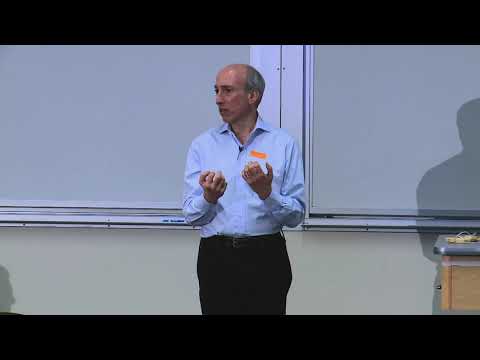
Prof. Gensler talks about crypto-exchange, while not directly an application of blockchain technology, is a major part of the crypto-finance ecosystem.
License: Creative Commons BY-NC-SA
More information at https://ocw.mit.edu/terms
More courses at https://ocw.mit.edu
← 16. Central Banks & Commercial Banking, Part 2 · 19. Primary Markets, ICOs & Venture Capital, Part 1 →