Seyed Masoud Hosseini · Overview · Study log · Weekly summaries · Ideas · Search · Transcript · RSS feed
Blockchain & Money · Lecture 1 of 23 · 1:02:03
Lecture 1: Introduction to Blockchain and Money
Study guide
What this lecture covers
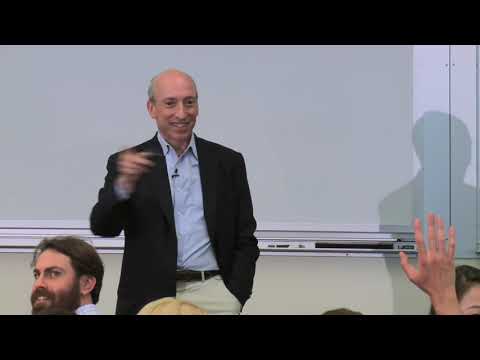
This opening lecture sets up the semester-long question the course will keep returning to: what is blockchain, and might it be a catalyst for change in the world of finance and money? Gary Gensler, a former Goldman Sachs partner and former chair of the Commodity Futures Trading Commission, traces the internet's layered history (Ethernet, TCP/IP, HTTP, SSL/TLS) and cryptography's long arc from ancient ciphers through the Enigma machine to the public-key cryptography that secures the modern internet, to show why moving value peer-to-peer online was still unsolved as late as the 1990s.
After watching, you should be able to state what blockchain technology does in plain terms (a time-stamped, append-only, cryptographically secured ledger with a consensus protocol for deciding who adds the next block), name the riddle Satoshi Nakamoto's 2008 email addressed, and describe the course's three-part structure: blockchain fundamentals, the economics of trust and verification, and financial-sector use cases.
Key ideas
- Cryptography as communication under adversaries: the core purpose of cryptography, from ancient ciphers to modern SSL/TLS, is keeping a message secret from parties who want to intercept it.
- Blockchain predates Bitcoin: time-stamped, cryptographically linked data blocks were described by Stuart Haber and W. Scott Stornetta in the early 1990s, well before Satoshi Nakamoto's 2008 Bitcoin proposal.
- Satoshi Nakamoto's riddle: the unsolved problem before Bitcoin was how to move value peer-to-peer over the internet without a trusted, centralized intermediary.
- Cost of trust: blockchain trades one kind of verification cost (a centralized authority) for another (a decentralized consensus protocol); it isn't simply cheaper or better, it's a different cost structure.
- Permissioned versus permissionless: permissioned blockchains restrict who can add to the ledger (used by institutions like the Australian Stock Exchange); permissionless blockchains, like Bitcoin, allow anyone to participate.
- Scale problem: as of the lecture, Bitcoin processes roughly seven transactions per second, versus tens of thousands per second needed by modern payment and securities-clearing systems.
- Financial sector as an hourglass neck: finance intermediates money and risk for the whole economy and collects outsized economic rents by sitting at that narrow point, which is part of why blockchain is seen as a potential disruptor.
- Duck test for public policy: regulators like Gensler tend to judge new instruments by function rather than label — if it behaves like a security, it's treated like one.
Walkthrough
Course framing and warm-up poll (1:01)
Gensler introduces himself and polls the class on cryptocurrency ownership and blockchain project experience, then states the two questions the week's lecture is built around: what is blockchain, and why might it be a catalyst for change in finance. He narrows the course's scope deliberately to blockchain's intersection with money and finance rather than its broader applications.
A history lesson: the internet and cryptography (5:04)
He walks through the internet's protocol layers (Ethernet, TCP/IP, HTTP) and the commercialization that followed, using the 1995 Pizza Hut online order (dramatized in the film The Net) to illustrate that early e-commerce could not move money online. This leads into a history of cryptography, from ancient cipher devices through the Enigma machine to 1970s public-key cryptography, framed throughout as "communication in the presence of adversaries."
Failed digital currencies and the riddle Satoshi solved (11:21)
Gensler covers PayPal and a list of earlier digital-currency attempts that failed between 1989 and 1999, plus M-Pesa's success in Kenya as an example of mobile-money adoption among the unbanked. He then presents Satoshi Nakamoto's October 2008 email describing a peer-to-peer electronic cash system with no trusted third party as the answer to the outstanding riddle of moving value online without an intermediary.
What blockchain is, and the pizza story (15:26)
He defines blockchain as time-stamped, append-only, cryptographically secured logs, secured through hash functions and digital signatures, with consensus protocols determining who appends each block. The 2010 Bitcoin pizza purchase (10,000 BTC for two pizzas) illustrates that even 16 months after Bitcoin's creation, no one had used it as a medium of exchange.
Blockchain's tradeoffs and the plumbing of finance (21:35)
Gensler defines blockchain technology as verifiably moving data on a decentralized network, framing its economics as a tradeoff in the cost of verification rather than a strict improvement. He connects this to finance's core function of moving money and risk, and previews the challenges (technical, commercial, and public-policy) the course will examine.
Financial sector obstacles and opportunities (26:47)
He lists the financial sector's structural problems — legacy payment systems, high interchange fees, counterparty risk, and 1.7 billion unbanked people worldwide — as the opportunity side of the ledger, then lists blockchain's own current shortcomings: scalability (roughly seven transactions per second for Bitcoin versus tens of thousands needed by modern clearing systems), privacy, interoperability, and governance.
Public policy and course logistics (34:56)
Gensler outlines three recurring public-policy concerns — illicit activity, financial stability, and investor protection — and introduces the "duck test" for regulatory judgment. He closes with course mechanics: grading (30% participation, two individual write-ups, a team project), the study questions for the next class on the history and roles of money, and his own background in finance and public service.
Before you watch
- No prior computer science or cryptography background is required; the course builds up hash functions and asymmetric cryptography from scratch.
- Skim the syllabus and any assigned readings before class, since Gensler references them directly and polls the class on them.
- It helps to have a general sense of what Bitcoin is, since the lecture assumes basic familiarity while building toward technical depth in later lectures.
Check your understanding
- What problem did Satoshi Nakamoto's 2008 proposal claim to solve, and why had it remained unsolved for so long?
- In what sense does blockchain "trade off" costs of verification rather than simply lowering them?
- What is the difference between a permissioned and a permissionless blockchain, and why might an institution like a stock exchange prefer one over the other?
- According to the lecture, what specific scalability gap exists between Bitcoin and modern payment or securities-clearing systems?
- Why does Gensler describe finance as sitting "at the neck of an hourglass," and how does that relate to blockchain's potential as a catalyst for change?
Vocabulary
- blockchain (noun)
- A time-stamped, append-only chain of data blocks secured by cryptography.
Blockchain lets many parties agree on the same record. - catalyst (noun)
- Something that causes a big change to happen.
Gensler asks whether blockchain can be a catalyst for change in finance. - cryptography (noun)
- The science of protecting information from people who shouldn't see it.
Cryptography secures messages from adversaries. - peer-to-peer (adjective)
- Directly between two parties, without a middleman.
Bitcoin allows peer-to-peer payments online. - intermediary (noun)
- A third party that sits between two sides of a transaction.
Moving money once required a trusted intermediary. - consensus protocol (noun)
- A set of rules letting many parties agree on shared data.
A consensus protocol decides who adds the next block. - permissioned (adjective)
- Restricted so only approved participants can take part.
A permissioned blockchain limits who can add to the ledger. - permissionless (adjective)
- Open so anyone can join and participate.
Bitcoin is a permissionless blockchain anyone can join. - scalability (noun)
- The ability to handle much more volume as usage grows.
Bitcoin's scalability is far below modern payment systems. - unbanked (adjective)
- Without access to any bank account or financial services.
Billions of unbanked people could benefit from mobile money. - regulator (noun)
- An official or agency that oversees and enforces rules.
A regulator judges new instruments by function, not label. - duck test (noun)
- A rule of thumb judging something by how it acts, not what it's called.
The duck test asks if something behaves like a security. - commercialization (noun)
- The process of turning something into a product sold for profit.
The internet's commercialization created new online businesses. - adversary (noun)
- A party trying to attack, deceive, or intercept a system.
Cryptography protects communication in the presence of adversaries. - append-only (adjective)
- Allowing new data to be added but never changed or deleted.
A blockchain is an append-only record of transactions. - medium of exchange (noun)
- Something widely accepted in trade for goods and services.
Bitcoin wasn't used as a medium of exchange for a long time. - counterparty risk (noun)
- The risk that the other side of a deal fails to deliver.
Counterparty risk is one of finance's core structural problems. - trace (verb)
- To follow the history or origin of something.
The lecture traces the internet's layered history. - obstacle (noun)
- Something that blocks progress toward a goal.
High fees are an obstacle in the traditional financial sector. - riddle (noun)
- A puzzling problem that seems hard to solve.
Satoshi Nakamoto's paper solved a long-standing riddle.
Chapters
- 0:00 Title slates
- 0:20 Welcome; course introduction
- 4:15 Readings for class
- 5:13 A history lesson to give context
- 9:22 Cryptography is communication in the presence of adversaries
- 12:14 List of digital currencies that failed between 1989 and 1999
- 15:38 What blockchain is
- 19:26 Pizza for bitcoins
- 21:37 Blockchain technology
- 22:41 Role of money and finance
- 26:40 Financial sector problems and blockchain potential opportunities
- 28:44 Financial sector issues with blockchain technology and what the financial sector favors
- 35:00 Public policy framework
- 36:46 The duck test
- 37:25 Incumbents eyeing crypto finance
- 39:35 Financial sector potential use cases
- 41:57 Larry Lessig's book "code and other laws of cyberspace"
- 48:46 Outline of all classes
- 49:08 Study questions
- 50:55 Readings and video
- 52:04 Conclusions
- 55:13 Questions
- 1:01:42 Credits
From the YouTube description
MIT 15.S12 Blockchain and Money, Fall 2018
Instructor: Prof. Gary Gensler
View the complete course: https://ocw.mit.edu/15-S12F18
YouTube Playlist: https://www.youtube.com/playlist?list=PLUl4u3cNGP63UUkfL0onkxF6MYgVa04Fn
This lecture provides an introduction to the course and to blockchain technology.
Chapters
0:00 Title slates
0:20 Welcome; course introduction
4:15 Readings for class
5:13 A history lesson to give context
9:22 Cryptography is communication in the presence of adversaries
12:14 List of digital currencies that failed between 1989 and 1999
15:38 What blockchain is
19:26 Pizza for bitcoins
21:37 Blockchain technology
22:41 Role of money and finance
26:40 Financial sector problems and blockchain potential opportunities
28:44 Financial sector issues with blockchain technology and what the financial sector favors
35:00 Public policy framework
36:46 The duck test
37:25 Incumbents eyeing crypto finance
39:35 Financial sector potential use cases
41:57 Larry Lessig's book "code and other laws of cyberspace"
48:46 Outline of all classes
49:08 Study questions
50:55 Readings and video
52:04 Conclusions
55:13 Questions
1:01:42 Credits
License: Creative Commons BY-NC-SA
More information at https://ocw.mit.edu/terms
More courses at https://ocw.mit.edu