Seyed Masoud Hosseini · Overview · Study log · Weekly summaries · Ideas · Search · Transcript · RSS feed
Distributed Systems · Lecture 16 of 20 · 1:18:00
Lecture 16: Cache Consistency: Memcached at Facebook
Study guide
What this lecture covers
The lecture walks through the Facebook memcached paper as a case study in scaling a real website: how a single web server evolves into front ends, sharded databases, and finally a caching layer, and what breaks once that caching layer becomes the thing keeping the whole system alive. It treats the paper less as a source of new ideas and more as a record of what a company actually hit when performance requirements collided with consistency.
By the end you should understand why Facebook chose an invalidate-based (lookaside) cache over an update-based one, how leases solve both the thundering herd problem and a subtler stale-data-forever race, and how replication and partitioning trade off across regions, clusters, and a regional pool. The lecture builds on the course's general treatment of caching and replication and applies it to a production system.
Key ideas
- Lookaside cache: the front end, not memcached, is responsible for checking the cache, fetching from the database on a miss, and populating the cache; memcached has no knowledge of the database.
- Invalidate over update: writers send a
deletefor a key to memcached rather than pushing the new value, because concurrent writers can otherwise leave a stale value permanently cached. - Leases: memcached hands out a unique token on a miss; only the holder's later
setis accepted, which serializes concurrent fills and prevents an old read from clobbering a newer delete. - Thundering herd: when a popular key is deleted, many front ends miss at once and hammer the database with identical requests; leases fix this by letting only the first misser fetch and install the value while others wait.
- Partition vs. replication: partitioning splits data across servers for more total capacity but scales badly for a few very hot keys; replication serves hot keys in parallel but multiplies memory use.
- Regions, clusters, and the regional pool: Facebook replicates entire regions for locality and failover, shards and lightly replicates within a region via clusters to bound per-request fan-out, and keeps a shared regional pool for unpopular keys to avoid wasting RAM on many copies.
- Cold start and gutter servers: a newly added cluster borrows data from a warm cluster's memcached before touching the database, and gutter servers stand in temporarily when a memcached server fails, both to shield the database from sudden full load.
Walkthrough
From one server to sharded MySQL (2:03)
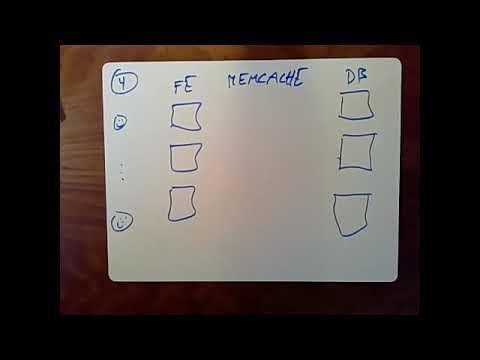
The lecture traces the typical evolution of a growing website: a single machine running Apache, PHP, and MySQL; then multiple front-end servers sharing one database once PHP CPU time becomes the bottleneck; then sharded MySQL servers once a single database server runs out of capacity. Sharding helps throughput but forces the PHP code to know the shard layout and complicates transactions that span shards.
Web Architecture 3: adding memcached (6:48 approx / chapter "Web Architecture 3")
Even sharded MySQL is expensive per read, and popular keys can overload a single shard no matter how finely data is partitioned. The lecture explains why Facebook inserted a caching layer of memcached servers between front ends and databases: memcached serves reads roughly ten times faster than MySQL for the same hardware, so it absorbs almost all read traffic and lets the database handle only writes and misses.
How reads and writes work with lookaside caching (24:23)
A read asks memcached for the key; on a miss the front end queries the database and installs the result in memcached itself, since memcached knows nothing about the database. A write updates the database, then deletes the key from memcached rather than pushing the new value in. The lecture works through why an update-based scheme (a direct set from the writer) can leave memcached permanently wrong when two clients race to increment the same value, which is why Facebook chose invalidation.
Partition and replication across regions and clusters (38:35)
Facebook fully replicates data across two regions for locality and to keep the hundreds of per-page lookups a front end makes close to home; within a region, data is sharded (not replicated) at the database level, but memcached is both sharded and lightly replicated across clusters so hot keys get parallel service without every cluster growing too large (which would cause costly N-squared connections and incast congestion). A separate regional pool caches unpopular keys just once, since replicating rarely used data everywhere wastes RAM.
Cold start and gutter servers (53:14 and 1:02:26)
Spinning up a brand-new cluster with an empty cache would multiply database load by orders of magnitude, so a cold cluster first checks a warm cluster's memcached before falling back to the database. Separately, when a memcached server fails outright, front ends redirect to idle gutter servers that cache data temporarily (with short timeouts instead of explicit deletes) until the failed server is replaced, so the database is never exposed to a memcached server's full request rate.
Solving the stale-forever race with leases (1:06:34)
The lecture builds a concrete race: a slow reader can install an old value into memcached after a newer write's delete has already passed through, leaving the cache stuck on stale data indefinitely. The fix extends the lease mechanism: a miss grants a lease token, and any delete that arrives afterward invalidates that lease, so a late set carrying an outdated value is rejected by memcached instead of being installed.
Before you watch
- Be comfortable with the idea of a cache and cache invalidation, since the lecture assumes you know what caching buys you before explaining Facebook's specific consistency fixes.
- Some familiarity with earlier lectures on replication and sharding in this course helps, since the lecture treats partition-versus-replication trade-offs as background.
Check your understanding
- Why does Facebook's write path delete a key from memcached instead of sending the new value directly, and what race does this avoid?
- How do leases solve the thundering herd problem, and separately, how does the same mechanism prevent a stale value from being cached forever?
- What trade-off does Facebook make by keeping clusters within a region relatively small rather than one large shared pool of memcached servers?
- Why does the system use full region-to-region replication instead of sharding data across the two data centers?
- What role do gutter servers play, and why don't they receive the same delete traffic as ordinary memcached servers?
Vocabulary
- shard (verb)
- To split data across multiple servers to increase capacity.
Facebook had to shard its MySQL database as traffic grew. - lookaside cache (noun)
- A cache where the application, not the cache, manages checking and filling it.
Memcached works as a lookaside cache in front of MySQL. - invalidate (verb)
- To mark cached data as no longer valid.
A write invalidates the old cached value by deleting it. - thundering herd (noun)
- Many requests hitting a resource at once after it becomes unavailable.
A popular key's deletion can cause a thundering herd of misses. - lease (noun)
- A temporary token that grants permission to complete one specific action.
A lease lets only one client fill the cache after a miss. - race condition (noun)
- A bug where the outcome depends on unpredictable timing between operations.
A race condition can leave the cache permanently wrong. - partition (noun)
- Splitting data into separate pieces across different servers.
Partitioning spreads data but scales poorly for a few hot keys. - hot key (noun)
- A single piece of data requested far more often than others.
A hot key can overload a single database shard. - cold start (noun)
- The state of a system starting up with no cached data yet.
A cold start cluster borrows data from a warm cluster first. - incast congestion (noun)
- Network slowdown caused by too many machines replying to one request at once.
Large clusters risk incast congestion from many simultaneous replies. - gutter server (noun)
- A temporary backup server used when a regular cache server fails.
Gutter servers protect the database during a memcached outage. - evolution (noun)
- The gradual change and development of something over time.
The lecture traces the evolution of a growing website. - front end (noun)
- The part of a system that directly serves user requests.
The front end checks the cache before querying the database. - regional pool (noun)
- A shared cache used for less popular data across one region.
The regional pool avoids wasting memory on rare keys. - cold cluster (noun)
- A newly started group of servers with no cached data yet.
A cold cluster first checks a warm cluster before hitting the database. - absorb (verb)
- To take in and handle something without passing it further.
Memcached absorbs almost all read traffic from the database. - expensive (adjective)
- Costly in terms of time, money, or resources.
A read from sharded MySQL is expensive per request. - overload (verb)
- To put too much demand on a system at once.
A single hot key can overload one database shard. - locality (noun)
- Keeping data or computation physically close to where it's used.
Full region replication improves locality for lookups. - outright (adverb)
- Completely and immediately, without partial failure.
A memcached server can fail outright without warning.
Chapters
- 0:00 <Untitled Chapter 1>
- 6:48 Web Architecture 3
- 7:47 Sharding
- 21:22 Data Centers
- 24:24 Reads and Writes
- 38:35 Partition and Replication
- 51:37 So It Limits How Expensive Underlying Network Is on the Other Hand of Course They'Re Replicating the Data and the Two Clusters and for Items That Aren't Very Popular and Aren't Really Going To Benefit from the Performance Win of Having Multiple Copies this It's Wasteful To Sit on All this Ram and You Know We'Re Talking about Hundreds or Thousands of Servers so the Amount of Money They Spent on Ram for the Memcache Services Is no Joke So in Addition to the Pool of Memcache Servers inside each Cluster There's Also this Regional Pool of Memcache Servers That's Shared by All the Clusters in a Region
- 58:01 We Have All these Front Ends Constantly Sending Gets for that Data They'Re all GonNa Miss all at the Same Time They'Re all GonNa Now Having Missed Send a Read Request to the Front End Database All at the Same Time and So Now this Front-End Database Is Faced with Maybe Dozens or Hundreds of Simultaneous Requests for this Data so the Loews Here Is GonNa Be Pretty High and It's Particularly Disappointing because We Know that All these Requests Are for the Same Key so the Database Is Going To Do the Same Work Over and Over Again To Respond with the Latest Written Copy of that Key
- 1:06:39 You Know the Consistency Problem Is that There's Lots of Copies of the Data for any Given Piece of Data You Know There's a Copy in the Primary Database There's a Copy in the Corresponding Database Server of each of the Secondary Regions There's a Copy of that Key in each Local Cluster in One of the Memcache Keys in each Local Cluster There May Be Copies of that Key and the Gutter Servers and There May Be Copies of the Key in the Memcache Servers and the Gutter Memcache Servers at each Other Region
- 1:07:22 And Furthermore the Writes May Come from Multiple Sources the Same Key May Be Written at the Same Time by Multiple Front Ends and this Region May Be by Friends and Other Regions Too and So It's this Concurrency and Multiple Copies and Sort of Multiple Sources of Writes since There's Multiple Front Ends It Creates a Lot of Opportunity for Not Just for There To Be Stale Data but for Data Stale Data To Be Left in the System for Long Periods of Time and So I Want To I Want To Illustrate What Are those Problems Actually in a Sense We'Ve Already Talked a Bit about this When Somebody Asked Why the Front Ends Don't Update Why Do They Delete Instead of Updating
- 1:11:12 There's no Mechanism for the Memcache D To Ever See To Ever Get the Actual Correct Value It's GonNa Store and Serve Up Stale Data for Key K Forever and They because They Ran into this and while They'Re Okay with Data Being Somewhat out-of-Date They'Re Not Okay with Data Being out of Date Forever because Users Will Eventually Notice that They'Re Seeing Ancient Data and so They Had To Solve this They Had To Make Sure that this Scenario Didn't Happen They Actually Solved this this Problem Also with the Lease Mechanism
From the YouTube description
Lecture 16: Cache Consistency: Memcached at Facebook
MIT 6.824: Distributed Systems (Spring 2020)
https://pdos.csail.mit.edu/6.824/
← Lecture 15: Big Data: Spark · Lecture 17: COPS, Causal Consistency →