Seyed Masoud Hosseini · Overview · Study log · Weekly summaries · Ideas · Search · Transcript · RSS feed
Design & Analysis of Algorithms · Lecture 9 of 34 · 39:29
R4. Randomized Select and Randomized Quicksort
Study guide
What this lecture covers
This recitation works through the expected-time analysis of two randomized algorithms introduced in the preceding lecture: randomized select (finding the i-th smallest element, called "quick find" here) and randomized quicksort. Rather than relying on the master method, which does not apply to recurrences involving an expectation over a random pivot rank, the TA demonstrates a guess-and-verify induction technique: propose a bound, substitute it into the recurrence, and check whether the induction step holds.
It follows the lecture on randomization (Monte Carlo and Las Vegas algorithms) and pairs with the deterministic median-finding algorithm from earlier in the course. After watching, you should be able to set up the expectation recurrence for a randomized divide-and-conquer algorithm and carry out an inductive proof that guesses a bound, substitutes it, and refines the guess until the induction succeeds.
Key ideas
- Randomized select ("quick find"): picks a random pivot
x, partitions the array around it, and recurses into only the side containing the target ranki, with recurrenceT(n) <= max(T(K-1), T(n-K)) + Theta(n)whereKis the random pivot's rank. - Expectation over the recursion: because
Kis random, the algorithm's exact running time cannot be pinned down, so the analysis instead boundsE[T(n)]by averaging over all possible values ofK, each with probability1/n. - Guess-and-verify induction: since these recurrences do not fit the master method, the technique is to hypothesize a bound (such as
E[T(n)] <= Bn), substitute the inductive hypothesis for smaller subproblems, and check whether the resulting inequality holds; if it fails, try a larger bound. - Sum approximation by integrals: sums like
sum(j)orsum(j^2)over a range are approximated by integrals to get their leading-order behavior (Theta(n^2)andTheta(n^3)respectively) when computing the substituted recurrence. - Randomized select is Theta(n) expected: the guess
E[T(n)] = Theta(n)succeeds for quick find because only one subproblem is recursed into, so the summed work has a3/8 n^2leading term that is dominated by the linear guess. - Randomized quicksort is Theta(n log n) expected: for quicksort, both subarrays are recursively sorted (a sum instead of a max in the recurrence), so the guesses
Theta(n)andTheta(n^2)both fail the induction step, and onlyTheta(n log n)succeeds. - Average vs. expected vs. amortized time: "average" running time averages over possible inputs (a weak guarantee, since it assumes something about input distribution); "expected" running time averages over the algorithm's own internal randomness, independent of the input; "amortized" running time averages over a sequence of operations.
Walkthrough
Correction to problem set 2 on combining B-trees (0:00)
The recitation opens with a correction to a homework problem about merging two B-trees of different heights, noting that simply making the new key a root with two children can produce an invalid node if it doesn't meet the minimum-children requirement; the fix is to insert the key into the last child of the taller tree and let splits cascade if needed.
Recap of randomized select and its recurrence (2:52)
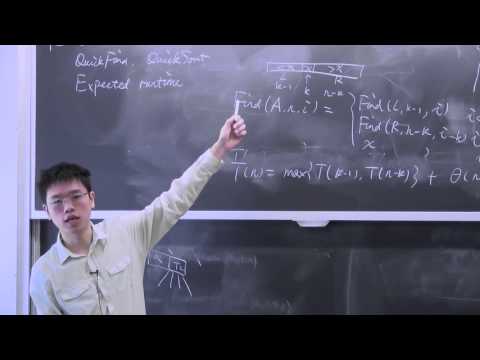
The recitation contrasts the deterministic median-of-medians algorithm (using groups of five, which is fast in the worst case but complex) with randomized select: pick a random element, partition around it, and recurse into whichever side contains the target rank i. Because the pivot's rank K is random, the recurrence T(n) <= max(T(K-1), T(n-K)) + Theta(n) cannot be solved directly, so the analysis takes an expectation over all choices of K.
Proving randomized select is Theta(n) by induction (9:09)
Guessing E[T(n)] <= Bn, the recitation substitutes this into the expectation sum, approximates the resulting sum of j terms as roughly 3/8 n^2 using the observation that summing from n/2 to n is about 1/2 n^2 - 1/8 n^2, and shows the induction step holds for a suitable constant B, confirming E[T(n)] = Theta(n).
Randomized quicksort's recurrence (21:40)
Quicksort differs from select only in that both partitions must be recursively sorted, turning the max in the recurrence into a sum: E[T(n)] = (1/n) * sum_{J=1}^{n} (T(J-1) + T(n-J)) + Theta(n). The recitation shows that the earlier guess of Theta(n) fails this induction step, since the sum's range now spans the whole array rather than just the upper half.
Trying larger bounds for quicksort (25:44)
The recitation successively tries Theta(n^2) (too weak a claim — proves an upper bound but not a tight one), n^(1+epsilon) for any epsilon > 0 (also holds, using the integral approximation for sum(j^(1+epsilon))), and finally Theta(n log n), computing sum(j log j) by integral approximation as roughly (1/2) n^2 log n minus lower-order terms. This bound satisfies the induction step, establishing E[T(n)] = O(n log n) for randomized quicksort.
Average, expected and amortized time (38:00)
The recitation closes by distinguishing three notions of "average" running time. Average running time averages over possible inputs and is a weak guarantee, since a non-randomized algorithm (always picking the first element as pivot) can behave well on random input but badly on adversarial input like a sorted array. Expected running time averages over the algorithm's own randomness and gives guarantees independent of the input, at the cost of needing a good source of randomness. Amortized running time averages over a sequence of operations on the same data structure.
Before you watch
- Watch the main randomization lecture on Monte Carlo and Las Vegas algorithms, including randomized quicksort, since this recitation assumes that setup.
- Review the deterministic linear-time median-finding (median-of-medians) algorithm from earlier in the course, which is used here as a point of comparison.
- Be comfortable with basic summation formulas and approximating sums by integrals, since the inductive proofs rely on this technique throughout.
Check your understanding
- Why can't the master method be applied directly to the recurrence for
E[T(n)]in randomized select? - Why does the guess
E[T(n)] = Theta(n)succeed for randomized select but fail for randomized quicksort? - How does approximating
sum(j)by an integral help establish that randomized select runs in expectedTheta(n)time? - What is the difference between "average" running time and "expected" running time, and why is the expected-time guarantee for randomized quicksort stronger?
Vocabulary
- expected running time (noun)
- The average time an algorithm takes, averaged over its own internal randomness.
The expected running time of randomized quicksort is O(n log n). - guess-and-verify (noun)
- A proof method where you propose a bound, plug it in, and check if it holds.
Guess-and-verify induction is used when the master method doesn't apply. - inductive hypothesis (noun)
- The assumption, in a proof by induction, that a claim holds for smaller cases.
The proof substitutes the inductive hypothesis for smaller subproblems. - integral approximation (noun)
- Using a continuous integral to estimate the value of a discrete sum.
An integral approximation estimates the sum of ranks quickly. - recurrence (noun)
- An equation expressing a quantity in terms of smaller versions of itself.
The randomized select recurrence depends on where the pivot lands. - expectation (noun)
- The average outcome of a random process, weighted by probability.
The analysis takes the expectation over all possible pivot choices. - adversarial input (noun)
- Input specifically designed to make an algorithm perform as badly as possible.
A sorted array is adversarial input for basic quicksort. - amortized time (noun)
- The average cost per operation across a sequence of operations on the same structure.
Amortized time differs from expected time because it averages over operations, not randomness. - pivot (noun)
- An item chosen to split data into smaller and larger groups.
Randomized select picks a random pivot before partitioning. - partition (array) (verb)
- To rearrange an array into groups based on a comparison value.
The algorithm partitions the array around the chosen pivot. - leading-order (adjective)
- Describing the term in an expression that grows fastest and dominates for large inputs.
The leading-order behavior of the sum is Theta(n^2). - dominate (math) (verb)
- To be much larger than other terms, making them unimportant for the total.
The linear guess dominates the smaller leading term. - tight (bound) (adjective)
- As close as possible to the true value, without extra slack.
Theta(n^2) is a correct but not tight bound for quicksort. - distribution (probability) (noun)
- How likely different outcomes are across all possibilities.
Average running time assumes something about the input's distribution. - cascade (splits) (verb)
- To trigger a chain of further similar actions.
Splits can cascade upward when merging two B-trees. - master method (noun)
- A general shortcut for solving many common divide-and-conquer recurrences.
The master method does not apply when the recurrence involves an expectation. - hypothesize (verb)
- To propose an idea as a starting point, to be tested later.
The technique hypothesizes a bound before checking if it holds. - substitute (verb)
- To put one value or expression in place of another.
The proof substitutes the guessed bound into the recurrence. - refine (verb)
- To improve something gradually by making small adjustments.
The recitation refines the guessed bound until it succeeds. - correction (noun)
- A fix made to an earlier mistake.
The recitation opens with a correction to a homework problem. - minimum-children requirement (phrase)
- A rule stating the smallest number of children a node must have.
A merged root can violate the minimum-children requirement. - successively (adverb)
- One after another, in a series.
The recitation successively tries larger and larger bounds. - internal randomness (phrase)
- Random choices made by the algorithm itself, not from the input.
Expected running time depends only on the algorithm's internal randomness. - solid guarantee (phrase)
- A dependable promise about performance that doesn't rely on luck.
Expected time gives a more solid guarantee than average time. - sorted array (noun)
- A list of items arranged in increasing or decreasing order.
A sorted array is a bad case for naive quicksort.
Chapters
From the YouTube description
MIT 6.046J Design and Analysis of Algorithms, Spring 2015
View the complete course: http://ocw.mit.edu/6-046JS15
Instructor: Ling Ren
In this recitation, problems related to Randomized Select and Randomized Quicksort are discussed.
License: Creative Commons BY-NC-SA
More information at http://ocw.mit.edu/terms
More courses at http://ocw.mit.edu
← 6. Randomization: Matrix Multiply, Quicksort · 7. Randomization: Skip Lists →