Seyed Masoud Hosseini · Overview · Study log · Weekly summaries · Ideas · Search · Transcript · RSS feed
Bitcoin & Cryptocurrency Technologies · Lecture 7 of 12 · 1:14:58
Lecture 7: Community, Politics, and Regulation
Study guide
What this lecture covers
This lecture steps back from Bitcoin's cryptography and mechanics to look at how the system functions as a social and political institution. It follows the mining and anonymity lectures by asking a different kind of question: who actually governs Bitcoin, what happens when its community disagrees, where did it come from, and how do governments respond to it.
After watching, you should be able to describe the three interlocking forms of consensus Bitcoin depends on, explain what happens when the rules fork, identify the competing claims to power within the Bitcoin community, summarize what is and isn't known about Satoshi Nakamoto, and explain why and how governments regulate Bitcoin businesses, including through anti-money-laundering rules and New York's BitLicense proposal.
Key ideas
- Three forms of consensus: Bitcoin needs agreement on the rules (what's valid), on history (what's in the blockchain), and on value (that coins are worth something), and these three are mutually dependent.
- Bitcoin Core and BIPs: the Bitcoin Core software acts as the de facto rulebook, and Bitcoin Improvement Proposals (BIPs) are the formal mechanism for proposing and discussing rule changes.
- The right to fork: unlike users of a centralized currency, who can only exit, Bitcoin users can fork the rules, which gives the community more real power over developers than it might appear to have.
- Contested stakeholders: developers, miners, investors, merchants and customers, and payment services can each be argued to hold power over Bitcoin's direction, and no single group definitively controls it.
- Satoshi Nakamoto: almost certainly a pseudonym, active until around 2010, holding a large stash of early-mined coins that remain unspent, with the real identity still unknown.
- Capital controls and crime: governments worry about Bitcoin because it can help move wealth across borders undetected and can make certain crimes, like kidnapping ransoms and tax evasion, easier to carry out anonymously.
- Silk Road: an anonymous online drug marketplace run as a Tor hidden service and paid for in Bitcoin, eventually shut down after law enforcement connected its operator to the platform despite his use of pseudonyms.
- Anti-money-laundering and know-your-customer rules: US law requires certain businesses to identify customers, assess risk, watch for suspicious activity like structuring, and report large transactions.
- The lemons market argument for regulation: when buyers can't distinguish high-quality from low-quality offerings, markets can degrade to only low-quality goods, which is one economic justification for regulations like disclosure or licensing requirements.
Walkthrough
Bitcoin consensus types (0:00)
The lecture opens by identifying three kinds of consensus Bitcoin relies on: consensus about the rules (what makes a transaction or block valid), consensus about history (what's actually in the blockchain), and consensus that coins have value, which it likens to the "Tinkerbell effect" since belief in value depends on expecting others to keep believing it too. It stresses that these three forms of consensus are interdependent: rules enable agreement on history, and agreement on history is what makes belief in value possible, while belief in value is what incentivizes the mining that produces the history in the first place.
Core software and forks (6:59)
This section covers the Bitcoin Core software as the practical rulebook, MIT-licensed and treated as the reference implementation even by alternative clients, and Bitcoin Improvement Proposals as the process for suggesting and discussing rule changes. It explains that core developers have real influence, since their code is followed by default, but not full control, because open-source forking means the community can walk away if it dislikes a direction, unlike users of a centralized currency who can only exit. It then walks through what a hard fork of the rules looks like: two incompatible blockchain branches emerge, effectively creating two separate currencies, and the two typically compete for market share until one wins out.
Bitcoin stakeholders (17:44)
The lecture lays out competing claims to power over Bitcoin's future: developers (who write the rules), miners (who write the history and can push rule changes with sufficient hash power), investors (who determine whether Bitcoin has value), and merchants, customers, and payment services (who drive the underlying transactional demand). It concludes that all of these groups hold some leverage and that no one party is definitively in charge, then covers the Bitcoin Foundation, founded in 2012 to pay core developers and represent Bitcoin to government, and the controversies around its legitimacy and board membership.
History and growth (27:27)
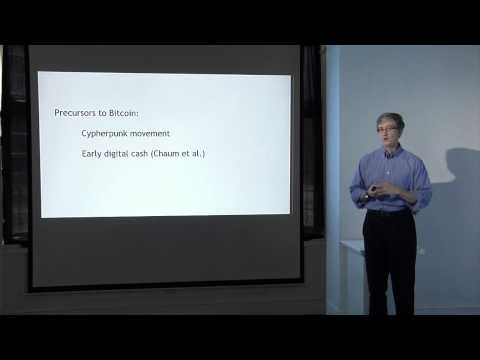
This section traces Bitcoin's origins to the cypherpunk movement, which combined libertarian ideas with strong public-key cryptography, and to earlier digital cash research such as David Chaum's work. It covers the 2008 "Bitcoin: A Peer-to-Peer Electronic Cash System" white paper by Satoshi Nakamoto, what is and isn't known about Satoshi's identity (a pseudonym, active until roughly 2010, holding a large early-mined coin balance that has never been cashed out), and the roughly exponential growth in transaction volume and total value since 2009.
Law enforcement interaction (36:45)
The lecture explains why governments pay attention to Bitcoin: it can defeat capital controls, and it can make crimes like kidnapping, tax evasion, and illegal sales easier by enabling anonymous, distant payment. It covers Silk Road in detail as a case study, an anonymous drug marketplace run as a Tor hidden service, using Bitcoin escrow and a reputation system, run by "Dread Pirate Roberts," and shut down after the arrest of Ross Ulbricht in 2013, with the lesson that keeping a criminal identity fully separated from a real one is harder than it looks and that law enforcement can still follow the money.
AML and KYC regulation (46:27)
This section covers the goals and mechanics of anti-money-laundering rules and know-your-customer requirements: identifying and authenticating customers, assessing their risk, and watching for anomalous behavior such as structuring transactions to dodge the $10,000 reporting threshold. It stresses that US enforcement of these rules has been serious, with businesses shut down and individuals prosecuted for noncompliance.
Economic rationale for regulation (52:23)
The lecture makes the case for when regulation can be economically justified, using the "lemons market" example: if buyers can't distinguish high-quality from low-quality goods, sellers have no incentive to offer quality, and the market degrades. It reviews market-based fixes like reputation and warranties, why they often fail (especially in new markets like Bitcoin exchanges), and three regulatory responses: mandated disclosure, quality standards, and required warranties. It also briefly covers price-fixing and anti-competitive agreements as another category of market failure that antitrust law addresses.
New York's BitLicense proposal (1:04:17)
The lecture examines New York's July 2014 BitLicense proposal in detail: which activities (transmitting, custody, exchange, conversion, and issuance of virtual currency) would require a license, the compliance burdens involved (financial reserves, cybersecurity, disaster recovery, record-keeping, a compliance officer), and the status of the proposal as of the recording. It predicts some form of licensing will likely be adopted, frames this as a step away from Bitcoin's cypherpunk origins and toward integration with the regulated economy, and suggests that consumer trust in "we're regulated" claims will be the real test of whether such regulation succeeds.
Before you watch
- Watch the earlier lecture on Bitcoin and anonymity, since Silk Road and Tor hidden services are discussed there in more technical detail and referenced again here.
- Familiarity with basic Bitcoin mechanics (blocks, the blockchain, mining) from earlier lectures in the course is assumed throughout.
Check your understanding
- Why are Bitcoin's three forms of consensus (rules, history, value) described as interdependent rather than independent?
- What gives Bitcoin users more leverage over developers than users of a centralized currency have over its operator?
- What made it possible for law enforcement to eventually connect Silk Road to its operator despite the use of Tor and pseudonyms?
- In a "lemons market," why might a seller of high-quality goods actually lose money compared to selling low-quality goods?
- What activities would have required a BitLicense under New York's 2014 proposal?
Vocabulary
- governance (noun)
- The process and structure by which decisions are made and rules are set for a system.
Bitcoin's governance has no single leader making final decisions. - stakeholder (noun)
- A person or group with an interest in or influence over a system.
Miners, developers, and investors are all stakeholders in Bitcoin's future. - fork (noun)
- A split in a system's rules or history, creating two separate paths going forward.
A rule change that isn't backward compatible causes a hard fork. - hard fork (noun)
- A rule change that creates two incompatible versions of a blockchain.
A hard fork can split the community into two separate currencies. - reference implementation (noun)
- The main version of software that others treat as the standard to follow.
Bitcoin Core acts as the reference implementation most other software follows. - improvement proposal (noun)
- A formal document suggesting a change to a system's rules or design.
A Bitcoin Improvement Proposal is the standard way to suggest a rule change. - pseudonym (noun)
- A fake name used instead of someone's real identity.
Satoshi Nakamoto is almost certainly a pseudonym. - capital controls (noun)
- Government limits on moving money in or out of a country.
Bitcoin can help people bypass capital controls. - money laundering (noun)
- Disguising the source of illegally obtained money to make it appear legitimate.
Regulators worry Bitcoin could be used for money laundering. - anti-money-laundering (AML) (noun)
- Laws and rules designed to prevent disguising the origins of illegal money.
Anti-money-laundering rules require certain businesses to monitor suspicious transactions. - know-your-customer (KYC) (noun)
- Rules requiring businesses to verify the identity of their customers.
Know-your-customer rules require exchanges to identify who is trading. - structuring (noun)
- Breaking a large transaction into smaller ones to avoid triggering reporting requirements.
Structuring transactions to avoid the $10,000 threshold is illegal. - regulation (noun)
- Official rules imposed by a government to control an activity.
Governments are considering regulation for Bitcoin exchanges. - lemons market (noun)
- A market where buyers can't tell good products from bad ones, causing quality to decline overall.
The lemons market argument supports requiring disclosure from sellers. - disclosure (noun)
- The act of making required information publicly known.
Mandated disclosure is one way regulators try to fix a lemons market. - license (noun)
- Official permission required to legally operate a certain kind of business.
New York's BitLicense would require a license to handle virtual currency. - cypherpunk (noun)
- A member of a movement advocating for privacy through strong cryptography.
Bitcoin traces its roots to the cypherpunk movement. - legitimacy (noun)
- The quality of being genuinely accepted as valid or rightful.
There were controversies around the Bitcoin Foundation's legitimacy. - interdependent (adjective)
- Depending on each other in a way that neither can exist alone.
Bitcoin's three forms of consensus are interdependent. - leverage (noun)
- The power to influence or control a situation.
Forking gives the community leverage over core developers. - antitrust (noun)
- Laws intended to prevent unfair business practices that reduce competition.
Antitrust law addresses price-fixing and anti-competitive agreements. - compliance (noun)
- The act of following required rules or laws.
A BitLicense holder needs a compliance officer.
Chapters
- 0:00 Bitcoin consensus types
- 6:59 Core software and forks
- 17:44 Bitcoin stakeholders
- 27:27 History and growth
- 36:45 Law enforcement interaction
- 46:27 AML and KYC regulation
- 52:23 Economic rationale for regulation
- 1:04:17 New York bit license
From the YouTube description
Seventh lecture of the Bitcoin and cryptocurrency technologies online course.
For the accompanying textbook, including the free draft version, see: http://bitcoinbook.cs.princeton.edu/
In this lecture:
* Consensus in Bitcoin
* Bitcoin Core Software
* Stakeholders : Who’s in Charge?
* Roots of Bitcoin
* Governments Notice Bitcoin
* Anti Money-Laundering Regulation
* New York’s BitLicense Proposal
← Lecture 6: Bitcoin and Anonymity · Lecture 8: Alternative Mining Puzzles →