Seyed Masoud Hosseini · Overview · Study log · Weekly summaries · Ideas · Search · Transcript · RSS feed
Bitcoin & Cryptocurrency Technologies · Lecture 1 of 12 · 58:42
Lecture 1: Intro to Crypto and Cryptocurrencies
Study guide
What this lecture covers
This opening lecture lays the cryptographic groundwork the rest of the course depends on, before touching Bitcoin itself. It answers a narrow but essential question: what mathematical building blocks make a trustworthy digital currency possible? The lecture works through cryptographic hash functions and digital signatures, then shows how they combine into data structures like hash pointers, blockchains, and Merkle trees.
By the end, you'll understand why Bitcoin uses SHA-256 and ECDSA, how a hash pointer makes tampering detectable, and how public keys double as identities. The lecture closes with two simplified currencies, GoofyCoin and ScroogeCoin, that demonstrate the double-spending problem and set up the central challenge the rest of the course addresses: solving that problem without a trusted central party.
Key ideas
- Collision resistance: no one can practically find two different inputs that hash to the same output, even though collisions mathematically exist.
- Hiding property: given
H(r || x), whereris a random, high-entropy value, it's infeasible to recoverx— this underlies digital commitments. - Puzzle friendliness: for a random puzzle ID, there's no shortcut to finding an input that makes the hash land in a target set, which is what makes Bitcoin mining work.
- Hash pointer: a pointer to data plus a hash of that data, letting you both retrieve and verify the data hasn't changed.
- Blockchain and Merkle tree: both are built from hash pointers; tampering anywhere forces the attacker to also forge every hash pointer back to the head, which they can't do.
- Digital signatures:
generateKeys,sign, andverifylet only the key holder produce a valid signature, while anyone can check it. - Public keys as identities: an address is just a public key (or its hash); anyone can generate one privately, enabling decentralized identity.
- Double spending: the core problem a cryptocurrency must solve — stopping an owner from spending the same coin twice.
Walkthrough
Cryptographic hash functions (15:04)
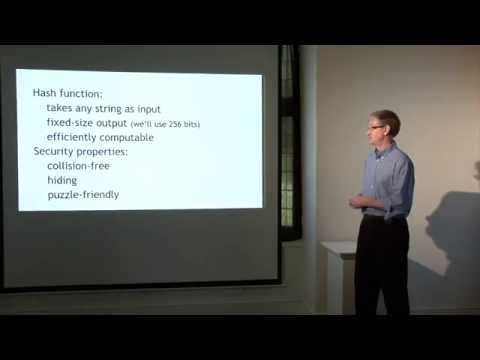
The lecture defines a cryptographic hash function as one that accepts any input, produces a fixed-size output (256 bits, as Bitcoin uses), and is efficiently computable. It then covers three required security properties in turn: collision resistance, the hiding property, and puzzle friendliness. For each, the lecture explains what the property means and immediately shows a use: collision resistance enables using a hash as a compact message digest; the hiding property, achieved by hashing a message concatenated with a random high-entropy value, enables digital commitments (a digital sealed envelope); and puzzle friendliness enables search puzzles like the one used in Bitcoin mining. The segment ends by describing SHA-256's structure: padding the message, splitting it into 512-bit blocks, and running a compression function iteratively starting from a fixed initial value.
Hash pointers and data structures (20:28)
A hash pointer combines a normal pointer with a hash of the pointed-to data, so it both locates data and lets you verify it hasn't changed. The lecture builds a blockchain from hash pointers, showing why it's tamper-evident: changing any block breaks the hash stored in the next block, which forces the attacker to tamper with every subsequent hash pointer up to the head, which they can't forge. It then builds a Merkle tree the same way, explaining that only the root hash needs to be remembered, membership can be proven in logarithmic time by showing a path to the root, and a sorted Merkle tree additionally allows proving non-membership. Both structures generalize to any acyclic pointer-based data structure.
Digital signatures (29:25)
The lecture defines the three-operation API — generateKeys, sign, verify — and states the two required properties: valid signatures always verify, and forging a signature without the secret key is infeasible. Unforgeability is framed as a game where an attacker who only knows the public key, and who can request signatures on chosen messages, still cannot produce a valid signature on a new message with better than negligible probability. Practical notes include using good randomness (critical for ECDSA specifically, since bad randomness during signing can leak the private key), signing a hash of a long message rather than the message itself, and signing a hash pointer to effectively sign everything that pointer chain reaches.
Public keys as identities (39:04)
A public key can stand in for an identity: anyone who can produce a valid signature under that key is treated as speaking for it. Because keys can be generated freely and privately, this gives decentralized identity management — no registration authority, and anyone can create as many identities ("addresses" in Bitcoin) as they like. The lecture notes the privacy trade-off: a fresh address has no initial link to a real-world identity, but a pattern of transactions over time can let an observer connect the dots.
A simple cryptocurrency (44:39)
GoofyCoin lets one party, Goofy, create coins by signing a creation statement, and lets any coin owner pass it on by signing a transfer statement referencing a hash pointer to the coin. The scheme is simple but insecure: an owner can sign two different transfer statements for the same coin and give one to each recipient, a double-spending attack. ScroogeCoin fixes this by having a central party, Scrooge, publish a signed, append-only blockchain history of every transaction. Two transaction types are introduced: create-coins (valid because Scrooge says so) and pay-coins (valid only if the consumed coins exist, haven't been spent before, the input and output values match, and every consumed coin's owner signed). Because the full history is public, a double spend is immediately visible and rejected. The lecture closes by naming the remaining problem: ScroogeCoin still depends on trusting Scrooge, and the rest of the course builds toward removing that central party.
Before you watch
- No prior lectures in this course are required; this is the starting point.
- Basic familiarity with what a hash function and a public/private key pair are will make the pace easier, though the lecture defines both from scratch.
Check your understanding
- Why does a hash function being collision-free not mean collisions don't exist?
- How does concatenating a message with a random value give a hash function the hiding property, and why is this used for commitments?
- Why does tampering with one block in a hash-pointer blockchain force an attacker to also forge every hash pointer up to the head?
- In the digital signature unforgeability game, what is the attacker allowed to do before attempting a forgery, and what must be true about the message they forge?
- Walk through why GoofyCoin allows double spending and explain exactly how ScroogeCoin's published history prevents it.
Vocabulary
- cryptography (noun)
- The study of methods to keep information secure and verifiable.
Cryptography provides the tools that make Bitcoin possible. - cryptocurrency (noun)
- A digital currency secured using cryptographic methods rather than a central authority.
Bitcoin was the first widely used cryptocurrency. - hash function (noun)
- A function that turns any input into a fixed-size code, used to verify data without revealing it.
A hash function converts a message into a short, fixed-length string. - collision resistance (noun)
- A property meaning it's practically impossible to find two different inputs that produce the same hash.
Collision resistance lets a hash safely represent a longer document. - hiding property (noun)
- A property meaning you cannot guess the original input just from seeing its hash.
The hiding property is used to build digital commitments. - puzzle friendliness (noun)
- A property meaning there's no shortcut to finding an input whose hash meets a target condition.
Puzzle friendliness is what makes Bitcoin mining require real work. - commitment (noun)
- A way of locking in a value now while keeping it secret until later.
A digital commitment works like a sealed envelope that's opened later. - hash pointer (noun)
- A reference to some data plus a hash of that data, letting you verify it hasn't changed.
A hash pointer lets you detect if the linked data was tampered with. - blockchain (noun)
- A chain of data blocks linked together with hash pointers so that changes are easy to detect.
The blockchain records every transaction ever made. - tamper-evident (adjective)
- Describing a system where any unauthorized change leaves visible evidence.
A blockchain built from hash pointers is tamper-evident. - Merkle tree (noun)
- A tree of hashes that lets you verify one piece of data belongs to a larger set using only a short proof.
A Merkle tree allows proving membership in logarithmic time. - digital signature (noun)
- A cryptographic method that proves a message came from a specific key holder and hasn't been altered.
A digital signature lets anyone verify who authorized a transaction. - unforgeability (noun)
- The property that no one without the secret key can create a valid signature.
Unforgeability guarantees only the real owner can sign a transaction. - private key (noun)
- A secret value known only to its owner, used to create signatures or prove identity.
Losing your private key means losing access to your coins. - public key (noun)
- A value that can be shared openly and used to verify signatures made with the matching private key.
A public key can act as an anonymous identity in the network. - ECDSA (noun)
- A specific digital signature algorithm based on elliptic curve mathematics.
Bitcoin uses ECDSA to sign and verify transactions. - decentralized (adjective)
- Not controlled by a single central authority.
Anyone can create a decentralized identity by generating a new key pair. - double spending (noun)
- The problem of a digital currency owner trying to spend the same coin more than once.
Preventing double spending is the central challenge in digital currency design. - append-only (adjective)
- Describing a record that can only have new entries added, never changed or deleted.
ScroogeCoin keeps an append-only history of all transactions. - central party (noun)
- A single trusted organization or person that controls or verifies a system.
ScroogeCoin still depends on trusting a central party named Scrooge.
Chapters
- 0:00 <Untitled Chapter 1>
- 1:51 Cryptographic hash functions
- 20:28 Hash pointers and data structures
- 29:25 Digital signatures
- 39:04 Public keys as identities
- 44:39 A simple cryptocurrency
From the YouTube description
First lecture of the Bitcoin and cryptocurrency technologies online course.
For the accompanying textbook, including the free draft version, see: http://bitcoinbook.cs.princeton.edu/
In this lecture (click the time to jump to the section):
* Cryptographic hash functions 1:51
* Hash pointers and data structures 20:28
* Digital signatures 29:25
* Public keys as identities 39:04
* A simple cryptocurrency 44:39