Seyed Masoud Hosseini · Overview · Study log · Weekly summaries · Ideas · Search · Transcript · RSS feed
General Philosophy · Lecture 20 of 33 · 14:48
5.3 Gettier and Other Complications
Study guide
What this lecture covers
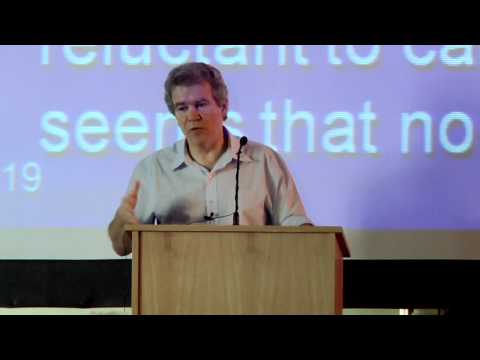
This lecture presents the Gettier problem, the famous set of counterexamples that undermined the justified-true-belief analysis of knowledge introduced in the previous lecture. Millican works through classic Gettier cases, surveys failed attempts to patch the analysis, and closes with the lottery paradox and contextualist worries about whether "knowledge" names a single, unified concept at all.
You'll come away able to construct a Gettier-style counterexample, explain why probability-based patches run into the lottery paradox, and describe how context can shift what counts as "knowing" something in ordinary speech.
Key ideas
- The Gettier structure: if you're justified in believing P, and P clearly implies Q, you seem justified in believing Q—but Q can turn out true only by accident, making the result a justified true belief that isn't knowledge.
- The mirage/oasis case: seeing a mirage justifies believing there's an oasis ahead; by coincidence a real oasis is hidden behind a dune, so the belief is true and justified but not knowledge.
- The job applicant case: justifiably believing a specific well-qualified man will get a job leads to the true belief that "a man will get the job," but only because a different man got it through unrelated circumstances.
- The 'no false premises' patch: adding a fourth condition that justification must not depend on any falsehood—shown to fail with cases like a slightly inaccurate headcount that still supports a true, apparently knowledgeable inference.
- The lottery paradox: no matter how high a probability threshold you set for knowledge, a large enough lottery generates beliefs (each ticket won't win) that meet the threshold yet clearly aren't knowledge, since one ticket must win.
- The accident-avoidance idea and its difficulty: trying to define knowledge as truth that isn't "accidental" is intuitive but hard to pin down precisely, as shown by the corroded-speedometer example.
- Contextualism: how demanding a standard we apply for "knowing" something can shift with the stakes, suggesting the threshold for knowledge may not be fixed.
- Ordinary uses of "know": everyday questions like "does she know he's cheating?" often really ask about belief or about the facts, not about a strict epistemological state, raising a Wittgensteinian doubt about whether "knowledge" has one single essence.
Walkthrough
The Gettier structure and two examples (0:09)
Millican sets up the general pattern behind Gettier cases: justified belief in P, together with a clear logical implication to Q, seems to justify Q as well. He illustrates with the mirage/oasis case and the classic job-applicant case, showing in both that the resulting belief is true and justified by the standard analysis, yet intuitively not knowledge, because the truth is essentially accidental relative to the justification.
Attempts to patch the analysis (3:13)
He describes the historical effort to add a fourth condition—that justification must not rely on any false premise—and shows this fails using the headcount example, where inferring "more than 40 people" from a slightly wrong reported figure of 78 (actually 77) still seems like knowledge despite depending on a falsehood.
The lottery paradox (6:14)
Millican explains why replacing justification with a high-probability requirement doesn't work either: in a billion-ticket lottery, the belief that any single ticket won't win is extremely probable yet clearly not knowledge, since exactly one ticket will win. Since this holds for arbitrarily large lotteries, no probability threshold below certainty can capture knowledge.
Ruling out accidents (8:16)
Considering the idea that knowledge requires ruling out accidental truth, Millican uses the example of a corroded speedometer that happens to still keep a driver within a safe margin, showing how hard it is to say precisely when a true belief counts as "accidentally" true versus reliably grounded.
Contextualism and everyday uses of "know" (10:17)
The lecture closes by examining how the bar for "knowing" something shifts with the importance of the situation, using the example of checking a train's departure time under increasing pressure. Millican also distinguishes everyday uses of "know" that really ask about someone's belief (as in soap-opera dialogue) from uses that really ask about the facts, suggesting—drawing on the later Wittgenstein—that "knowledge" may not have a single unified essence but instead varies with our practical purposes.
Before you watch
- Watch the previous lecture on the traditional justified-true-belief analysis of knowledge, since this lecture is built entirely around counterexamples to that analysis.
Check your understanding
- What is the general structure that Gettier cases share, and how does the oasis/mirage example fit it?
- Why does adding a "no false premises" condition fail to rescue the justified-true-belief analysis?
- How does the lottery paradox show that a high-probability requirement cannot fully capture knowledge?
- What does the corroded-speedometer example reveal about the difficulty of defining knowledge as "non-accidental" true belief?
- How does contextualism suggest that the standard for "knowing" something can shift depending on the situation?
Vocabulary
- Gettier problem (noun)
- A set of famous cases showing that justified true belief can fail to be knowledge.
The Gettier problem challenges the traditional analysis of knowledge. - counterexample (noun)
- A specific case that proves a general claim false.
The mirage case is a counterexample to the JTB analysis. - mirage (noun)
- An optical illusion, especially one that makes something appear to be present when it isn't.
A traveler sees a mirage that looks like an oasis. - oasis (noun)
- A fertile spot with water in a desert.
By coincidence, a real oasis is hidden behind the dune. - coincidence (noun)
- A surprising match between events that seem to have no real connection.
The true belief only comes about by coincidence. - patch (a theory) (verb)
- To fix or adjust a theory to deal with a problem, without fully rebuilding it.
Philosophers tried to patch the JTB analysis with a new condition. - premise (noun)
- A statement assumed or used as a basis for an argument.
The patch requires justification to rely on no false premise. - lottery paradox (noun)
- A puzzle showing that a highly probable belief about a lottery ticket losing still isn't knowledge.
The lottery paradox challenges probability-based definitions of knowledge. - threshold (noun)
- A minimum required level for something to count.
No probability threshold below certainty seems to work for knowledge. - accidental (truth) (adjective)
- True only by chance, not because of a reliable connection to the facts.
Gettier cases involve truth that is accidental relative to justification. - corroded (adjective)
- Damaged or worn away, especially by rust or chemical reaction.
The corroded speedometer example tests our idea of reliability. - contextualism (noun)
- The view that the standard for knowledge can shift depending on the situation.
Contextualism says the bar for knowing can rise with the stakes. - stakes (noun)
- What one stands to gain or lose in a situation.
Higher stakes can raise the standard needed to count as knowing. - unified (concept) (adjective)
- Having one single, consistent meaning across all its uses.
Wittgenstein doubted that knowledge is a fully unified concept. - structure (of an argument) (noun)
- The underlying pattern or framework an argument follows.
Millican sets up the general Gettier structure first. - headcount (noun)
- A count of the number of people present.
The headcount example tests the 'no false premises' patch. - reported figure (phrase)
- A number stated as accurate, though it may not be exactly correct.
The reported figure of 78 was actually slightly wrong. - arbitrarily (large) (adverb)
- As large as one wants, without any fixed limit.
The argument holds for arbitrarily large lotteries. - practical (purpose) (adjective)
- Related to real-world usefulness rather than pure theory.
Knowledge may vary with our practical purposes. - complication (noun)
- An added difficulty that makes a situation more complex.
The lecture presents further complications for the JTB theory.
Chapters
- 0:00 Introduction
- 1:20 Examples
- 6:42 Lottery Paradox
- 8:44 Accidents
- 10:31 Contextualism
- 11:47 Context
- 13:21 Knowledge
From the YouTube description
A series of lectures delivered by Peter Millican to first-year philosophy students at the University of Oxford. The lectures comprise the 8-week General Philosophy course and were delivered in late 2009.
← 5.2 The Traditional Analysis of Knowledge · 5.4 Scepticism, Externalism and the Ethics of Belief →