Seyed Masoud Hosseini · Overview · Study log · Weekly summaries · Ideas · Search · Transcript · RSS feed
Probability · Lecture 15 of 76 · 18:27
Rooks on a Chessboard
Study guide
What this lecture covers
This recitation problem uses the discrete uniform law and the counting principle to find the probability that eight rooks, placed at random on an 8-by-8 chessboard, form a "safe" arrangement where no two rooks share a row or column. It is a drill for counting skills built up earlier in the course, particularly the multiplication (counting) principle applied sequentially.
After watching, you should be able to recognize when the discrete uniform law applies, count the total number of ways to place objects on a grid using a sequential placement argument, and count constrained arrangements by tracking how each placement reduces the number of valid remaining positions.
Key ideas
- Discrete uniform law: when all outcomes in a discrete sample space are equally likely, the probability of an event is the count of outcomes in the event divided by the total count of outcomes.
- Sequential placement: counting problems become manageable by imagining objects placed one at a time and counting the choices available at each stage.
- Counting principle: the total number of ways to complete a multi-stage process is the product of the number of choices at each stage, illustrated with a simple sandwich-building example (bread choices times meat choices).
- Total arrangements: placing 8 rooks on 64 squares with no other restriction gives
64 x 63 x ... x 57, expressible as64!/56!. - Safe arrangements: each rook placed eliminates its entire row and column for future rooks, shrinking the effective board; the numbers of remaining safe spots for successive rooks are the perfect squares
64, 49, 36, 25, 16, 9, 4, 1.
Walkthrough
Setting up the problem with the discrete uniform law (2:03)
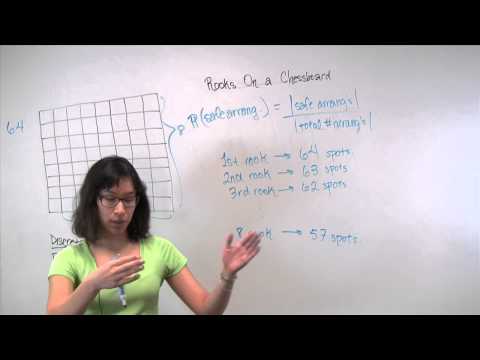
The problem is defined: eight rooks placed uniformly at random on an 8-by-8 board, with a "safe" arrangement meaning no two rooks share a row or column. Since all spatial arrangements are equally likely, the discrete uniform law reduces the probability calculation to counting safe arrangements over total arrangements.
Counting the total number of arrangements (4:06)
Placing each rook sequentially onto an initially empty board, the first rook has 64 possible squares, the second 63, and so on down to 57 for the eighth, since each square can hold only one piece. The counting principle (illustrated with a sandwich example of choosing bread then meat) justifies multiplying these numbers together.
Counting safe arrangements (10:13)
Each placed rook eliminates its entire row and column from consideration for later rooks. Visualizing this as cutting away the occupied row and column and sliding the remaining board pieces together shows that after one rook is placed, the second rook effectively faces a 7-by-7 board, and each subsequent rook faces a further-shrunk board, giving the sequence of perfect squares 64, 49, 36, 25, 16, 9, 4, 1. Multiplying these via the counting principle gives the number of safe arrangements.
Before you watch
- Review the discrete uniform law and the counting (multiplication) principle from earlier lectures in this course.
- Be comfortable with factorial notation, since it is used to express the total-arrangements count compactly.
Check your understanding
- Why does placing an object at a random uniform position let you use the discrete uniform law?
- How does the counting principle justify multiplying the number of choices at each stage of a sequential placement?
- Why do the numbers of safe positions for successive rooks form the sequence of perfect squares?
- How would the answer change if the chessboard were a different size or a different number of rooks were placed?
Vocabulary
- rook (noun)
- A chess piece that can move any distance along a row or column.
A rook attacks anything in the same row or column. - safe arrangement (noun)
- A placement where no two pieces threaten each other.
A safe arrangement has no two rooks sharing a row or column. - sequential (adjective)
- Happening one after another, in order.
The rooks are placed sequentially, one at a time. - perfect square (noun)
- A number that is the result of squaring a whole number.
64, 49, and 36 are all perfect squares. - eliminate (verb)
- To remove something from further consideration.
Each placed rook eliminates its row and column for later placements. - chessboard (noun)
- The 8-by-8 grid of squares used to play chess.
Eight rooks are placed at random on the chessboard. - at random (phrase)
- Without any particular order or pattern, giving every option equal chance.
The rooks are placed at random on the board. - restriction (noun)
- A rule that limits which arrangements are allowed.
The problem adds the restriction that no two rooks share a row. - total count (noun)
- The overall number of possible outcomes before any condition is applied.
The total count of arrangements is 64 times 63 and so on. - visualize (verb)
- To picture something clearly in your mind or on a diagram.
You can visualize the shrinking board after each rook is placed. - slide together (phrase)
- To move remaining pieces closer as if closing a gap.
Removing a row and column is like sliding the rest of the board together. - drill (exercise) (noun)
- A repeated practice problem meant to strengthen a specific skill.
This recitation problem is a drill for counting skills. - grid size (noun)
- The dimensions of a grid, such as how many rows and columns it has.
A different grid size would change the sequence of safe positions. - arrangement (noun)
- A specific way of placing a set of objects.
A safe arrangement has no two rooks attacking each other. - sandwich example (noun)
- A simple everyday example used to illustrate a counting principle.
The sandwich example shows how choices at each stage multiply. - reduce (a board) (verb)
- To make a problem smaller by removing part of it.
Removing a row and column effectively reduces the board. - board size (noun)
- The number of rows and columns making up a grid.
The board size directly changes the sequence of safe positions. - expression (compact) (noun)
- A short mathematical way of writing a longer calculation.
The total count is expressed compactly using factorial notation. - practice drill (noun)
- An exercise designed to strengthen a specific technique through repetition.
This is a practice drill for counting skills. - no other restriction (phrase)
- With no additional rules limiting the possibilities.
With no other restriction, the rooks could be placed anywhere.
Chapters
- 0:00 <Untitled Chapter 1>
- 0:06 Rooks on a Chessboard
- 0:45 What Does the Rooks on a Chessboard Problem Ask
- 3:02 The Discrete Uniform Law
- 3:39 The Discrete Uniform Law
- 7:23 The Counting Principle
- 15:59 Third Rook
- 16:41 Counting Principle
- 17:37 The Counting Principle
From the YouTube description
MIT 6.041SC Probabilistic Systems Analysis and Applied Probability, Fall 2013
View the complete course: http://ocw.mit.edu/6-041SCF13
Instructor: Katie Szeto
License: Creative Commons BY-NC-SA
More information at http://ocw.mit.edu/terms
More courses at http://ocw.mit.edu