Seyed Masoud Hosseini · Overview · Study log · Weekly summaries · Ideas · Search · Transcript · RSS feed
Probability · Lecture 6 of 76 · 8:10
A Coin Tossing Puzzle
Study guide
What this lecture covers
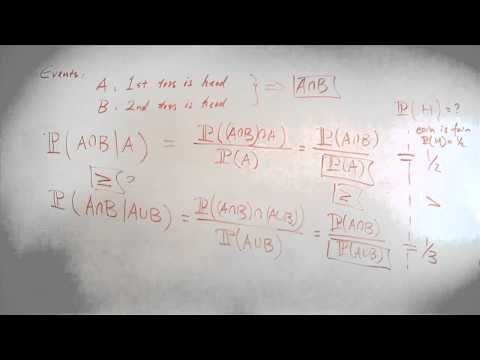
This recitation problem tests intuition about conditional probability. Alice tosses a possibly biased coin twice and wonders whether knowing "the first toss is heads" makes both tosses being heads more likely than only knowing "at least one toss is heads." The video verifies her guess and then generalizes the argument to any two nested events.
It's a compact exercise in translating a verbal claim into symbols and comparing two conditional probabilities using only the definition of conditional probability and basic set relationships.
Key ideas
- Translating words into events: "first toss is heads" and "second toss is heads" become events
AandB, with "both heads" asA ∩ B. - Conditioning on a subset simplifies the numerator: since
A ∩ Bis a subset ofA, the intersection(A ∩ B) ∩ Areduces to justA ∩ B. - Monotonicity of probability: because
Ais a subset ofA ∪ B,P(A)is never greater thanP(A ∪ B). - Comparing fractions with equal numerators: a larger denominator means a smaller fraction, so
P(A∩B|A) ≥ P(A∩B|A∪B). - The result doesn't depend on the coin's bias: the inequality holds for any probability of heads, fair or not.
- Generalization: for any events
C ⊆ D ⊆ EwithC ∩ D = C ∩ E, the same argument showsP(C|D) ≥ P(C|E).
Before you watch
- Know the definition of conditional probability and the multiplication rule, covered in the second lecture of this course.
- Be comfortable with basic set relationships such as subset and intersection.
Check your understanding
- Why does
(A ∩ B) ∩ Asimplify toA ∩ B? - Why is
P(A)always less than or equal toP(A ∪ B)? - For a fair coin, what are the two conditional probabilities in this problem, and why is one strictly larger than the other?
- What are the two conditions that events
C,D, andEmust satisfy for the generalized inequality to hold?
Vocabulary
- intuition (noun)
- A quick, instinctive sense of what should be true, before proving it.
Alice's intuition suggested one probability should be larger than the other. - nested events (noun)
- Events where one is entirely contained inside another.
The generalization works for any three nested events. - subset (noun)
- A set entirely contained within another set.
A intersect B is a subset of A. - monotonicity (noun)
- The property that a quantity never decreases as its input set grows larger.
Monotonicity of probability means a bigger event can't have smaller probability. - generalize (verb)
- To extend a specific result so it applies to a wider range of cases.
The lecture generalizes the coin result to any nested events. - bias (of a coin) (noun)
- An unequal tendency toward one outcome, such as heads over tails.
The result holds no matter what the coin's bias is. - possibly biased (phrase)
- Describing something that might not be perfectly fair, without knowing for sure.
Alice tosses a possibly biased coin twice. - translate (into symbols) (verb)
- To rewrite a spoken idea using precise mathematical notation.
The first step is to translate the verbal claim into symbols. - verbal claim (noun)
- A statement made in plain words rather than in symbols.
Alice's verbal claim is checked using the definition of conditional probability. - reduce (to) (verb)
- To simplify an expression down to a simpler form.
The intersection reduces to just A and B once you use the subset fact. - numerator (noun)
- The top part of a fraction.
Both conditional probabilities share the same numerator. - denominator (noun)
- The bottom part of a fraction.
A larger denominator makes the fraction smaller. - fraction (noun)
- A number representing a part of a whole, written as one number over another.
Comparing two fractions with equal numerators is straightforward. - inequality (noun)
- A mathematical statement that one quantity is greater than, less than, or not equal to another.
The inequality shows one probability is always at least as big as the other. - compact (adjective)
- Short and containing a lot in a small space.
This is a compact exercise using only basic definitions. - verify (verb)
- To check that a claim is true.
The video verifies Alice's guess using the definition of conditional probability. - hold (to be true) (verb)
- To remain valid or correct in a given situation.
The inequality holds for any probability of heads. - argument (noun)
- A logical chain of reasoning used to prove something.
The same argument extends to any three nested events. - at least (phrase)
- Not less than a certain amount.
At least one toss is heads describes the wider event. - specific inequality (noun)
- A particular relationship stating one quantity is not smaller than another.
The specific inequality compares two conditional probabilities.
Chapters
- 0:00 Introduction
- 0:25 Converting the problem into a mathematical form
- 0:54 Two types of information
- 1:56 Conditional probability
- 5:31 General form
From the YouTube description
MIT 6.041SC Probabilistic Systems Analysis and Applied Probability, Fall 2013
View the complete course: http://ocw.mit.edu/6-041SCF13
Instructor: Kuang Xu
License: Creative Commons BY-NC-SA
More information at http://ocw.mit.edu/terms
More courses at http://ocw.mit.edu
← Lecture 2: Conditioning and Bayes' Rule · Conditional Probability Example →