Seyed Masoud Hosseini · Overview · Study log · Weekly summaries · Ideas · Search · Transcript · RSS feed
Probability · Lecture 59 of 76 · 51:24
Lecture 17: Markov Chains II
Study guide
What this lecture covers
This lecture asks whether the state probabilities of a Markov chain always settle to a fixed steady-state value as time goes on, and if so, whether that value depends on where the chain started. Building on the previous lecture's definitions of transition probabilities, recurrence, and transience, it identifies the two conditions needed for steady-state convergence: a single recurrent class and no periodicity.
After stating the steady-state convergence theorem and deriving the balance equations that the steady-state probabilities must satisfy, the lecture reinterprets those probabilities as long-run visit frequencies. It then specializes to birth-death processes, a structured subclass of chains that includes queueing systems, and derives a closed-form geometric solution for a simple, heavily loaded or unloaded queue.
Key ideas
- Time homogeneity: a Markov chain's transition probability
p_ijis the same every time the chain is at statei, regardless of when or how it got there. - Steady-state convergence theorem: if a chain has a single recurrent class and is not periodic, the n-step transition probabilities
r_ij(n)converge to a limitpi_jthat does not depend on the starting statei. - Periodicity: a chain is periodic if its states can be grouped into clusters such that transitions always move to the next cluster in a fixed cycle; any self-transition immediately rules out periodicity.
- Balance equations: taking the limit of the n-step recursion gives
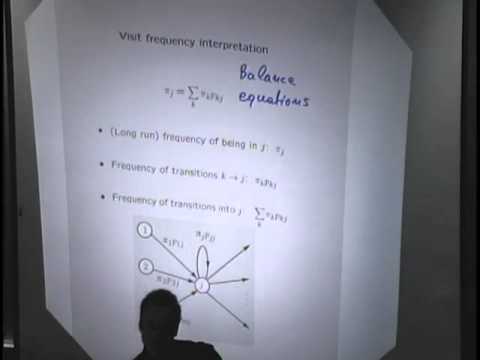
pi_j = sum_k pi_k * p_kj, a linear system solved together with the normalization conditionsum_j pi_j = 1. - Frequency interpretation:
pi_jcan be understood as the long-run fraction of time the chain spends at statej, and the balance equations express that the frequency of transitions intojequals the frequency of being atj. - Birth-death process: a chain whose states form a line, where each transition moves up by one, down by one, or stays put, modeling queues, populations, or epidemics.
- Cut argument for birth-death chains: because crossings between adjacent states
iandi+1must balance in the long run,pi_i * p_i = pi_(i+1) * q_(i+1)gives a simple recursion for the steady-state probabilities. - Load factor
rho = p/q: for a constant-rate birth-death chain,rhodetermines whether the state distribution is uniform (rho=1), or, forrho<1and unbounded state space, a geometric distributionpi_i = (1-rho) * rho^i.
Walkthrough
Review and the n-step recursion (0:00)
The lecture recaps the Markov chain definition, time homogeneity, and the recursive formula for n-step transition probabilities, then works two short examples: computing the probability of a specific multi-step trajectory by multiplying transition probabilities along the path, and contrasting a brute-force enumeration of trajectories with the more efficient recursive approach.
Recurrent classes and periodicity (11:20)
The lecture reviews recurrent and transient states from the previous lecture, explains that multiple separate recurrent classes make the initial state matter permanently, and introduces periodicity: a chain is periodic if its states split into clusters that are visited in a fixed cyclic order. It gives the practical shortcut that any self-transition rules out periodicity.
The steady-state convergence theorem (18:39)
The lecture states that when a chain has a single recurrent class and no periodicity, the n-step transition probabilities converge to steady-state values pi_j independent of the starting state, and gives the intuitive argument: two copies of the chain started at different states will eventually collide at the same state due to randomness, after which their futures are identical.
Deriving and interpreting the balance equations (25:15)
Taking the limit of the n-step recursion produces the balance equations pi_j = sum_k pi_k * p_kj, solved alongside the normalization condition since the raw system is singular. The lecture then reinterprets pi_j as a long-run visiting frequency, showing that the balance equations express a matching of the frequency of transitions into a state with the frequency of being at that state, and reworks the previous lecture's two-state example to confirm pi_1 = 2/7, pi_2 = 5/7.
Birth-death processes (33:35)
The lecture introduces birth-death processes: chains whose states form a line and whose transitions only move one step up, one step down, or stay put, giving examples such as queue lengths, active phone calls, and disease counts in an epidemic model.
Solving birth-death chains with a cut argument (39:14)
Rather than solving the full balance equations, the lecture uses a cut between adjacent states to argue that upward and downward crossing frequencies must match, giving a simple recursion pi_(i+1) = pi_i * p_i / q_(i+1) that, combined with normalization, yields all the steady-state probabilities.
The constant-rate queueing model (42:20)
Specializing to constant up- and down-transition probabilities with ratio rho = p/q, the lecture shows that rho=1 gives a uniform distribution over states (the symmetric random walk), while for rho<1 and an unbounded state space, the distribution becomes geometric, pi_i = (1-rho)*rho^i, with expected queue length growing large as rho approaches 1.
Before you watch
- Watch the previous lecture on Markov chain basics, transition probabilities, and recurrent versus transient states.
- Be comfortable with geometric series, since the birth-death process solution relies on summing one.
- Review the total probability theorem, used to derive both the n-step recursion and the balance equations.
Check your understanding
- Why does a single recurrent class with no periodicity guarantee that the initial state is eventually forgotten?
- How do the balance equations follow from taking the limit of the n-step transition recursion?
- Why does any self-transition in a chain's diagram rule out periodicity?
- How does the cut argument for birth-death chains avoid solving the full system of balance equations?
- What happens to the expected number of customers in the queueing model as the load factor
rhoapproaches 1, and why?
Vocabulary
- time homogeneity (phrase)
- The property that a rule stays the same no matter when it is applied.
Time homogeneity means the transition probability doesn't change over time. - balance equations (phrase)
- A set of equations that steady-state probabilities must satisfy.
We solve the balance equations to find the steady-state probabilities. - normalization condition (phrase)
- The requirement that all probabilities in a distribution add up to 1.
The normalization condition is needed alongside the balance equations. - long-run frequency (phrase)
- How often something happens on average over a very long time.
Pi_j is the long-run frequency of visiting state j. - birth-death process (phrase)
- A chain whose states form a line, moving up, down, or staying in place.
A queue length is modeled as a birth-death process. - cut argument (phrase)
- A technique that balances the flow crossing a boundary between two groups of states.
The cut argument gives a simple recursion for birth-death chains. - load factor (phrase)
- A ratio comparing arrival rate to service rate, showing how busy a system is.
The load factor rho determines the shape of the queue distribution. - unbounded (adjective)
- Having no fixed upper limit.
An unbounded state space allows the queue to grow indefinitely. - collide (verb)
- To end up at the same point or state.
Two copies of the chain eventually collide at the same state. - singular (adjective)
- Describing a system of equations that has no unique solution on its own.
The balance equations alone are singular without the normalization condition. - steady-state (adjective)
- Describing a value that has settled and no longer changes over time.
The chain's probabilities approach a steady-state value. - convergence theorem (phrase)
- A statement guaranteeing that a sequence of values settles to a fixed limit.
The steady-state convergence theorem needs two conditions to hold. - periodicity (noun)
- The property of repeating in a fixed cycle.
Periodicity would stop the chain from converging to a single steady state. - transition probability (phrase)
- The chance of moving from one state to another in a single step.
The transition probability p_ij stays the same at every time step. - recurrent class (phrase)
- A group of states the chain keeps returning to forever.
The theorem requires a single recurrent class for convergence. - transient (adjective)
- Describing a state that a chain visits only a limited number of times before leaving for good.
Transient states are eventually left behind and never revisited. - self-transition (noun)
- A move from a state back to that same state.
Any self-transition immediately rules out periodicity. - cluster (noun)
- A group of states or items treated together.
In a periodic chain, states are grouped into clusters. - cyclic (adjective)
- Repeating in the same fixed order again and again.
A periodic chain visits its clusters in a cyclic order. - queueing system (phrase)
- A system where items or people wait in line for service.
The birth-death process models a simple queueing system. - geometric distribution (phrase)
- A probability pattern where each value is a fixed fraction less likely than the one before it.
For rho < 1, the steady-state probabilities follow a geometric distribution. - recursion (noun)
- A rule that defines each value in terms of the previous one.
The cut argument gives a simple recursion for the queue probabilities. - trajectory (noun)
- The specific sequence of states a process passes through over time.
The lecture computes the probability of one specific multi-step trajectory. - brute-force (adjective)
- Solving a problem by checking every possibility directly, without a shortcut.
A brute-force enumeration of trajectories is less efficient than the recursive approach. - enumeration (noun)
- The process of listing out every possible case one by one.
The lecture contrasts enumeration with the recursive formula. - crossing (noun)
- A movement from one side of a boundary to the other.
Upward and downward crossings between states must balance in the long run. - specialize (verb)
- To focus on a more specific case of a general idea.
The lecture specializes the theory to birth-death processes.
Chapters
- 0:00 MIT OpenCourseWare
- 0:22 Overview
- 2:19 Markov Models
- 11:20 State Classification
- 13:59 Periodicity
- 16:25 Is it periodic
- 18:35 What does the chain do
- 23:10 Steady State Probabilities
- 25:15 Balanced Equations
- 33:35 BirthDeath Processes
- 42:32 Special Case
From the YouTube description
MIT 6.041 Probabilistic Systems Analysis and Applied Probability, Fall 2010
View the complete course: http://ocw.mit.edu/6-041F10
Instructor: John Tsitsiklis
License: Creative Commons BY-NC-SA
More information at http://ocw.mit.edu/terms
More courses at http://ocw.mit.edu