Seyed Masoud Hosseini · Overview · Study log · Weekly summaries · Ideas · Search · Transcript · RSS feed
Introduction to Psychology · Lecture 6 of 20 · 56:30
6. How Do We Communicate?: Language in the Brain, Mouth
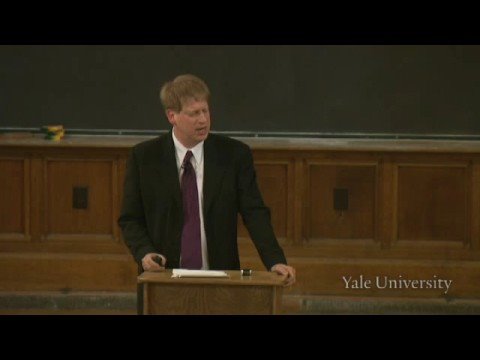
Study guide
What this lecture covers
This lecture opens the course's discussion of language, treating it as central to nearly every theory of human nature. Bloom asks what makes language special among human abilities, then breaks language down into its structural layers (phonology, morphology, syntax) before tracing how children acquire it, from infancy through the sharp decline in language-learning ability after puberty.
After watching, you should be able to explain why linguists think language is part of human nature rather than a cultural invention, describe the roles of phonology, morphology, and syntax, explain recursion as the mechanism behind language's infinite expressive power, and describe the main milestones and constraints of child language acquisition, including the critical-period evidence from second-language learners.
Key ideas
- Language as (probably) instinctive: evidence includes universal presence across human societies, the creation of full grammatical languages (creoles) by children exposed only to a pidgin, dedicated brain regions and aphasias, and genetic mutations linked to specific language impairment.
- Creativity of language: language lets speakers produce and understand a virtual infinity of sentences never heard before, which rules out an account based on memorizing a list of sentences.
- Three structural layers: phonology (the sound or sign system), morphology (words and morphemes, the smallest units of meaning), and syntax (rules for combining words into phrases and sentences).
- The arbitrariness of the sign: the link between a word's sound or shape and its meaning is arbitrary (Ferdinand de Saussure), which is why the same idea gets entirely different words across languages.
- Recursion: a grammatical rule that can call itself (a sentence containing a sentence) gives language the "infinite use of finite media," producing unlimited sentences from a finite vocabulary.
- Ambiguity: the same string of words can be generated by more than one syntactic structure, producing humor, confusing headlines, and in at least one case, a criminal trial that turned on the interpretation of a sentence.
- Nature versus learning: while vocabulary and specific grammar rules (like English's subject-verb-object word order) must be learned from exposure, Chomsky argued language acquisition resembles organ growth more than ordinary learning.
- Development without correction: children acquire grammar without being taught it explicitly; parents correct meaning and truthfulness, not grammaticality, and children in cultures that rarely speak directly to infants still learn language normally.
- Developmental timeline and the critical period: infants prefer their native language's rhythm within days of birth, initially distinguish all phonemes before narrowing around 12 months, move through babbling and first words, and lose language-learning flexibility around puberty, as shown by accent and grammar differences among people who learn a second language at different ages.
Walkthrough
The scientific notion of language and structure (0:00)
Bloom defines language narrowly (systems like English or American Sign Language) to make scientific generalizations possible, then presents evidence that language is part of human nature: every human society has one, children exposed only to a makeshift pidgin spontaneously create full creole languages within a generation, deaf children develop structured sign systems even without full input, and neurological and genetic evidence points to dedicated language machinery in the brain.
Phonology: a system of sounds (15:53)
He explains that languages draw from a finite set of phonemes (about 40 in English) and that listeners unconsciously insert perceived pauses between words that do not actually exist in the acoustic signal, a fact made obvious when hearing an unfamiliar language. He illustrates top-down processing, where prior knowledge shapes what sounds we perceive, using mondegreens (misheard song lyrics) as examples.
Morphology: a system of words (24:07)
Bloom introduces the arbitrariness of the sign and defines the morpheme as the smallest unit of meaning, distinguishing it from the word (since a word like "dogs" combines two morphemes). He notes that adult speakers typically know tens of thousands of words, acquired at a striking average rate during childhood.
Syntax: communicating complicated ideas (27:21)
He explains how syntax combines a finite vocabulary into an infinite number of sentences through recursion, illustrated with a toy grammar and increasingly embedded example sentences. He discusses structural ambiguity using jokes, garbled headlines, and a real criminal case that hinged on the interpretation of an ambiguous sentence, then briefly distinguishes syntax as a technical synonym for grammar.
Noam Chomsky and language acquisition (39:10)
Bloom presents Chomsky's claim that language acquisition should be understood more like the growth of a bodily organ than like ordinary learning, while acknowledging that vocabulary and language-specific rules (like word order) must still come from exposure. He supports this with evidence that children learn grammar without corrective feedback, since parents respond to meaning rather than grammaticality, and that children in cultures with little direct baby talk still learn language on a typical timeline.
The time course of language acquisition (47:07)
He traces the developmental sequence: newborns already prefer the rhythm of their native language, infants initially discriminate all possible phonemes before narrowing to their native set by about 12 months, babbling begins around seven months (equally for spoken and signed languages), first words appear around 12 months, and short combinatorial phrases follow around 18 months. He closes with critical-period evidence from Elissa Newport and Sam Supalla's research showing that age at first exposure, more than intelligence or motivation, predicts how completely someone can learn a second language, with fluency becoming markedly harder to achieve after puberty.
Before you watch
- This lecture follows the developmental psychology material from Lecture 5 and continues into the next lecture, which turns to animal communication.
- Familiarity with the brain material from Lecture 2, particularly aphasia and brain lateralization, is useful background for the discussion of language and the brain.
Check your understanding
- What kinds of evidence support the claim that language is part of human nature rather than purely a cultural invention?
- How does recursion allow a finite vocabulary and a finite set of rules to generate an infinite number of sentences?
- Why does the existence of specific language impairment challenge the idea that language ability simply follows from general intelligence or sociability?
- What does the Newport and Supalla research on second-language learners suggest about a critical period for language acquisition?
- Why do parents' corrections of children's speech fail to explain how children learn correct grammar?
Vocabulary
- instinctive (adjective)
- Happening naturally without needing to be taught.
Linguists debate whether language is instinctive in humans. - pidgin (noun)
- A simplified mixed language used between people who do not share a native language.
Workers who spoke no common tongue developed a pidgin to communicate. - creole (noun)
- A full, grammatically complete language that develops from a pidgin, usually among children.
Children turned the pidgin into a rich creole within one generation. - phonology (noun)
- The study of the sound or sign system of a language.
Phonology looks at which sounds a language uses and how they combine. - morphology (noun)
- The study of words and the smallest units of meaning inside them.
Morphology explains why 'dogs' contains two units of meaning. - syntax (noun)
- The rules for combining words into phrases and sentences.
Syntax lets speakers build new sentences they have never heard before. - arbitrariness of the sign (noun)
- The idea that a word's sound has no natural connection to its meaning.
The arbitrariness of the sign explains why 'dog' and 'chien' mean the same thing. - recursion (noun)
- A rule that can apply to its own output, allowing a structure to contain a smaller version of itself.
Recursion lets a sentence contain another sentence inside it. - ambiguity (noun)
- The quality of having more than one possible meaning.
Structural ambiguity can make a headline confusing. - phoneme (noun)
- A single distinct sound unit that a language uses to build words.
English uses roughly 40 different phonemes. - top-down processing (noun)
- Understanding something by using existing knowledge to interpret new information.
Top-down processing explains why we mishear song lyrics as familiar phrases. - mondegreen (noun)
- A misheard phrase, especially from a song, that sounds like something else.
A famous mondegreen turns an unclear lyric into a funny new sentence. - morpheme (noun)
- The smallest unit of language that carries meaning.
The word 'dogs' is made of the morphemes 'dog' and '-s'. - embedded (adjective)
- Placed inside another structure, one level deeper.
An embedded clause is a sentence placed inside another sentence. - critical period (noun)
- A limited time window during which a skill is much easier to learn.
There seems to be a critical period for learning language fluently. - aphasia (noun)
- A language disorder caused by damage to the brain.
Certain aphasias affect a person's ability to produce grammatical sentences. - specific language impairment (noun)
- A disorder affecting language ability while other thinking skills stay normal.
Genetic studies of specific language impairment point to dedicated language machinery. - babbling (noun)
- The repeated, meaningless sounds infants make before real words.
Babbling begins around seven months of age. - grammaticality (noun)
- Whether a sentence follows the correct grammar rules of a language.
Parents rarely correct a child's grammaticality directly. - fluency (noun)
- The ability to use a language smoothly and naturally.
Fluency in a second language is harder to reach after puberty.
Chapters
- 0:00 Chapter 1. The Scientific Notion of Language and Structure
- 15:53 Chapter 2. Phonology: A System of Sounds
- 24:07 Chapter 3. Morphology: A System of Words
- 27:21 Chapter 4. Syntax: Communicating Complicated Ideas
- 35:21 Chapter 5. Question and Answer on Language Structure
- 39:10 Chapter 6. Noam Chomsky and Language Acquisition
- 47:07 Chapter 7. The Time Course of Language Acquisition
From the YouTube description
Introduction to Psychology (PSYC 110)
One of the most uniquely human abilities is the capacity for creating and understanding language. This lecture introduces students to the major topics within the study of language: phonology, morphology, syntax and recursion. This lecture also describes theories of language acquisition, arguments for the specialization of language, and the commonalities observed in different languages across cultures.
00:00 - Chapter 1. The Scientific Notion of Language and Structure
15:53 - Chapter 2. Phonology: A System of Sounds
24:07 - Chapter 3. Morphology: A System of Words
27:21 - Chapter 4. Syntax: Communicating Complicated Ideas
35:21 - Chapter 5. Question and Answer on Language Structure
39:10 - Chapter 6. Noam Chomsky and Language Acquisition
47:07 - Chapter 7. The Time Course of Language Acquisition
This course was recorded in Spring 2007.
← 5. What Is It Like to Be a Baby: The Development of Thought · Lecture 7: Language, Perception, Attention and Memory →