Seyed Masoud Hosseini · Overview · Study log · Weekly summaries · Ideas · Search · Transcript · RSS feed
The Craft of Writing Effectively + weekly essay · Video · 1:21:51
The Craft of Writing Effectively
Study guide
What this lecture covers
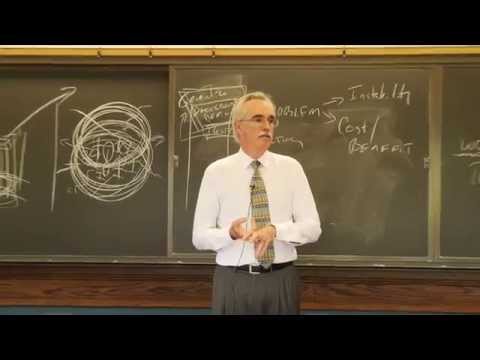
This talk answers a question most writing advice ignores: why does technically correct, clear, well-organized writing still fail to get published or funded? Larry McEnerney, director of the University of Chicago's writing program, argues that expert writers are judged on value to a specific community of readers, not on rules, clarity, or how new their ideas are. As the sole video in this course, the lecture stands on its own as an introduction to reader-centered writing for graduate students and researchers.
After watching, you should be able to explain why explaining your ideas is different from persuading readers, recognize the "code" words that signal value in a field, and restructure an introduction around a reader's problem instead of background information.
Key ideas
- Top-down writing instruction: Chicago's program targets faculty and graduate students rather than freshmen, because expert writers, not beginners, have the harder writing problem.
- Writing to think vs. writing to be read: experts use their writing process to work out ideas, but that process produces language patterns that clash with how readers actually read.
- The stopping sequence: readers who hit interference slow down and reread, then misunderstand, then get aggravated, then stop reading entirely.
- Value over clarity: clear, organized, persuasive writing that isn't valuable to its readers is still useless; value is what editors and funders respond to first.
- Value lives in readers, not content: the same material can be valuable to one community and worthless to another, so writing decisions depend on who is reading.
- Explaining versus arguing: explaining demonstrates what's in your head; professional readers instead need to be persuaded, which means anticipating and answering their doubts.
- The code: every field has particular words (like nonetheless, however, inconsistent, anomaly) that signal instability and therefore value; you must learn your community's specific code.
- Problem before solution: strong introductions establish an unstable situation that matters to a specific reader community before offering a thesis as the solution.
Walkthrough
Why this isn't a course in rules (0:34)
McEnerney opens by distinguishing Chicago's writing program, which serves faculty and graduate students rather than freshmen, from typical composition courses. He rejects the idea that writing problems are remedial or fixable with rules, arguing that rule-based instruction suits people producing frequent, low-value writing, not researchers producing high-value work. The core shift he asks for is to stop thinking about rules and start thinking about readers.
The expert writer's core problem (4:35)
Expert writers are defined not by writing skill but by expert subject knowledge. Unlike journalists, they use writing itself to do their thinking, generating text "on the horizontal axis" while thinking. But readers evaluate that text on a different, vertical axis. Because experts write in patterns shaped by their thinking process, and read in a different pattern, their own writing interferes with how their readers process the text, even when those readers are fellow experts.
How interference makes readers stop (8:38)
Through an audience exercise, McEnerney traces what happens when writing interferes with reading: readers first slow down and reread, then fail to understand, then get aggravated, and finally stop reading. He connects this to why student writing seems to "work": teachers are paid to keep reading regardless of quality. Outside school, readers only keep reading if the text is valuable to them, and most writers have no practice handling readers who can simply stop.
Value beats clarity, organization, and persuasion (13:45)
Using two versions of a fabricated biology abstract, the lecture shows how readers strongly prefer the version that signals value, even when both convey the same content. McEnerney argues that clarity, organization, and persuasiveness are secondary: writing that is clear but not valuable is still useless. He stresses that value is a property assigned by a specific community of readers, not something inherent in the writing itself, which is why the same text can succeed with one audience and fail with another.
Stop explaining, start arguing (19:49)
McEnerney identifies a habit carried over from school: writers "explain" to demonstrate understanding, a pattern learned from teachers who read to assess students. Professional readers, by contrast, read to decide whether their own thinking should change, and they have a professional obligation to challenge claims. He argues writers must therefore anticipate what readers will doubt and argue against it, rather than laying out background or definitions first. He also dismantles the goals of being "new" or "original," retelling the story of a researcher whose historically accurate but unwanted findings were rejected as not counting as knowledge, to illustrate that knowledge is defined by what a community currently values, not by novelty alone.
Constructing a problem: instability, cost and benefit (53:16)
The lecture names specific "code" words, such as but, however, although, inconsistent, and anomaly, that signal instability rather than the stable, continuous background many writers default to. McEnerney contrasts the common "martini glass" structure (generalization, thesis, generalization) with an approach that opens on a problem belonging to a specific reader community, then offers a thesis as its solution. He adds that this instability should often be framed in terms of a cost the readers bear or a benefit they gain, and warns against the weaker language of a knowledge "gap," which implies a bounded, fillable model of knowledge that mostly doesn't hold in practice.
A case study: John Tutino's revision process (1:16:37)
Closing with an article on the Hidalgo Revolt by John Tutino, McEnerney shows how an opening paragraph that looks like historical background is actually constructing a problem, signaled by the word "but." He traces, through a footnote, how Tutino's originally data-heavy presentation only found its real argument after readers at a seminar pushed him to state its larger significance, and how that argument then became the article's first sentence. The example ties the lecture's ideas together: even experienced writers discover their true problem through revision guided by readers, not by explaining their process from the start.
Before you watch
- No prior lectures in this course are required; this is the only video.
- Bring a piece of your own academic writing (a draft, abstract, or introduction) to test the ideas against as you watch.
- Basic familiarity with academic publishing or grant writing helps the examples land, though it isn't required.
Check your understanding
- Why does McEnerney say expert writers face a different writing challenge than journalists or high school students?
- What is the difference between "explaining" and "arguing," and why does the lecture say explaining fails with professional readers?
- Why is being new or original not, by itself, enough for writing to be considered valuable?
- What role do words like "however," "although," and "anomaly" play in signaling value to readers?
- Why does McEnerney warn against using "gap" language to describe a research contribution?
Vocabulary
- craft (noun)
- A skill developed through practice, especially in making or writing something well.
The talk is about the craft of writing effectively. - expert writer (noun)
- Someone who writes about a subject they deeply understand, for other specialists.
Expert writers face different challenges than beginners. - remedial (adjective)
- Intended to correct or fix a basic weakness, often for beginners.
He rejects the idea that writing problems are only remedial. - composition course (noun)
- A class that teaches the basics of writing.
This program differs from a typical freshman composition course. - horizontal axis (noun)
- Here, the order in which ideas appear as a writer produces them while thinking.
Experts generate text on the horizontal axis while thinking. - vertical axis (noun)
- Here, the order in which a reader actually processes and judges a text.
Readers evaluate the text on a different, vertical axis. - interference (noun)
- Something that gets in the way and disrupts a process.
Writing patterns can cause interference with how readers read. - aggravated (adjective)
- Annoyed or made more irritated.
Confused readers eventually become aggravated and stop reading. - abstract (noun)
- A short summary of an academic paper's content.
The lecture compares two versions of a fabricated biology abstract. - fabricated (adjective)
- Made up or invented, not real.
He uses a fabricated example to show the effect of value. - persuasive (adjective)
- Effective at convincing someone to believe or agree with something.
Persuasive writing alone is not enough without value to the reader. - inherent (adjective)
- Existing as a natural or basic part of something.
Value is not inherent in the writing itself. - community (noun)
- A group of people who share the same interests or field.
Value depends on the specific community of readers. - novelty (noun)
- The quality of being new or original.
Novelty alone does not make writing valuable. - code (in writing) (noun)
- A set of special words or signals a field's readers respond to as valuable.
Learning your field's code helps you signal value to readers. - anomaly (noun)
- Something that does not fit the expected pattern.
The word 'anomaly' signals an unstable, interesting situation. - inconsistent (adjective)
- Not matching or agreeing with something else.
Calling a result inconsistent signals a problem worth solving. - instability (noun)
- A state of being unsettled or not fixed, here meaning an unresolved problem.
Good introductions establish instability before offering a solution. - martini glass structure (noun)
- A common but weak essay shape: broad opening, narrow thesis, broad ending.
McEnerney criticizes the martini glass structure of many introductions. - thesis (noun)
- The main claim or argument of a piece of writing.
The thesis is presented as the solution to the reader's problem. - knowledge gap (noun)
- A claimed missing piece in what is currently known.
He warns against weak 'gap' language to frame a contribution. - revision (noun)
- The process of changing and improving a piece of writing.
Tutino found his real argument through revision. - footnote (noun)
- A small note at the bottom of a page giving extra information.
The lecture traces the argument's history through a footnote. - seminar (noun)
- A small class or meeting where people discuss and give feedback on work.
Readers at a seminar pushed him to state his argument's significance. - significance (noun)
- The importance or meaning of something.
He was asked to explain the significance of his findings.
Chapters
- 0:00 Intro
- 5:07 Do your thinking
- 6:00 The writing process
- 7:00 The challenge
- 7:50 Writing patterns
- 8:40 Misunderstanding
- 9:30 Rereading
- 10:40 Academics
- 11:30 Teachers
- 12:30 Beyond School
- 13:30 The Problem
- 14:15 Value
- 17:20 Reading
- 19:30 Important
- 20:35 Explanation
- 20:55 The Inside of Your Head
- 22:15 Why Do You Think That
- 25:15 How Do You Make It Important
- 28:00 Positivity
- 28:30 Knowledge
- 29:50 Permeable
- 31:35 Circle the words
- 34:35 You have to know them
- 35:00 You have to know your readers
- 36:15 Flow words
- 37:05 Creating value
- 39:05 Know the code
- 42:00 The University of Chicago
- 42:30 Challenge Existing Community
- 44:20 Why People Write Essays
- 46:50 Preserving Ideas
- 49:35 The Function of Language
- 51:45 The Construction of Knowledge
- 53:10 Nuts and Bolts
- 56:30 Problem
From the YouTube description
Do you worry about the effectiveness of your writing style? As emerging scholars, perfecting the craft of writing is an essential component of developing as graduate students, and yet resources for honing these skills are largely under utilized. Larry McEnerney, Director of the University of Chicago's Writing Program, led this session in an effort to communicate helpful rules, skills, and resources that are available to graduate students interested in further developing their writing style.